Egypt
 Libya
 Morocco
 Sudan
 Tunisia
 Benin
 Burkina Faso
 Cabo Verde
 Côte d'Ivoire
 Ghana
 Guinea
 Guinea-Bissau
 Liberia
 Mali
 Mauritania
 Niger
 Nigeria
 Senegal
 Sierra Leone
 The Gambia
 Togo
 Cameroon
 Central African Republic
 Chad
 DR Congo
 Equatorial Guinea
 Gabon
 Republic of the Congo
 São Tomé and Príncipe
 Burundi
 Comoros
 Djibouti
 Eritrea
 Ethiopia
 Kenya
 Madagascar
 Malawi
 Mauritius
 Mozambique
 Rwanda
 Seychelles
 Somalia
 South Sudan
 Tanzania
 Uganda
 Angola
 Botswana
 Eswatini
 Lesotho
 Namibia
 South Africa
 Zambia
 Zimbabwe
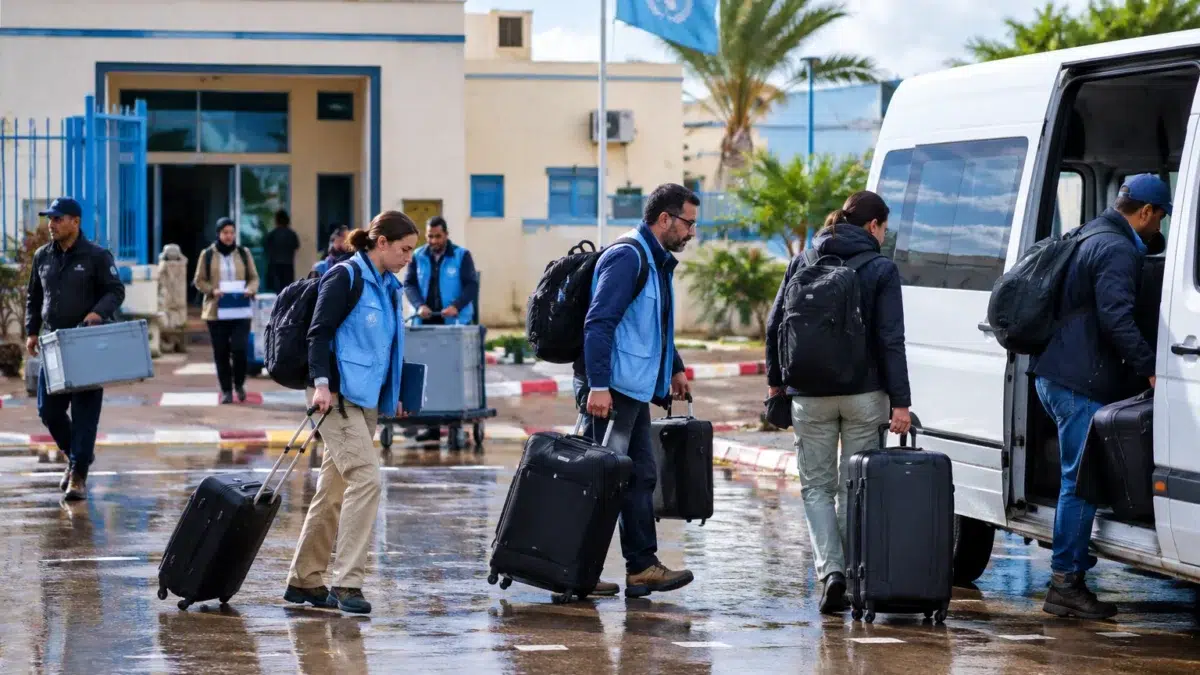
For the people of Western Sahara, the departure of United Nations observers does not resolve the question that justified their presence. Instead, it changes how the ceasefire will be monitored, while the territory’s status remains disputed and political positions remain far apart.
A mission created to prepare a vote
MINURSO — the United Nations Mission for the Referendum in Western Sahara — was established in 1991, following a ceasefire agreement between Morocco and the Polisario Front. Its original mandate was to help organise a referendum on self-determination. The vote never took place, notably because the parties could not agree on the arrangements or the electorate.
The dispute dates back to the end of Spain’s presence in the territory in 1975. Morocco considers Western Sahara an integral part of its territory and advocates autonomy under its sovereignty. The Polisario Front seeks independence and calls for a vote in which that option can be chosen. The UN continues to classify Western Sahara as a non-self-governing territory.
The conflict directly concerns Morocco, but its regional balance also involves Algeria and Mauritania. Rivalries between Rabat and Algiers weigh on relations in the Maghreb and complicate efforts to co-operate. The Arab Maghreb Union, which brings together these two countries with Tunisia, Libya and Mauritania, is not currently an active framework for resolving the dispute.
Mandate ends, then physical withdrawal
MINURSO’s mandate expired on 31 October 2026, after the Security Council failed to renew it. The mission ceased operations the following day and began winding down. The distinction matters: 31 January 2027 is presented as the target deadline for completing the withdrawal and closing the facilities, not as the date the mandate expired.
The timetable announced by the head of the mission, Alexander Ivanko, provides for the gradual departure of personnel and the closure of sites. The first contingent left Laâyoune on 16 November, according to several Moroccan and Spanish press reports. The UN had previously said the withdrawal involved around 160 military observers, 180 civilians and 13 facilities. These figures describe the plan communicated by the organisation, not a final tally of what has already been completed.
The United Nations statement on the start of the liquidation confirms that operations ended on 1 November. The 31 January 2027 deadline for completing the withdrawal was also reported by RTVE and Moroccan media. It is therefore an announced deadline that may depend on how the logistical process unfolds.
A monitoring role disappears
For more than three decades, UN observers monitored the ceasefire and maintained a channel of communication between the parties. The mission did not resolve the conflict, but its presence provided a monitoring mechanism on the ground. Its departure removes this permanent observation point at a time when no political agreement has replaced the stalled referendum process.
The end of the mission does not, in itself, mean that a resumption of fighting is inevitable. However, it reduces the international community’s ability to document incidents swiftly and prevent competing interpretations. The consequences will not be the same for everyone: Moroccan authorities will have to manage the withdrawal in the areas they administer, while Sahrawis living on either side of the lines of control remain directly affected by security and access to services.
The positions expressed reflect this divide. Rabat says the end of the mission does not undermine its commitment to respect the ceasefire. The Polisario, for its part, has condemned the end of the mandate and warned of the risks associated with reduced international monitoring. These are the parties’ positions, not independent assessments of how the security situation is developing.
The Security Council remains central to the issue
The physical withdrawal does not end the UN’s diplomatic responsibilities. The Security Council will have to determine what role it intends to retain in monitoring the issue and in mediation efforts. The disagreement among permanent members, highlighted during discussions on renewal, shows that the future of the arrangements also depends on international power dynamics.
For Morocco, Western Sahara is a major issue of sovereignty and domestic politics. For Sahrawis who support independence, the absence of a referendum leaves the question of self-determination unanswered. For Algeria and Mauritania, developments in the dispute affect the stability of regional relations. MINURSO’s departure resolves none of these questions.
The next visible milestone is therefore logistical: the closure of sites and the complete departure of personnel, announced for no later than 31 January 2027. But the political stakes will extend beyond that date. Without an equivalent monitoring mechanism or a compromise on the territory’s status, the Maghreb will have to contend with a long-standing dispute whose effects extend beyond Morocco’s borders.