Egypt
 Libya
 Morocco
 Sudan
 Tunisia
 Benin
 Burkina Faso
 Cabo Verde
 Côte d'Ivoire
 Ghana
 Guinea
 Guinea-Bissau
 Liberia
 Mali
 Mauritania
 Niger
 Nigeria
 Senegal
 Sierra Leone
 The Gambia
 Togo
 Cameroon
 Central African Republic
 Chad
 DR Congo
 Equatorial Guinea
 Gabon
 Republic of the Congo
 São Tomé and Príncipe
 Burundi
 Comoros
 Djibouti
 Eritrea
 Ethiopia
 Kenya
 Madagascar
 Malawi
 Mauritius
 Mozambique
 Rwanda
 Seychelles
 Somalia
 South Sudan
 Tanzania
 Uganda
 Angola
 Botswana
 Eswatini
 Lesotho
 Namibia
 South Africa
 Zambia
 Zimbabwe
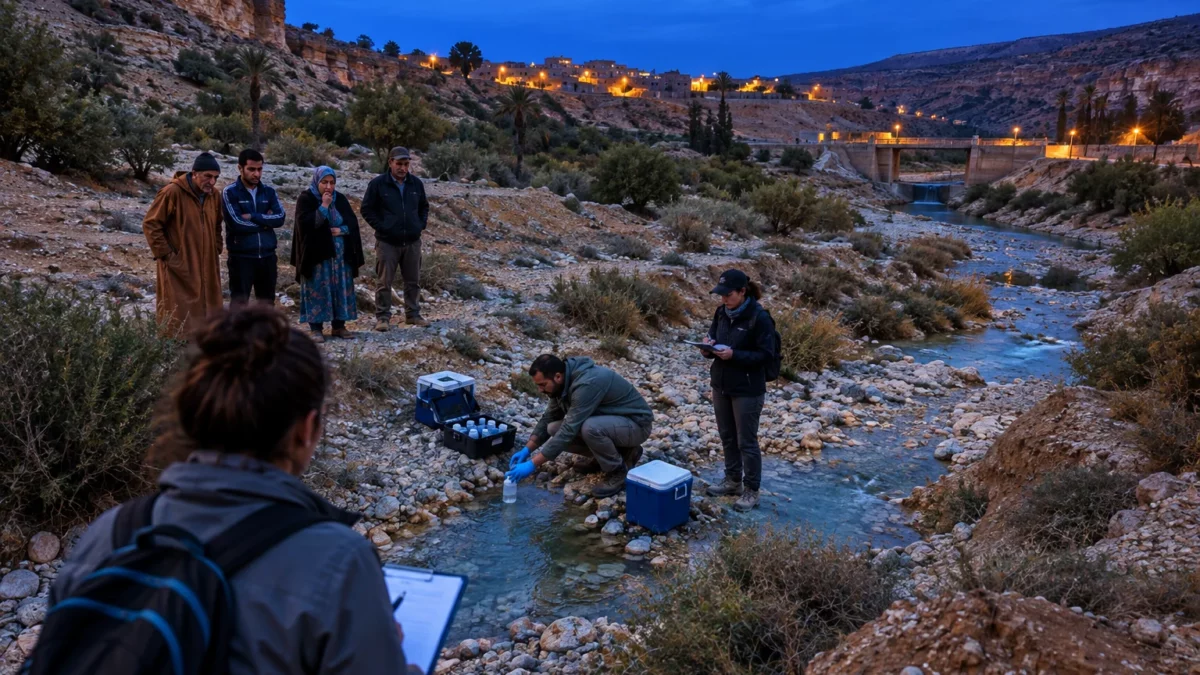
In Maghnia, in western Algeria, water quality raises a question that goes beyond laboratory tests: how can a dam be protected when it is fed by a watercourse that crosses a border closed to political exchanges? The Oued Mouilah flows into the Hammam Boughrara Dam, an important resource for the Tlemcen region.
A local alert becomes a diplomatic issue
The Oued Mouilah basin connects Algerian and Moroccan territory. This geography makes it difficult to monitor and reduce discharges without technical exchanges between the two countries. Yet bilateral relations have been severed since 2021, and the land border has been closed since 1994. The environmental issue therefore arises in a context where cooperation mechanisms are limited.
The Maghreb region has no regional water-management framework comparable to those found in some shared basins elsewhere. The Arab Maghreb Union, which brings together Algeria, Morocco, Tunisia, Libya and Mauritania, remains largely paralysed. This lack of coordination complicates joint monitoring of watercourses and the sharing of data.
In Algeria, pollution in the river is also linked to water security: the ability to ensure a reliable, good-quality water supply over the long term. The Hammam Boughrara Dam collects water from this network and supports local uses. Possible consequences therefore affect residents, farmers and natural environments, although the scale of the risks must be established through independent assessments.
What the analyses and authorities say
In mid-November 2026, Algerian officials attributed the pollution to discharges from Morocco. The Minister of Hydraulics, Lounès Bouzegza, told the National People’s Assembly that measures were being taken to protect water intended for consumption and prevent polluted water from reaching residents. He cited analyses showing, among other things, a rise in ammonia and an oxygen deficit. Algeria Press Service reports on the measures announced by the minister.
Researchers at Abou Bekr Belkaïd University of Tlemcen have also reported high concentrations of pollutants in samples taken from the watercourse. Experts quoted by the Algerian news agency speak of several types of contamination, including organic and industrial pollution. These observations fuel concern, but on their own they are not enough to establish the exact source of each substance or whether the discharges were intentional. That would require protocols, detailed results and a jointly accessible independent assessment. University research cited in Tlemcen on the river’s water quality.
Interior Minister Brahim Merad travelled to Tlemcen province to examine the situation. Meanwhile, Algeria’s Environment Minister, Kaouter Krikou, denounced practices she said were contrary to international conventions in Antalya, on the sidelines of COP31, the United Nations climate conference. Algerian MPs have called for the case to be taken to international bodies.
On the Moroccan side, government spokesman Samir Belfkih said the authorities were closely monitoring the accusations. This statement neither acknowledges responsibility nor offers a detailed rebuttal of the analysis results. At this stage, attributing the discharges to Morocco remains an accusation by the Algerian authorities, not a finding established by a joint independent investigation. Yabiladi’s report on the Moroccan authorities’ response.
Protecting water without turning an alert into a verdict
For residents and agricultural users around Maghnia, the immediate priority is to know the quality of the water and what precautions are necessary. The Algerian government says it has taken measures to protect water intended for consumption. Regular publication of results, including sampling locations and dates, would help distinguish confirmed risks from concerns and political accusations.
The issue is not confined to the border. Pollution reaching a dam can affect ecosystems and activities that depend on water, while the costs of monitoring and treatment fall first on local authorities. Without comparable upstream and downstream data, however, it is difficult to determine the contribution of different sources and choose appropriate remedial measures.
Technical cooperation — sharing samples, using common measurement methods and publishing results — would help document the source and evolution of the pollutants. It would not resolve the political crisis between Algiers and Rabat. But it could protect communities along the river without prejudging responsibility.
A test for shared-water management in the Maghreb
The Oued Mouilah case is a reminder that rivers do not stop at borders, even when relations between states deteriorate. It echoes tensions around other basins shared by Algeria and Morocco, including the Oued Guir, where development choices and water scarcity have already fuelled concern. Each situation nevertheless has its own data and cannot be equated with the case in Tlemcen.
What happens next will depend on two concrete factors: the release of analyses detailed enough to be verified, and the authorities’ ability to prevent residents’ exposure. Until the results have been assessed through independent, cross-border expertise, caution is warranted over responsibility. For both Algeria and Morocco, protecting a shared resource is a public-health and environmental issue that would benefit from being addressed separately from political accusations.