Egypt
 Libya
 Morocco
 Sudan
 Tunisia
 Benin
 Burkina Faso
 Cabo Verde
 Côte d'Ivoire
 Ghana
 Guinea
 Guinea-Bissau
 Liberia
 Mali
 Mauritania
 Niger
 Nigeria
 Senegal
 Sierra Leone
 The Gambia
 Togo
 Cameroon
 Central African Republic
 Chad
 DR Congo
 Equatorial Guinea
 Gabon
 Republic of the Congo
 São Tomé and Príncipe
 Burundi
 Comoros
 Djibouti
 Eritrea
 Ethiopia
 Kenya
 Madagascar
 Malawi
 Mauritius
 Mozambique
 Rwanda
 Seychelles
 Somalia
 South Sudan
 Tanzania
 Uganda
 Angola
 Botswana
 Eswatini
 Lesotho
 Namibia
 South Africa
 Zambia
 Zimbabwe
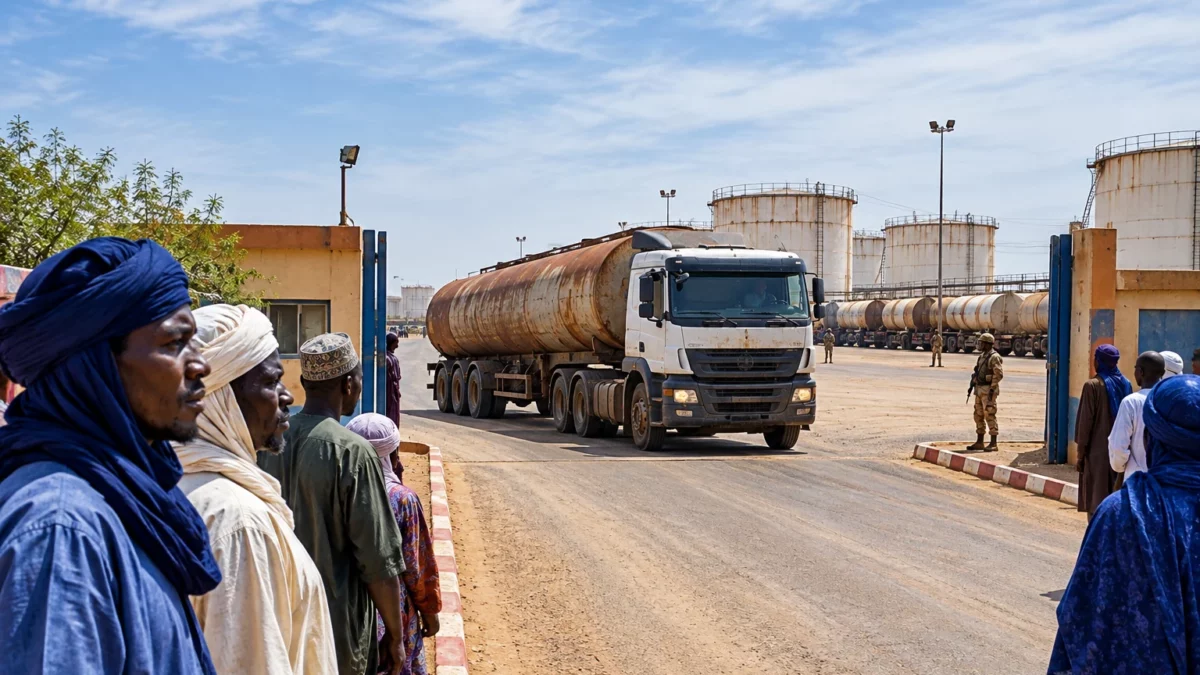
In Agadez, the arrival of a major fuel shipment from Algeria meets an immediate need. But the military escort accompanying it raises another question: was this a one-off mission or the start of a more lasting presence in Niger? For now, the available evidence does not support the conclusion that Algerian soldiers have been stationed in the north of the country.
A supply route from the north
On 1 November 2026, Nigerien authorities received 53 tanker trucks carrying 1.65 million litres of fuel in Agadez. Oil Minister Hamadou Tini was present at the depot of the Nigerien Petroleum Products Company (SONIDEP). The shipment, bought at a preferential price according to Nigerien state daily Le Sahel, came from the Adrar refinery in southern Algeria. Algeria’s APS news agency also reported the volume and the convoy’s arrival in Agadez.
Images shared online show the trucks near the Arlit customs office on 30 October, then in the streets of Agadez the following day. The route follows a road linking the Algerian border to the regional centre of northern Niger. According to ActuNiger, the journey from Adrar is about 2,000km. The convoy then reached the SONIDEP depot.
The delivery is part of a broader energy rapprochement. The two countries have discussed projects in electricity and hydrocarbons. Niger is also linked to plans for the Trans-Saharan Gas Pipeline, which is intended to carry gas from Nigeria to Algeria through Nigerien territory. These projects offer economic prospects, but their implementation depends on security conditions and political decisions in several capitals.
Escort authorised, but deployment still unclear
On 25 October, both chambers of the Algerian parliament approved the deployment of units of the National People’s Army abroad. The following day, President Abdelmadjid Tebboune announced that units would be sent to Niger, at the request of Nigerien authorities, to protect shared economic and energy interests. The decision marks a notable shift in Algeria’s stance, long defined by a commitment to non-intervention outside its borders. Algerian and international media confirmed the parliamentary vote.
Several media outlets have reported that Algerian soldiers accompanied the trucks. Nigerien forces are also said to have escorted the convoy along part of its route. Public information, however, does not specify the size of the escort or how and when it returned. The fact that soldiers protected a shipment is therefore not enough to establish that a unit remained stationed in Niger.
Madama, a former military installation in far northern Niger near the Libyan border, has been cited as a possible site for a deployment. But no accessible independent evidence confirms that an Algerian garrison has been established there. Claims about a future base near Agadez must likewise be distinguished from verified facts. Caution is warranted: political authorisation, a temporary escort and a permanent deployment are three different things.
Rapprochement amid regional realignment
The context extends beyond the delivery itself. After the July 2023 coup, Niger shifted its security partnerships and reduced ties with several Western partners. It belongs, with Mali and Burkina Faso, to the Alliance of Sahel States, established after the three countries broke with the Economic Community of West African States (ECOWAS), a regional organisation for economic and political co-operation. Algeria, Niger’s neighbour to the north, is meanwhile seeking to restore its influence in a Sahel where the balance of power is changing rapidly.
The relationship is not automatic, however. In 2025, relations between Algiers and the Alliance countries became strained after the Algerian army destroyed a Malian drone near the border. Since then, exchanges with Niamey have intensified. Nigerien President Abdourahamane Tiani visited Algeria in February 2026, and a military co-operation protocol was signed in October, according to state daily Le Sahel. The fuel delivery gives this rapprochement a concrete dimension, without clarifying all its military implications.
For residents and businesses in Agadez, the arrival of the fuel could help supply the region. However, the available information does not make it possible to gauge its effect on prices, availability at petrol stations or the needs of rural areas. A large one-off delivery does not in itself guarantee a lasting improvement: that will depend on distribution, stocks and the continuity of supplies.
Viral images do not prove an attack
The convoy’s progress has also fuelled misleading posts. Images presented as showing Algerian soldiers in Niger reportedly show signs of digital generation or manipulation, according to fact-checks cited in the available material. Other posts linked images of coffins to the convoy and claimed there had been an attack during the night of 17–18 November. But these videos were already circulating in late August and were linked to fires in Algeria’s Jijel region. They therefore prove neither an attack in Niger nor the deaths of soldiers during this mission.
The key question remains the status of the escort after the fuel was unloaded. Public sources confirm the delivery and the approval of a military deployment, but do not document a permanent presence in Madama or elsewhere. Future official communications, along with any images that can be geolocated, will help distinguish a logistical operation from a lasting deployment. For Niger and its neighbours, that distinction will weigh heavily in assessing the new security co-operation.