Egypt
 Libya
 Morocco
 Sudan
 Tunisia
 Benin
 Burkina Faso
 Cabo Verde
 Côte d'Ivoire
 Ghana
 Guinea
 Guinea-Bissau
 Liberia
 Mali
 Mauritania
 Niger
 Nigeria
 Senegal
 Sierra Leone
 The Gambia
 Togo
 Cameroon
 Central African Republic
 Chad
 DR Congo
 Equatorial Guinea
 Gabon
 Republic of the Congo
 São Tomé and Príncipe
 Burundi
 Comoros
 Djibouti
 Eritrea
 Ethiopia
 Kenya
 Madagascar
 Malawi
 Mauritius
 Mozambique
 Rwanda
 Seychelles
 Somalia
 South Sudan
 Tanzania
 Uganda
 Angola
 Botswana
 Eswatini
 Lesotho
 Namibia
 South Africa
 Zambia
 Zimbabwe
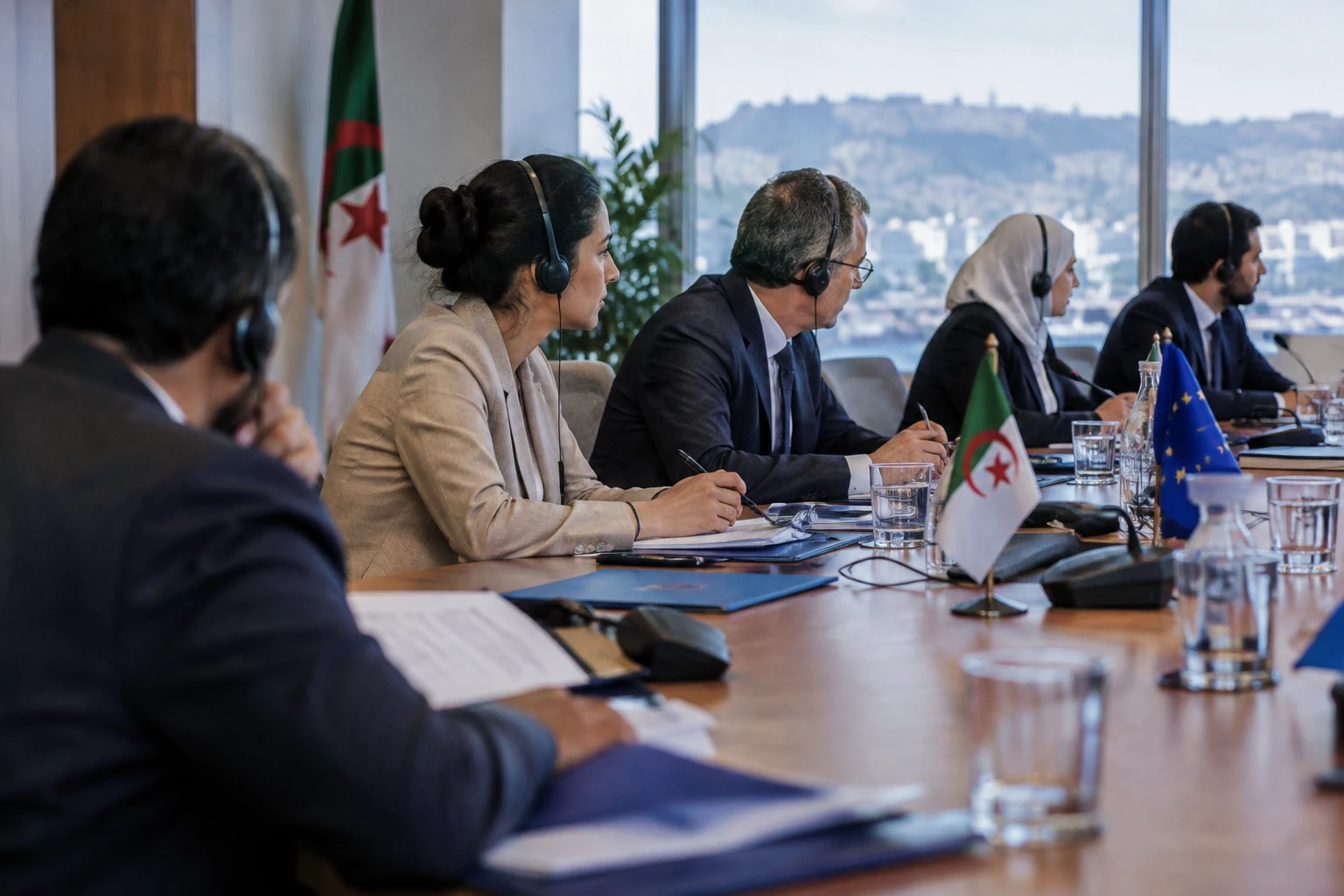
When diplomatic relations cool, the consequences are also felt in orders, factories and agricultural costs. Between Algeria and France, the decline in trade is now taking on a European dimension: Paris wants Brussels to examine restrictions targeting French companies.
Trade relations caught up in the crisis
The dispute is unfolding against a backdrop of already strained relations. In July 2024, French President Emmanuel Macron backed Morocco’s autonomy plan for Western Sahara. Algiers, which supports the Polisario Front and upholds the Sahrawi people’s right to self-determination, strongly objected to this shift in French policy. Since then, diplomatic tensions have affected several areas of co-operation.
The trade dispute, however, extends beyond the two capitals. The association agreement between the European Union and Algeria, which entered into force in 2005, governs their trade and provides mechanisms for settling disputes. The EU is Algeria’s largest trading partner, accounting for 49.6% of its international trade in 2025. Measures targeting French products specifically could therefore become an issue for the wider EU-Algeria partnership. The European Commission’s data on trade with Algeria show the extent of this interdependence.
This framework has already been the source of tensions. In June 2024, the European Commission opened proceedings over certain Algerian restrictions on European trade and investment. In July 2025, it requested the establishment of an arbitration panel, arguing that several measures could breach the agreement. These proceedings concern measures distinct from the current Franco-Algerian dispute. They nevertheless show that Brussels already has a trade case involving Algiers. The Commission sets out the stages of these proceedings.
Restrictions reported, but no public decree
On 13 November 2026, Paris said it wanted to refer the matter to the European Commission so that it could examine restrictions affecting French companies. The move is intended to establish whether these measures comply with Algeria’s trade commitments. It does not mean that the EU has decided to impose sanctions, or that new proceedings have already produced a result.
Restrictions reported since the summer have reportedly taken the form of refusals to grant import licences or instructions sent to operators. The Algerian authorities have not officially announced a general ban on French products. The distinction matters: company accounts and diplomatic information point to obstacles, but they do not replace a public text establishing their scope and legal basis.
The wheat trade illustrates the deterioration in commercial ties. Algeria, long a major market for French grain, has bought virtually none since 2024. French customs figures cited in November also show a sharp fall in exports to the Algerian market in August and September 2026 compared with the same months in 2025. This trend alone does not make it possible to attribute every decline to a political decision: prices, competition and sourcing choices also play a part.
Urea, a nitrogen fertiliser used in agriculture, adds a further concern in the opposite direction. French trade organisations and diplomatic sources have reported a possible suspension of Algerian deliveries to France. They estimate that around 30% of French imports of the product could be affected. But the volumes actually halted have not been publicly established. The Algerian authorities had announced no official measure, and Paris said it had received no notification. Reports about urea deliveries should therefore be read as attributed warnings, not as confirmation of a complete halt.
Different effects across sectors and countries
For French exporters, uncertainty makes it harder to plan orders and find markets. The risk does not concern only large companies: agricultural producers, industrial suppliers and medium-sized businesses may depend on regular contracts. If wheat sales dry up, the effects are also felt across French grain supply chains, from ports to co-operatives.
In Algeria, import rules may serve the aims of managing external purchases, protecting foreign currency reserves or supporting domestic production. But targeted refusals, if confirmed, could limit importers’ choice and shift purchases to other suppliers. The consequences may differ between companies with access to several markets and operators more dependent on their usual supply chains. In Algiers and across the regions, the practical impact will depend on the products concerned, their availability and their price.
The decline in trade is not simply an act of commercial retaliation. Franco-Algerian economic ties have already fallen in value, while Algeria seeks to diversify its partners and develop local production. France, for its part, retains significant interests in the country. Figures published by the French foreign ministry put trade at €9.4bn in 2025, down on 2024. The trend reflects both the political climate and economic factors, including hydrocarbon prices.
Brussels, the next stage of the dispute
The announced referral will test the European Union’s ability to handle a bilateral dispute without conflating Paris’s position with those of other member states. The Commission will have to examine the specific measures, how they are applied and whether they are compatible with the agreement. Algiers will also be able to present its interpretation of the rules and its trade policies. At this stage, no EU decision on the reported restrictions is known.
What happens next will therefore depend less on statements than on the evidence submitted to Brussels and the response from the Algerian authorities. Attention will turn to exchanges between the Commission and Algiers, the situation facing importers, urea deliveries and grain purchases. For North Africa, the stakes are concrete: preserving predictable trade rules while preventing tensions over Western Sahara from further constraining economic relations between neighbours and Mediterranean partners.