Egypt
 Libya
 Morocco
 Sudan
 Tunisia
 Benin
 Burkina Faso
 Cabo Verde
 Côte d'Ivoire
 Ghana
 Guinea
 Guinea-Bissau
 Liberia
 Mali
 Mauritania
 Niger
 Nigeria
 Senegal
 Sierra Leone
 The Gambia
 Togo
 Cameroon
 Central African Republic
 Chad
 DR Congo
 Equatorial Guinea
 Gabon
 Republic of the Congo
 São Tomé and Príncipe
 Burundi
 Comoros
 Djibouti
 Eritrea
 Ethiopia
 Kenya
 Madagascar
 Malawi
 Mauritius
 Mozambique
 Rwanda
 Seychelles
 Somalia
 South Sudan
 Tanzania
 Uganda
 Angola
 Botswana
 Eswatini
 Lesotho
 Namibia
 South Africa
 Zambia
 Zimbabwe
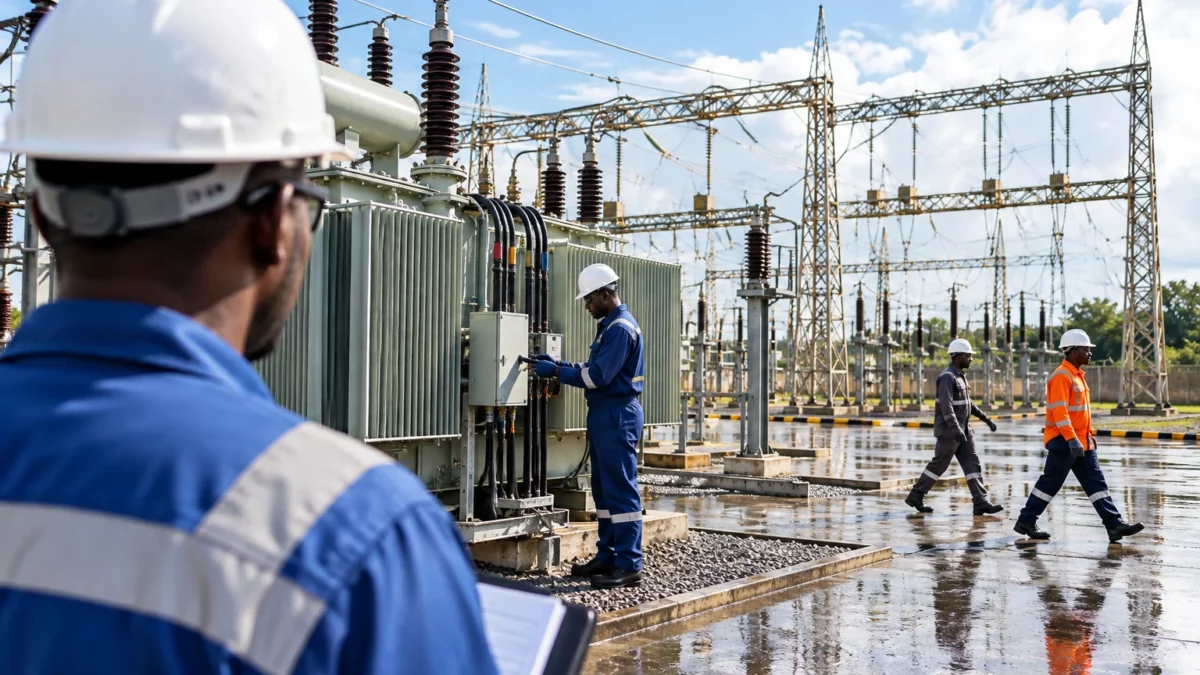
In San Pedro, the electricity challenge is not simply to generate more power. New plants must also be connected to the grid, and electricity delivered to households, businesses and other regions. An agreement signed between Côte d’Ivoire and Algeria puts both challenges on the table, but the figures announced do not yet match across the sources consulted.
A first step announced in San Pedro
On 17 November 2026, in Abidjan, Côte d’Ivoire Énergies (CI-Énergies) and Sonelgaz International concluded co-operation agreements covering electricity generation and distribution. The Ivorian government says the signing took place on the sidelines of the International Exhibition of Extractive Resources and Energy, held in Abidjan from 18 to 20 November.
However, the announcements available differ on the planned capacity. A CI-Énergies communication refers to six mobile turbines totalling 120 megawatts (MW), including two 20 MW units intended for San Pedro in a first phase. Algeria Press Service (APS), for its part, citing a Sonelgaz statement, reports contracts covering a 40 MW power plant and distribution equipment. At this stage, therefore, the 120 MW total has not been confirmed by both parties in the public information found.
This difference matters. It could reflect a first 40 MW tranche and a broader programme, or separate contractual scopes. But the available documents do not make it possible to determine which. The announced schedule for the first unit to enter service is the first quarter of 2027. The cost and financing arrangements are not specified in the material consulted.
The turbines could run on natural gas or liquid fuel, according to information about the programme. Electricity is expected to feed into the grid via the San Pedro 2 substation, announced at 225 kilovolts and still under construction. Actual generation will therefore also depend on completion of the connection equipment.
Capacity is rising, but the grid matters just as much
Côte d’Ivoire has recently increased its installed electricity capacity to 3,337 MW. The figure was announced on 6 November 2026, at the official commissioning of the Atinkou thermal power plant in Jacqueville. The government is targeting 11,400 MW by 2040 and at least 45% renewable energy in 2030. These targets differ from the 4,000 MW capacity target for 2027 mentioned in some reports on the new project: they should not be confused.
A power plant adds available capacity, but does not by itself guarantee a reliable supply. Substations, transformers and lines must be able to carry electricity to consumers. That is why the agreements with Sonelgaz also include high- and medium-voltage equipment. The partnership also provides for technical support to identify faults in underground cables, particularly in Abidjan and other localities.
For residents and businesses, the tangible impact will depend on the whole chain working: fuel being available, turbines operating, the substation completed and the grid robust enough. Households will not automatically benefit from an improvement as soon as the agreement is signed. Industrial and port activities in San Pedro could also look forward to a more reliable supply, subject to the project being completed.
A partnership to watch beyond the announcements
The agreement is part of closer energy ties between Abidjan and Algiers. It gives Sonelgaz, an Algerian state-owned company, a role in a sector where Côte d’Ivoire is seeking to strengthen generation and infrastructure. For the Ivorian authorities, the additional capacity is intended to support domestic demand and maintain electricity exports to the sub-region.
Côte d’Ivoire is a member of the Economic Community of West African States (ECOWAS), which brings together countries working towards regional integration. Its electricity grid and exchanges with neighbouring countries therefore give regional significance to decisions made on its territory. But producing more is not enough to ensure exports: operational interconnections and supply available when needed are also essential.
Mobile units can make it possible to add generation capacity more quickly than a major construction project, but their contribution will depend on fuel costs, maintenance and the pace of deployment. The share of thermal power also raises the question of how consistent it is with the government’s target of at least 45% renewable energy by 2030. The two trajectories can coexist, provided the new units meet flexibility needs without displacing investment in solar, hydropower or biomass.
Sonelgaz has already taken part in power projects outside Algeria: a 40 MW plant was inaugurated at Gorou Banda, in Niamey, in June 2026, and a project of the same capacity was announced in N’Djamena, Chad. These precedents show that the company is expanding its activities across the continent. They do not, however, guarantee the schedule or performance of the Ivorian project.
The next step will therefore be to clarify the exact scope of the Ivorian contracts: 40 MW for the plant identified by APS, or 120 MW for the broader programme referred to by CI-Énergies. Progress will also need to be tracked against the announced commissioning in San Pedro, completion of the substation and publication of the financing arrangements. These milestones, rather than the headline figure alone, will determine the agreement’s real contribution to Ivorian users and the West African grid.
Ivorian government details on the CI-Énergies–Sonelgaz agreement · APS report on the energy contracts · Ivorian energy targets for 2040 · Atinkou commissioning and announced installed capacity · 40 MW plant inaugurated in Niamey · Power plant project in N’Djamena