Egypt
 Libya
 Morocco
 Sudan
 Tunisia
 Benin
 Burkina Faso
 Cabo Verde
 Côte d'Ivoire
 Ghana
 Guinea
 Guinea-Bissau
 Liberia
 Mali
 Mauritania
 Niger
 Nigeria
 Senegal
 Sierra Leone
 The Gambia
 Togo
 Cameroon
 Central African Republic
 Chad
 DR Congo
 Equatorial Guinea
 Gabon
 Republic of the Congo
 São Tomé and Príncipe
 Burundi
 Comoros
 Djibouti
 Eritrea
 Ethiopia
 Kenya
 Madagascar
 Malawi
 Mauritius
 Mozambique
 Rwanda
 Seychelles
 Somalia
 South Sudan
 Tanzania
 Uganda
 Angola
 Botswana
 Eswatini
 Lesotho
 Namibia
 South Africa
 Zambia
 Zimbabwe
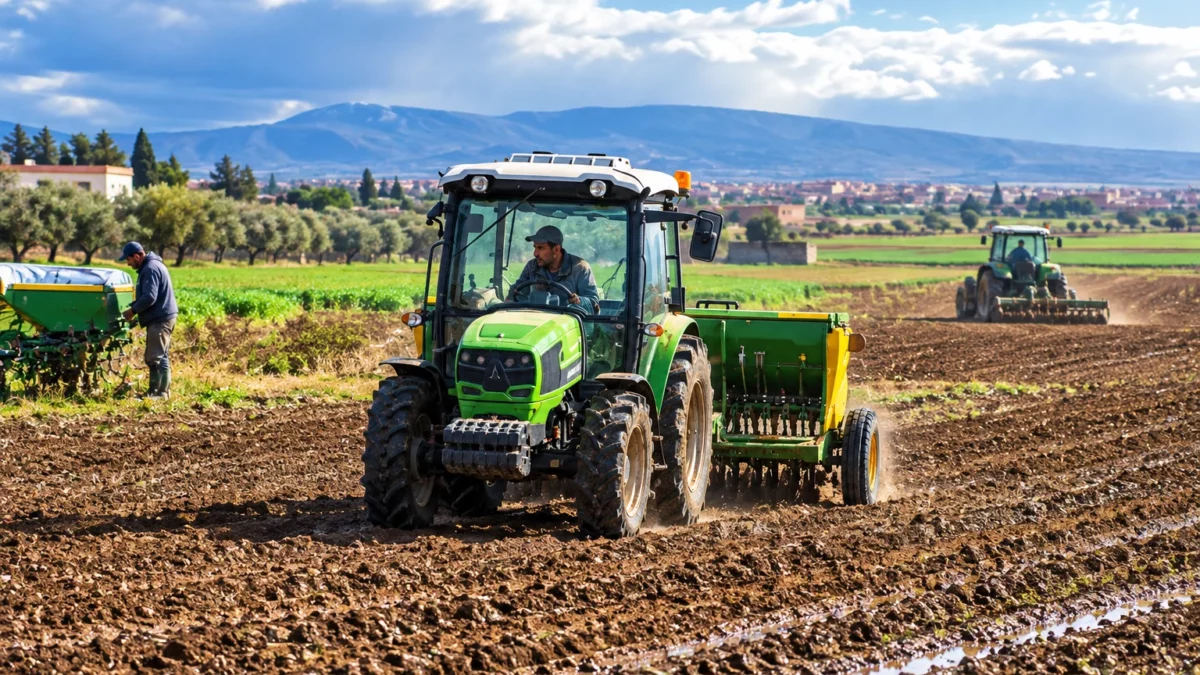
Producing machinery locally is not enough to mechanise fields. Equipment must also suit the terrain, spare parts must be available and solutions must be accessible to farms of different sizes. Algeria aims to address this challenge by forging new industrial partnerships with Belarus.
Agreements signed in Minsk, projects still to be implemented
On 18 November 2026, the second session of the Algerian-Belarusian Joint Commission concluded in Minsk with the signing of several agreements on agricultural mechanisation and agrifood. Two memorandums directly concern agricultural equipment. Algeria’s state news agency APS reported the details, which were also carried by Algerian media.
The first brings together Algeria’s state-owned ETRAG and Minsk tractor manufacturer MTZ. It provides for the assembly in Algeria of high-powered Belarus-brand tractors, with the gradual integration of locally produced components. The announced text is a memorandum of understanding: it sets out a direction for cooperation, but is not in itself proof that a factory is already in production.
The second agreement brings together Sambo Algérie, based in the wilaya of Sidi Bel Abbès, and Belarusian manufacturer Gomselmash. The partners will study the development and production in Algeria of self-levelling combine harvesters. These machines are designed to work on sloping or uneven ground, where conventional equipment may be less suitable.
The previous day, an Algerian delegation led by Agriculture Minister Sid Ali Khaldi had visited MTZ’s facilities in Minsk. The visit provided an opportunity to assess Belarusian industrial capacity ahead of the commission session. It was part of a series of bilateral talks on mechanisation and grain storage.
Local production remains limited against agricultural ambitions
Figures from the National Statistics Office (ONS) illustrate the scale of the industrial challenge. In 2024, Algeria produced 747 tractors and 200 combine harvesters. These figures describe recorded production, but on their own do not provide information on the condition of the existing fleet, imports or the needs of each sector.
The government has made the expansion of cultivated land one of its priorities. In January 2026, President Abdelmadjid Tebboune set a target of three million hectares under cultivation and called for faster access to harvesting equipment. At the same time, the Presidency announced the creation of cooperatives specialising in the rental of agricultural equipment. This approach could help farmers who cannot individually afford expensive machinery, provided the cooperatives have a sufficiently large fleet and a reliable maintenance service.
Another institutional element was put in place in 2026: the National Council for Agricultural Mechanisation, established by an executive decree published in the Official Gazette in September. It is tasked with proposing a national strategy and bringing together government departments, farmers, business operators and researchers. Coordination between this body, the rental cooperatives and industrial projects will be crucial: local manufacturing will have an impact only if the equipment meets farms’ needs and can be repaired in the field.
From assembly to industrial integration
For the Algerian state, the partnership could reduce dependence on imported machinery and develop production skills. But the announced level of integration must increase if it is to create more value in the country. Component manufacturing, technician training, spare-parts supply and the maintenance network will be as important as final assembly.
The effects will not be the same for everyone. Large cereal farms need powerful machines available during short harvesting periods. Smaller farmers rely more on rental, cooperatives and nearby repair services. The potential value of self-levelling machines lies in their suitability for uneven terrain, but the published agreements specify no production timetable, volumes, prices or financing arrangements.
Mechanisation can help reduce delays in sowing and harvesting. But on its own, it does not resolve constraints related to water, inputs, storage or fluctuating yields. Agriculture represents a significant share of Algeria’s economy: the World Bank estimates its value added at 14.5% of GDP in 2025. The stakes therefore extend beyond industry, although an increase in the number of machines does not automatically guarantee higher food production.
A partnership to watch beyond Algeria
Cooperation with Belarus illustrates the diversification of industrial partnerships sought by Algiers. It is not part of an integrated North African regional economic organisation: the Arab Maghreb Union exists as a regional framework, but these agreements are bilateral and were negotiated through a commission between the two states. Their wider African significance will depend in particular on whether Algerian facilities can produce sustainably and then serve potential neighbouring markets.
The next step will be less about signing new texts than implementing them. The establishment of assembly lines, the actual rate of local integration, machinery prices and access for farmers outside the main agricultural areas will all need to be monitored. Publicly available information does not yet provide these timelines. Concrete results will determine whether industrial agreements become useful tools for Algeria’s rural communities.