
 Egypt
 Libya
 Morocco
 Sudan
 Tunisia
 Benin
 Burkina Faso
 Cabo Verde
 Côte d'Ivoire
 Ghana
 Guinea
 Guinea-Bissau
 Liberia
 Mali
 Mauritania
 Niger
 Nigeria
 Senegal
 Sierra Leone
 The Gambia
 Togo
 Cameroon
 Central African Republic
 Chad
 DR Congo
 Equatorial Guinea
 Gabon
 Republic of the Congo
 São Tomé and Príncipe
 Burundi
 Comoros
 Djibouti
 Eritrea
 Ethiopia
 Kenya
 Madagascar
 Malawi
 Mauritius
 Mozambique
 Rwanda
 Seychelles
 Somalia
 South Sudan
 Tanzania
 Uganda
 Angola
 Botswana
 Eswatini
 Lesotho
 Namibia
 South Africa
 Zambia
 Zimbabwe
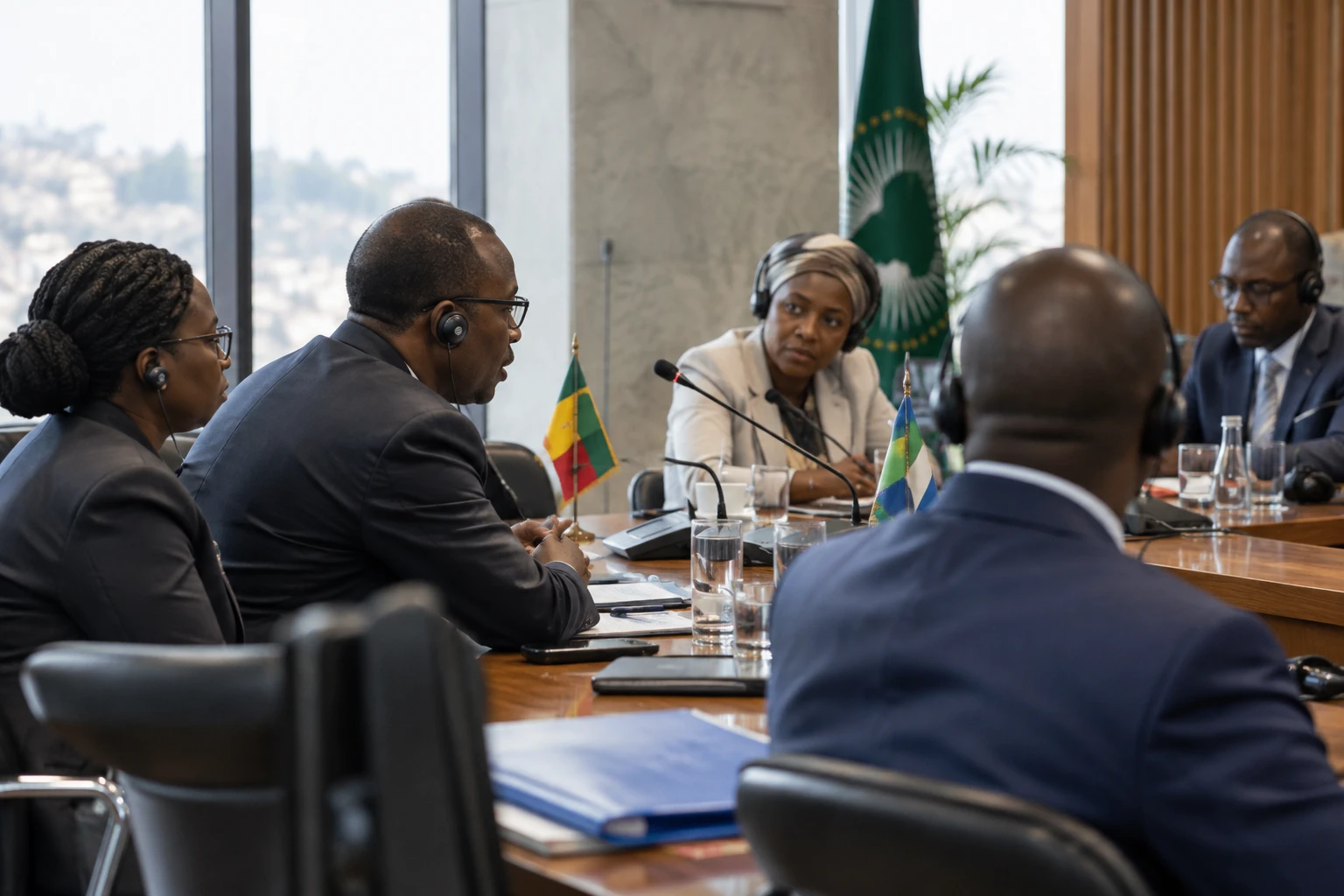
In New York, the debate over Western Sahara now goes beyond the question of the territory’s status alone. The end of the mandate of the United Nations Mission for the Referendum in Western Sahara (MINURSO) also creates uncertainty over the international presence on the ground and the conditions for a resumption of dialogue.
A regional issue, an international deadlock
Western Sahara, a former Spanish colony, is claimed by Morocco and the Polisario Front, which advocates independence for the territory. Algeria supports the Polisario and hosts Sahrawi refugees in Tindouf. Mauritania, which borders the territory, is also affected by regional dynamics.
The Security Council established MINURSO in 1991. Its mandate combined monitoring the ceasefire with preparing a referendum on self-determination. The vote has never taken place, notably because the parties have not reached agreement on who would be eligible to vote. The ceasefire, meanwhile, was broken in 2020, according to the UN.
The issue also divides the permanent members of the Council. Rabat backs an autonomy plan under Moroccan sovereignty. The Polisario and its supporters insist on the right to self-determination and on the decolonisation framework adopted by the United Nations. These positions are not interchangeable: they concern the territory’s final status and the role of its population in any decision.
Russian veto opens a new phase
On 30 October 2026, Russia vetoed a US draft resolution on the future of the mission. The text received 11 votes in favour, one against and three abstentions, but the negative vote of a permanent member prevented its adoption. A Russian draft aimed at technically extending the mandate then failed to secure the nine votes required.
MINURSO’s mandate expired on 31 October. The United Nations announced the start of the mission’s withdrawal and liquidation. The move brings a 35-year presence to a close, but resolves neither the territory’s status nor the political disagreements. The UN said it intended to ensure an orderly withdrawal of its personnel and facilities.
On 10 November, the General Assembly met in New York under the procedure that applies after a permanent member uses its veto. The rule allows member states to debate the situation that led to the veto. More than 30 countries spoke on the first day. The Assembly president scheduled further statements for the following day.
Rabat and Algiers defend opposing interpretations
At the session, Morocco’s ambassador, Omar Hilale, presented the veto and the failure to renew the mandate as a step favourable to Rabat’s position. He accused Algeria of perpetuating the diplomatic deadlock and exerting influence over the process. These accusations reflect Morocco’s interpretation of the conflict; in themselves, they are not facts established by the UN.
For his part, the Algerian representative accused the Security Council and the international community of failing to implement MINURSO’s original mandate. Algeria did not send its ambassador, according to reports of the session. The disagreement was thus expressed in the statements, without the General Assembly debate being able to resolve the underlying claims.
Moscow rejected criticism of its veto. At the Security Council, Russia defended keeping a United Nations mission in place and opposed a resolution that would make Moroccan autonomy the preferred outcome. Several delegations, including those of France and the United Kingdom, on the contrary regretted the veto and presented the mission’s presence as a factor for stability. Other states stressed that a vote in favour of the US text did not necessarily mean recognition of Moroccan sovereignty.
The consequences go beyond diplomatic circles
The mission’s disappearance changes the arrangements for international monitoring on the ground. MINURSO monitored the ceasefire and helped maintain a UN presence in the territory. Its withdrawal leaves practical questions: what mechanisms will now document tensions and prevent an escalation? The United Nations has not announced that an equivalent arrangement will replace the mission.
The effects will not be the same for everyone. The Moroccan authorities see this as an opportunity to advance their autonomy proposal. For the Polisario and Sahrawi refugees, the end of the mission raises concerns about the place of the right to self-determination and the international attention given to their situation. The people living in the territory remain at the heart of a conflict whose political outcome is still uncertain.
In Rabat, Moroccan diplomacy is seeking to turn its international support into political progress. But the position of some states that back the autonomy plan does not automatically amount to recognition of sovereignty or agreement on the final status. The gap between diplomatic wording and the parties’ expectations will remain decisive in what follows.
An issue for North Africa and the African Union
Rivalry between Morocco and Algeria weighs on cooperation in North Africa, where the Arab Maghreb Union remains paralysed. It also complicates discussions on security, trade and mobility in a region where bilateral decisions can quickly take on continental significance. The issue concerns the African Union, whose members do not all hold the same position on Sahrawi representation.
For Rabat, the challenge is to sustain diplomatic momentum around its plan without conflating political support with a settlement accepted by all parties. For Algiers and the Polisario, the challenge is to preserve the place of the principle of self-determination in discussions. For the United Nations, the immediate priority is to determine whether a new framework for a presence or mediation can be established after MINURSO’s withdrawal.
The General Assembly meeting lays bare the fault lines, but does not replace negotiation. What happens next will depend on the efforts of the Secretary-General’s Personal Envoy, Staffan de Mistura, and the ability of Security Council members to agree on a common framework. Without UN monitoring on the ground, a resumption of dialogue will also have to answer a practical question: how can stability be maintained while Western Sahara’s status remains contested?



