
 Egypt
 Libya
 Morocco
 Sudan
 Tunisia
 Benin
 Burkina Faso
 Cabo Verde
 Côte d'Ivoire
 Ghana
 Guinea
 Guinea-Bissau
 Liberia
 Mali
 Mauritania
 Niger
 Nigeria
 Senegal
 Sierra Leone
 The Gambia
 Togo
 Cameroon
 Central African Republic
 Chad
 DR Congo
 Equatorial Guinea
 Gabon
 Republic of the Congo
 São Tomé and Príncipe
 Burundi
 Comoros
 Djibouti
 Eritrea
 Ethiopia
 Kenya
 Madagascar
 Malawi
 Mauritius
 Mozambique
 Rwanda
 Seychelles
 Somalia
 South Sudan
 Tanzania
 Uganda
 Angola
 Botswana
 Eswatini
 Lesotho
 Namibia
 South Africa
 Zambia
 Zimbabwe
An arrest that goes beyond France alone
In the fight against drug trafficking, the strongest networks no longer stop at borders. They rely on safe havens, financial conduits and deceptive forms of mobility. It is precisely this kind of movement that the arrest of Mehdi Laribi, described as one of the alleged founders of the DZ Mafia, has brought back into focus. Arrested in Algeria on 20 July 2026 and then placed under judicial supervision, he is now a test case for French-Algerian police and judicial cooperation, which is resuming after a long period of strain.
For Algiers, the stakes are not merely diplomatic. They also concern domestic security. In recent months, the Algerian authorities have stepped up operations against networks trafficking processed kif, psychotropic drugs and goods across borders. In June 2026, the Algerian National Gendarmerie had already announced the dismantling of a cross-border network in Algiers and the seizure of four quintals of processed kif, thousands of psychotropic tablets and vehicles used by traffickers. Another operation, on 12 July 2026, led to further arrests and the seizure of 735 kilograms of processed kif.
The return of a sensitive channel between Paris and Algiers
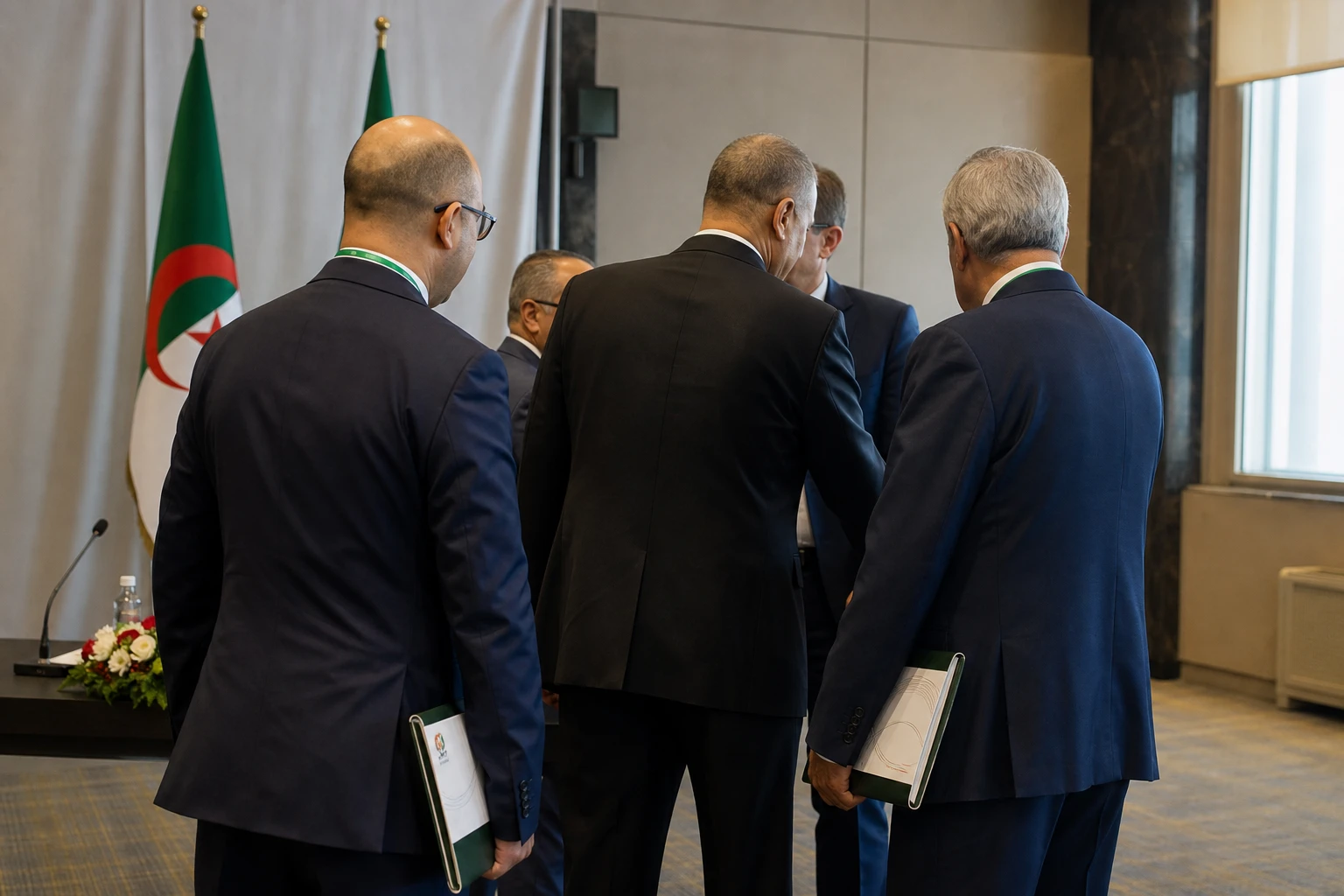
The current sequence comes amid a cautious thaw between the two capitals. On 16 and 17 February 2026, the French interior minister visited Algiers. Then, on 1 June 2026, he received his Algerian counterpart, Saïd Sayoud, in Paris to discuss, among other things, the fight against organised crime, drug trafficking and money laundering. The French Interior Ministry described the meeting as a continuation of efforts to restore effective dialogue. The Algerian ministry, for its part, stressed security cooperation and operational coordination.
This return to dialogue matters because bilateral relations had been badly damaged since the crisis that erupted in July 2024 over the Western Sahara issue and other political and security matters. Several ministerial visits in 2026 have helped reopen channels that had been closed, without erasing the accumulated tensions. In this context, the resumption of judicial exchanges over Mehdi Laribi carries immediate symbolic weight. It shows that a criminal case can make progress where traditional diplomacy remains slow.
What the law allows, and what it does not
The central issue is legal. The extradition treaty between France and Algeria, published in 2021, states that a party that does not extradite its national must, at the request of the other party, refer the case to the competent authorities so that proceedings can be brought if necessary. In other words, the inability to extradite a national does not bring everything to a halt: it can shift the case to the courts of the country where the person is located.
This mechanism gives Laribi’s arrest its practical significance. Described as French-Algerian, he cannot automatically be handed over to France if Algeria chooses to give precedence to the domestic legal route. In that case, Paris must transmit its investigative material to allow proceedings to be brought in Algeria, if warranted. It is a cumbersome procedure, but one that is consistent with bilateral law. It also prevents a politically charged case from turning into a straightforward diplomatic stand-off.
France, for its part, has structured its response to drug trafficking around more specialised tools. The National Prosecutor’s Office for Organised Crime, which began operating on 5 January 2026, was created to oversee cases involving the upper echelons of organised crime. Operation “Octopus”, launched against the DZ Mafia, had already led to mass arrests in March 2026, with more than forty people detained in a large-scale operation coordinated by the gendarmerie. The Laribi case therefore appears to be a judicial extension of an enforcement apparatus that is already being scaled up.
A matter of sovereignty as much as public security
For Algeria, the fight against drugs is not diplomatic window dressing. It concerns a sensitive issue: the circulation of illicit substances, their growing consumption and their social impact. Official Algerian statements in the summer of 2026 point to sustained activity by the security services, with seizures of psychotropic drugs, processed kif and hard drugs. The message is twofold. On the one hand, the authorities are demonstrating their capacity to act. On the other, they want to prevent Algerian territory from being seen as a refuge for traffickers on the run.
This approach reflects an imperative of sovereignty. In official Algerian discourse, international cooperation is useful, but it must never override national decision-making. In practice, this means that Algiers must balance police effectiveness, the protection of its international image and political control over sensitive cases. The Laribi case brings together precisely these elements: a wanted individual, a criminal network based in Marseille and an Algerian decision signalling that the country does not want to serve as a rear base for external trafficking.
The case should also be viewed in the context of North Africa and the Mediterranean basin. Drug networks use the same routes as other forms of trafficking: vehicles, forged documents, maritime flows, money laundering and family connections spread across several countries. At the regional level, the case is a reminder that security can no longer be addressed solely through border controls. It also depends on judicial cooperation, information-sharing and states’ ability to target criminal assets.
What happens next will show whether the Laribi case remains an isolated episode or becomes a precedent. If the criminal case file is transferred and acted upon, it could serve as a model for other cases in which a French-Algerian, or more broadly a dual national, is beyond the reach of conventional extradition. In a Euro-Mediterranean region where trafficking adapts quickly, it is often the strength of judicial ties, rather than political declarations, that measures the true solidity of a partnership.



