Egypt
 Libya
 Morocco
 Sudan
 Tunisia
 Benin
 Burkina Faso
 Cabo Verde
 Côte d'Ivoire
 Ghana
 Guinea
 Guinea-Bissau
 Liberia
 Mali
 Mauritania
 Niger
 Nigeria
 Senegal
 Sierra Leone
 The Gambia
 Togo
 Cameroon
 Central African Republic
 Chad
 DR Congo
 Equatorial Guinea
 Gabon
 Republic of the Congo
 São Tomé and Príncipe
 Burundi
 Comoros
 Djibouti
 Eritrea
 Ethiopia
 Kenya
 Madagascar
 Malawi
 Mauritius
 Mozambique
 Rwanda
 Seychelles
 Somalia
 South Sudan
 Tanzania
 Uganda
 Angola
 Botswana
 Eswatini
 Lesotho
 Namibia
 South Africa
 Zambia
 Zimbabwe
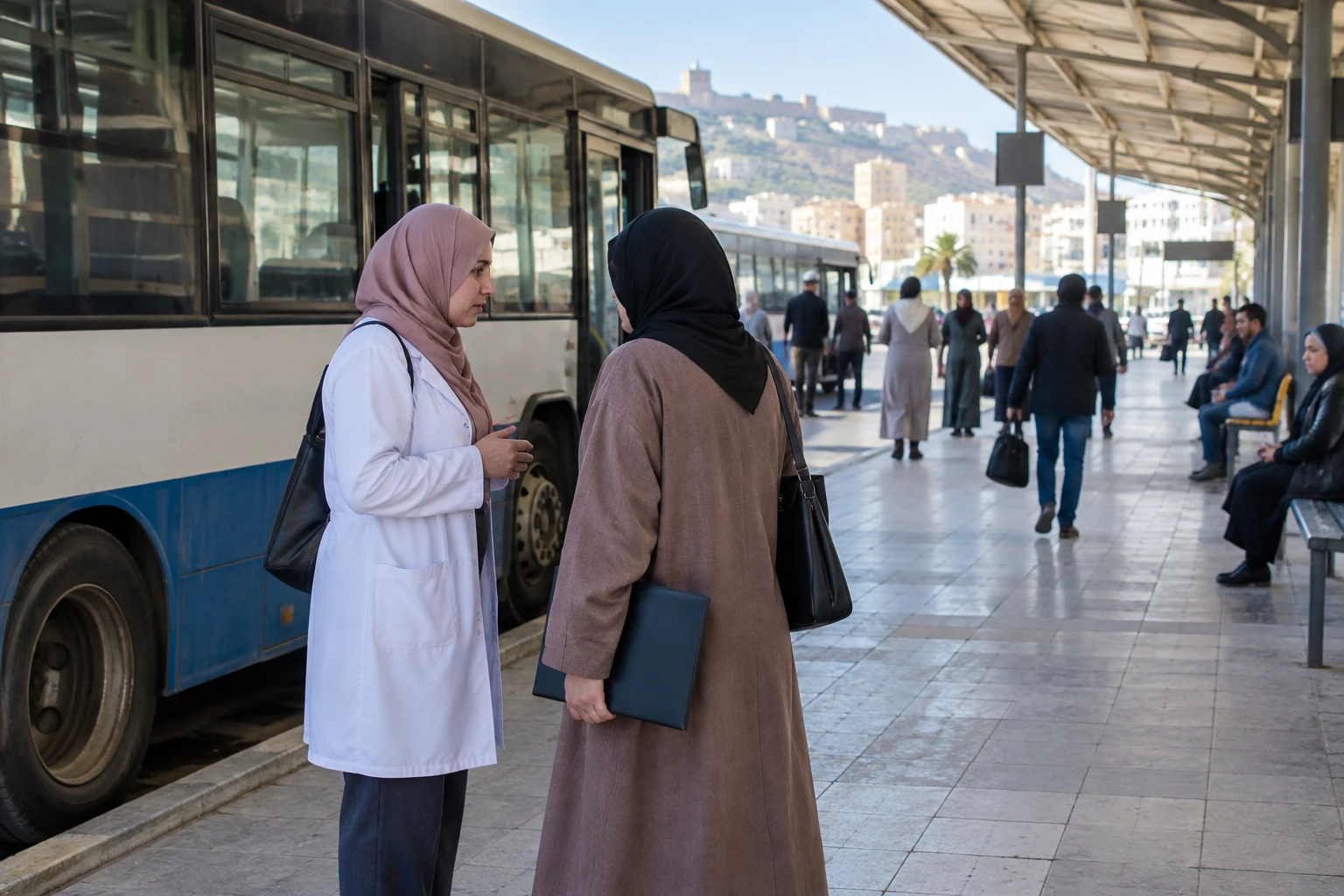
When someone confides their story to a psychiatrist, they expect their words to remain in the consulting room. In Algeria, that trust is at the heart of a case involving professional secrecy, literary narrative and the still-contested memory of the civil war.
The Oran court is due to deliver its ruling on Tuesday 27 October 2026 in the case against psychiatrist Aïcha Dahdouh. The previous day, she rejected the accusations in a statement sent to Agence France-Presse. The complainant, Saâda Arbane, believes that elements of her personal and medical life may have informed the novel Houris by Kamel Daoud, the psychiatrist’s husband. These claims remain contested: the court’s decision is not yet known.
In Oran, a case rooted in the wounds of the 1990s
The case reaches back to the Black Decade, a period of political and armed violence in Algeria that was particularly intense in the 1990s. Saâda Arbane says she survived an attack as a child that left her seriously injured and unable to speak normally. She says she recognised elements of her life in Aube, the heroine of Houris, published in 2024 and awarded the Prix Goncourt that same year.
The dispute therefore goes beyond the question of literary inspiration alone. It also concerns the protection of information shared during psychiatric treatment, consent to recount a lived experience and the ability of a survivor to control how her story is circulated. The two complaints filed in Oran in August 2024 brought this legal dimension into the public domain. Reports published at the start of the case said the complaints targeted the writer and his wife, on the basis of allegations that the courts must examine.
The region has no shared economic organisation comparable to ECOWAS or the European Union: Algeria belongs to the Arab Maghreb Union, whose political activity has remained limited. Here, the decisive framework is primarily national. The Oran court is called on to assess the facts under Algerian law, while the case has also prompted proceedings in France.
The psychiatrist denies any disclosure
In her statement of 25 October, Aïcha Dahdouh says: “I am innocent. I did not disclose medical secrets. I did not steal a file.” She adds that medical secrecy is “one of the foundations of medical ethics” and says she has remained faithful to it. This is her defence, not a finding by the court.
The psychiatrist also says she wants to be heard as a professional, without her words being conflated with those of her husband. “Kamel Daoud’s voice must not drown out mine,” she writes. She says she does not share his views on Algeria, Islam or Palestine, or his perspective on the pain of others. She is distancing herself at a time when public debate often treats the couple as a single actor.
Saâda Arbane, for her part, maintains that certain details of her life match those of the character and that she had refused to let her story be used. Several media outlets have reported that the two women had a therapeutic relationship. But establishing that treatment took place is not enough to prove that information was passed on, just as the alleged similarities alone do not demonstrate the origin of every element in the novel. This is precisely what the proceedings must clarify.
Readers must also distinguish between the legal cases. In Algeria, Kamel Daoud was sentenced in absentia in April 2026 to three years in prison, according to his own announcement, in proceedings linked to Houris. In France, he was acquitted in September in a defamation case brought by Saâda Arbane over remarks made to the press. That decision does not resolve the separate question of alleged violations of privacy or medical secrecy. The announcement of the sentence in Algeria was reported by the Associated Press; the acquittal in France concerns a different dispute.
What is at stake for patients’ trust
For patients, the issue is tangible: being able to speak about trauma without fearing that intimate details will be reused outside the context of care. For healthcare professionals, the case is a reminder that confidentiality is not merely an abstract rule. It is essential to the possibility of a therapeutic relationship, particularly when patients recount past violence or stigmatising experiences.
For Saâda Arbane, the proceedings concern recognition of her privacy and consent. For Aïcha Dahdouh, they put her professional responsibility and presumption of innocence at stake. For Kamel Daoud, they touch on freedom of creation and the political context in which his novel was banned in Algeria. These issues intersect, but they are not interchangeable. Literary freedom does not automatically settle an allegation of disclosure; conversely, an accusation is not enough to establish wrongdoing.
The debate is also taking place against the backdrop of the official memory of the civil war. The Charter for Peace and National Reconciliation, adopted in 2005, governs how that period may be discussed publicly. Critics of the text regard it as a restriction on historical debate; its defenders point to its aim of stabilisation after years of violence. In this case, that political context may shape public reception of the accusations, but it cannot prejudge the verdict.
Oran ruling is the next step
The judgment expected on 27 October will determine whether the psychiatrist is found to have disclosed medical secrets. It will not necessarily, by itself, answer all the questions raised by the novel: proceedings in France, claims relating to privacy and any appeals will follow their own paths.
Across the Maghreb and Africa, the case highlights a tension common to many countries: how to protect medical confidentiality, people’s dignity and freedom of creation, while allowing the courts to examine accusations without political instrumentalisation. The Oran decision will therefore be followed beyond Algeria, but its significance will depend on the facts accepted by the court and the reasoning it sets out.