
 Egypt
 Libya
 Morocco
 Sudan
 Tunisia
 Benin
 Burkina Faso
 Cabo Verde
 Côte d'Ivoire
 Ghana
 Guinea
 Guinea-Bissau
 Liberia
 Mali
 Mauritania
 Niger
 Nigeria
 Senegal
 Sierra Leone
 The Gambia
 Togo
 Cameroon
 Central African Republic
 Chad
 DR Congo
 Equatorial Guinea
 Gabon
 Republic of the Congo
 São Tomé and Príncipe
 Burundi
 Comoros
 Djibouti
 Eritrea
 Ethiopia
 Kenya
 Madagascar
 Malawi
 Mauritius
 Mozambique
 Rwanda
 Seychelles
 Somalia
 South Sudan
 Tanzania
 Uganda
 Angola
 Botswana
 Eswatini
 Lesotho
 Namibia
 South Africa
 Zambia
 Zimbabwe
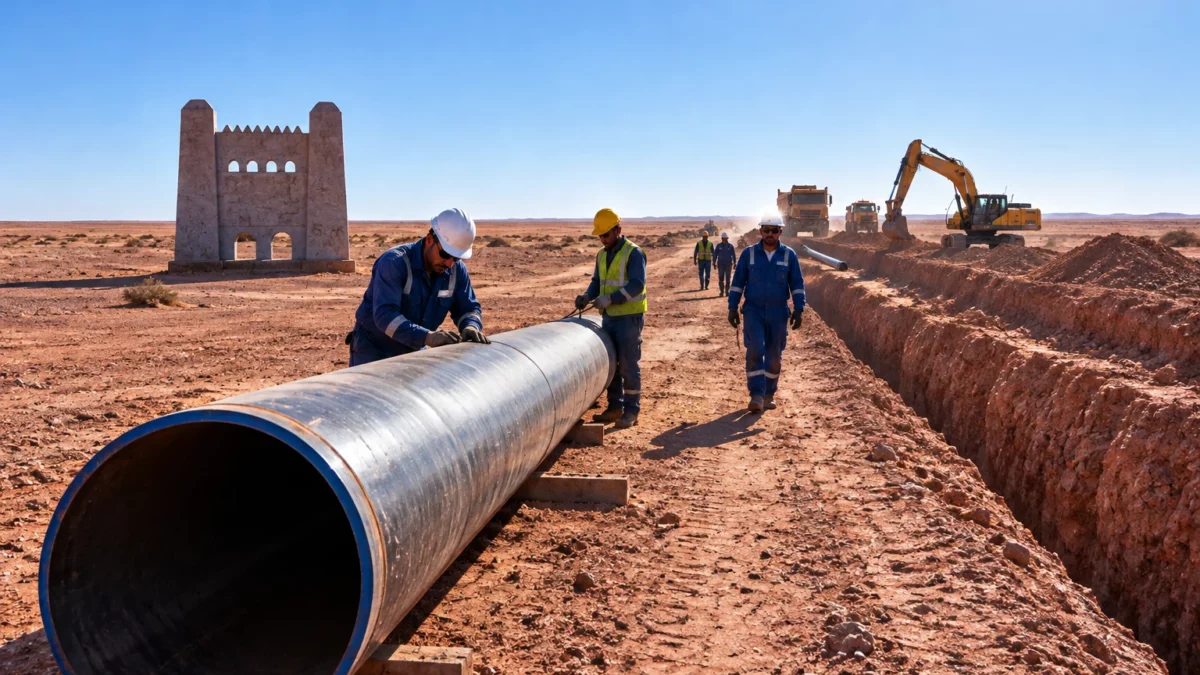
In Tin Zaouatine, in Algeria’s far south, access to water depends as much on the available resource as on the ability to transport it over long distances. The new project, launched in November, addresses this local challenge. It also raises a wider question: how can supplies be secured without putting further strain on the underground aquifers on which several Saharan regions already depend?
A network to connect communities in the Great South
Tin Zaouatine is in the wilaya of In Guezzam, in southern Algeria and near the border with Mali. The water is to come from Tanezrouft, in the wilaya of Bordj Badji-Mokhtar. The transfer will therefore connect two parts of the Great South, far from the country’s main northern centres.
At regional level, the project is primarily part of a national development decision. It also sits within a Saharan neighbourhood where groundwater management extends beyond national borders. The Arab Maghreb Union (AMU), which includes Algeria, Tunisia, Libya and Mauritania, among others, is the relevant regional framework, although the project itself remains Algerian. The North-Western Sahara Aquifer System is already the subject of cooperation between Algeria, Tunisia and Libya; the Tin Zaouatine project, however, concerns a different territory and should not be confused with that agreement.
Algeria has already relied on major transfers to supply the south. The system linking In Salah to Tamanrasset transports groundwater over a distance of about 750 kilometres. Algérienne des Eaux describes the network as a system designed to supply several communities along the route. This experience illustrates the scale of the infrastructure required, but does not in itself guarantee the sustainability of every new transfer.
A 250-kilometre project launched in November
Hydraulics Minister Lounès Bouzegza officially launched the works on Monday 16 November 2026, in the wilaya of Bordj Badji-Mokhtar. The Algeria Press Service (APS) dispatch says the transfer will start at Tanezrouft and end in the Tin Zaouatine region. It puts the route at nearly 250 kilometres.
The announced budget is close to 27 billion Algerian dinars. Algerian daily Algerie360 reports that the project includes five deep boreholes, pipelines, three reservoirs and four pumping stations. These installations are intended to draw water, store it and then transport it to the town. The technical details are reported by the outlet; the official announcements available confirm mainly the cost, route and launch.
The timeline requires some clarification. In November 2025, the then hydraulics minister told state television that work was expected to begin in the first quarter of 2026. The project was eventually officially launched on 16 November 2026. Algerie360 now reports an execution period of one year. If that deadline is met, delivery would be expected towards the end of 2027, but the sources consulted give no precise date for the start of operations.
More reliable access, but a resource to protect
For residents, the practical issue is the reliability of drinking-water supplies. The transfer could reduce dependence on local supply points and support the needs of households and public services. In an area far from major networks, the pipeline and its pumping stations also represent an investment in territorial infrastructure. The benefits will nevertheless depend on the quality of operations: power supply, maintenance, repairs and reservoir management.
The project comes against a backdrop of structural water stress. A study published in 2026 in the Algerian journal Strategia estimates Algeria’s renewable water availability at 248 cubic metres per person per year in 2025. This figure measures average availability nationwide; it does not directly describe the day-to-day situation in Tin Zaouatine. It nonetheless highlights the limited renewable resources available relative to the country’s needs.
Reliance on deep aquifers raises another question: how quickly they are replenished and how long they can sustain withdrawals. A transfer can address geographical inequality, but it does not create new water. In remarks reported by Algerian state television in November 2025, the minister also warned that intensive groundwater extraction could affect its sustainability. Monitoring the volumes pumped and changes in the aquifer will therefore be as important as building the pipeline.
Algeria’s water policy combines several responses. Desalination mainly supplies coastal cities; transfers move resources between regions; and wastewater reuse can reduce demand for drinking water. According to state television, the minister said in 2025 that 19% of treated wastewater was being reused in agriculture and industry. This national figure does not provide information about the facilities planned for Tin Zaouatine, but it underlines that transfer infrastructure is only one part of the strategy.
A test of continuity for southern Algeria
The project involves several levels of responsibility: the state is funding a major infrastructure project, operators will have to keep it running, and residents expect a daily service. A connection alone will not be enough to measure its success. The frequency of distribution, water quality, interruptions and changes in extraction will show its practical effects.
For Algeria, the project extends a development approach already evident in the In Salah–Tamanrasset transfer. For the rest of North Africa, it serves as a reminder of a shared challenge, without erasing the differences between countries or river basins: reconciling equitable access, costly infrastructure and prudent groundwater management. The next milestones will be progress on construction, the expected start of operations around 2027 and the publication of information on extraction volumes.
The APS dispatch on the launch of the transfer to Tin Zaouatine ; project details published by Algerie360 ; the ministry’s statements reported by Algerian state television ; the Algerian study on water resources and water governance ; Algérienne des Eaux’s presentation of the In Salah–Tamanrasset transfer.



