
 Egypt
 Libya
 Morocco
 Sudan
 Tunisia
 Benin
 Burkina Faso
 Cabo Verde
 Côte d'Ivoire
 Ghana
 Guinea
 Guinea-Bissau
 Liberia
 Mali
 Mauritania
 Niger
 Nigeria
 Senegal
 Sierra Leone
 The Gambia
 Togo
 Cameroon
 Central African Republic
 Chad
 DR Congo
 Equatorial Guinea
 Gabon
 Republic of the Congo
 São Tomé and Príncipe
 Burundi
 Comoros
 Djibouti
 Eritrea
 Ethiopia
 Kenya
 Madagascar
 Malawi
 Mauritius
 Mozambique
 Rwanda
 Seychelles
 Somalia
 South Sudan
 Tanzania
 Uganda
 Angola
 Botswana
 Eswatini
 Lesotho
 Namibia
 South Africa
 Zambia
 Zimbabwe
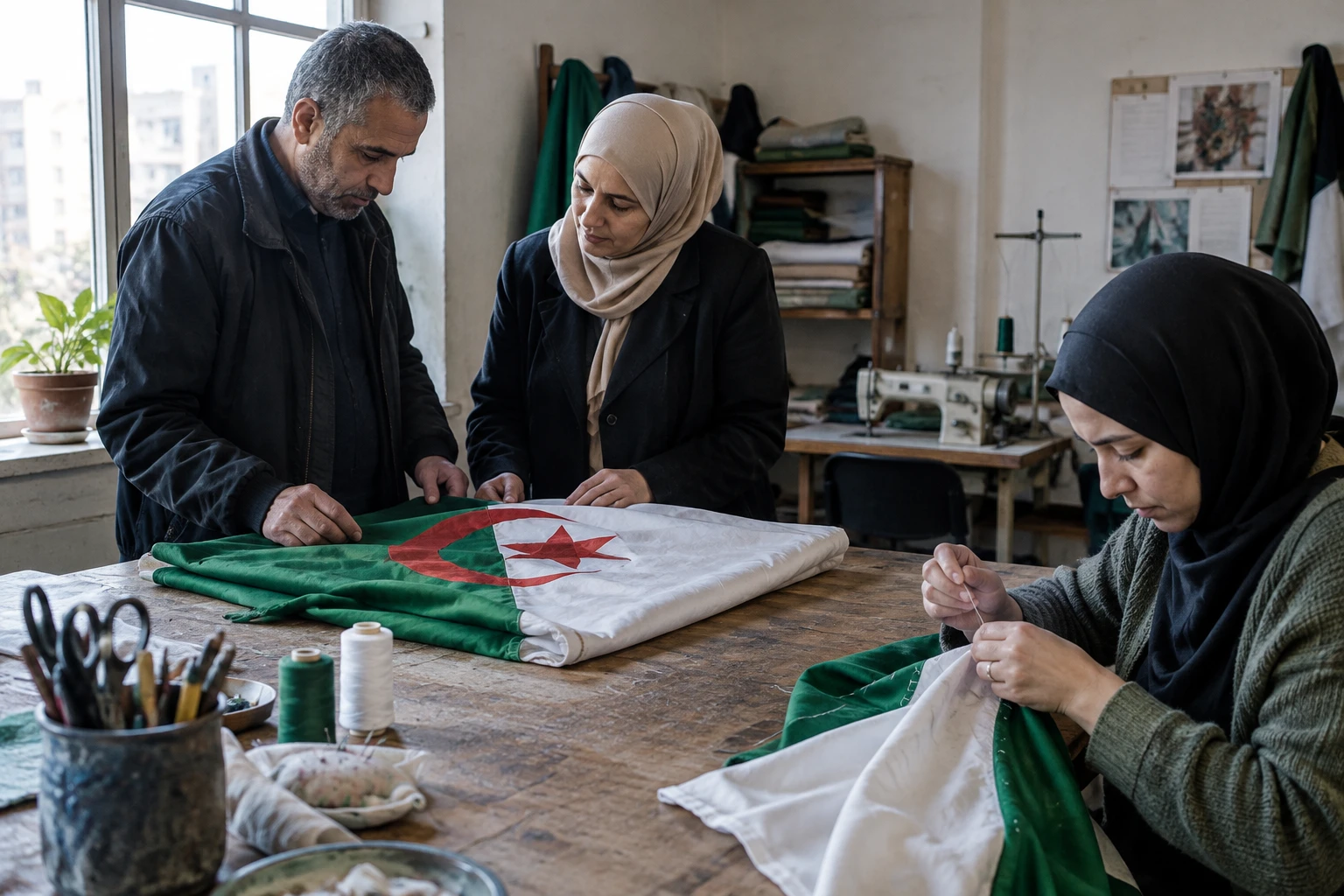
A national flag does not always emerge from a single act or bear a single person’s name. In the case of Algeria’s emblem, archives and historical accounts point instead to a collective process spanning several decades. Émilie Busquant, an activist and the partner of Messali Hadj, played an important part, but presenting her as its sole creator obscures a longer history.
An emblem shaped by mobilisation
To understand this history, we must return to the first decades of the 20th century. Under French colonial rule, Algerian workers organised in France and Algeria. They demanded social and political rights, while ideas of independence gained ground. Paris, the capital of the colonial power, also became a place where part of this movement organised.
The North African Star (ENA), founded in Paris in 1926, brought together activists, including those from the Maghreb diaspora. It initially championed demands shared by the populations of North Africa. Gradually, Algerian independence became central to its programme. Messali Hadj, born in Tlemcen in 1898, became one of its leading figures. Dissolved by the French authorities in 1937, the organisation left a lasting mark on Algerian nationalism.
The flag’s visual origins remain contested. Historians René Gallissot and Anissa Bouayed date appearances of the green-and-white emblem, with a red crescent and star, to Algerian trade union demonstrations in 1919 and 1920. A study by Salim Chena, published in 2024 in the journal Sociétés & Représentations, notes that the first banners were not necessarily identical to the current official design. Colours and symbols could vary between marches and organisations. Salim Chena’s historical study of the evolution of the Algerian flag places these variations in context.
An often-cited milestone came in August 1934, at an ENA assembly. A green-and-white flag adorned with a red crescent and star was presented there. Several accounts credit Émilie Busquant with making this example. According to historian Benjamin Stora, the colours were chosen at a meeting of activists, after which Busquant was asked to sew the flag.
This attribution should be stated precisely. Sewing one example does not necessarily mean inventing its colours or symbols. Available accounts sometimes fail to distinguish between making the flag, designing it and settling on a standard model. Moreover, the appearances cited for 1919 and 1920 predate the 1934 meeting by several years. Its exact authorship therefore remains uncertain, while historical accounts attest to Busquant’s role in making it.
From anti-colonial struggle to state symbol
After the ENA was dissolved, the Algerian People’s Party (PPA), founded in 1937, carried on the nationalist organisation’s work. The flag spread through demonstrations and took on increasing political significance. On 8 May 1945, in Sétif, Algerian demonstrators marched with national demands as Europe celebrated the end of the Second World War. Bouzid Saâl, a young scout carrying the emblem, was shot dead. His death is associated with the events in Sétif, Guelma and Kherrata, which were brutally suppressed by colonial forces and European civilians. Historians continue to debate the death toll from these massacres.
During the war of independence, which began in 1954, the National Liberation Front (FLN) adopted the flag. From 1958, it also became the flag of the Provisional Government of the Algerian Republic, the political body created by the independence movement. The emblem then represented a claim to sovereignty, advanced both in the country and on the international stage, rather than merely serving as a rallying sign for activists.
After independence, the Algerian state officially defined its characteristics. Law No. 63-145 of 25 April 1963 set out the rectangle divided between green and white, as well as the position of the red crescent and star. The law gave legal status to a symbol already adopted by the liberation movement. The law published in Algeria’s Official Gazette specifies the proportions and elements of the national emblem.
Busquant’s life also shows how this memory extends beyond national borders. Born in Lorraine in 1901, she shared Messali Hadj’s political commitment and supported his struggle. She died in Algiers in October 1953, before the war began. A commemorative plaque has been dedicated to her in her home town since 2003. Her story connects activist networks in the diaspora with the anti-colonial struggle in Algeria, without reducing the movement to the actions of one person.
A legacy extending beyond Algeria
In 2026, the ENA’s centenary is being marked with events devoted to the beginnings of the independence movement. In Oran, a seminar organised by the Centre for Research in Social and Cultural Anthropology is revisiting those origins. In Paris, the Arab World Institute is also holding an event about the organisation. These gatherings show that Algerian history is being explored on both sides of the Mediterranean, through places and memories that do not coincide. The Arab World Institute’s event marking the ENA centenary is part of this period of commemoration.
The regional dimension is also present in the name of the North African Star itself, which initially referred to Maghrebi solidarity. Today, Algeria is a member of the Arab Maghreb Union (AMU), established in 1989 to strengthen cooperation among the region’s states. This organisation should not be confused with the African Union, of which Algeria is also a member. In both frameworks, the emblem is a reminder that a national history was also shaped through regional activist networks and the diaspora.
For Algerians, the flag now carries several memories: workers’ mobilisation, the struggle for independence and state sovereignty. In the diaspora, it accompanies political rallies as well as moments of collective celebration. These contemporary uses can spark debate, but they do not settle the historical question of its origins.
The most robust answer to the question of its creation is therefore a nuanced one: the emblem took shape through nationalist mobilisation, before being adopted and standardised by independence organisations, then codified by the Algerian state. Émilie Busquant is associated with making a flag presented in 1934. The available evidence is not sufficient to credit her alone with inventing a symbol whose earlier forms are reported as far back as 1919 and 1920.



