Algeria
 Egypt
 Libya
 Morocco
 Sudan
 Tunisia
 Benin
 Burkina Faso
 Cabo Verde
 Côte d'Ivoire
 Ghana
 Guinea
 Guinea-Bissau
 Liberia
 Mali
 Mauritania
 Niger
 Nigeria
 Senegal
 Sierra Leone
 The Gambia
 Togo
 Cameroon
 Central African Republic
 Chad
 DR Congo
 Equatorial Guinea
 Gabon
 Republic of the Congo
 São Tomé and Príncipe
 Burundi
 Comoros
 Djibouti
 Eritrea
 Ethiopia
 Kenya
 Madagascar
 Malawi
 Mauritius
 Mozambique
 Rwanda
 Seychelles
 Somalia
 South Sudan
 Tanzania
 Angola
 Botswana
 Eswatini
 Lesotho
 Namibia
 South Africa
 Zambia
 Zimbabwe
In West Nile, a solar plant puts Uganda’s grid to the test
At Ombachi, in Madi Okollo district, the commissioning of Ituka is about more than an energy project. It says something broader: in Uganda, the problem is no longer simply how to produce more electricity, but how to transport it without undermining a grid already under considerable strain. The country has passed the 2,000 MW installed-capacity mark, but integrating new variable capacity, such as solar and wind, is now the real technical challenge.
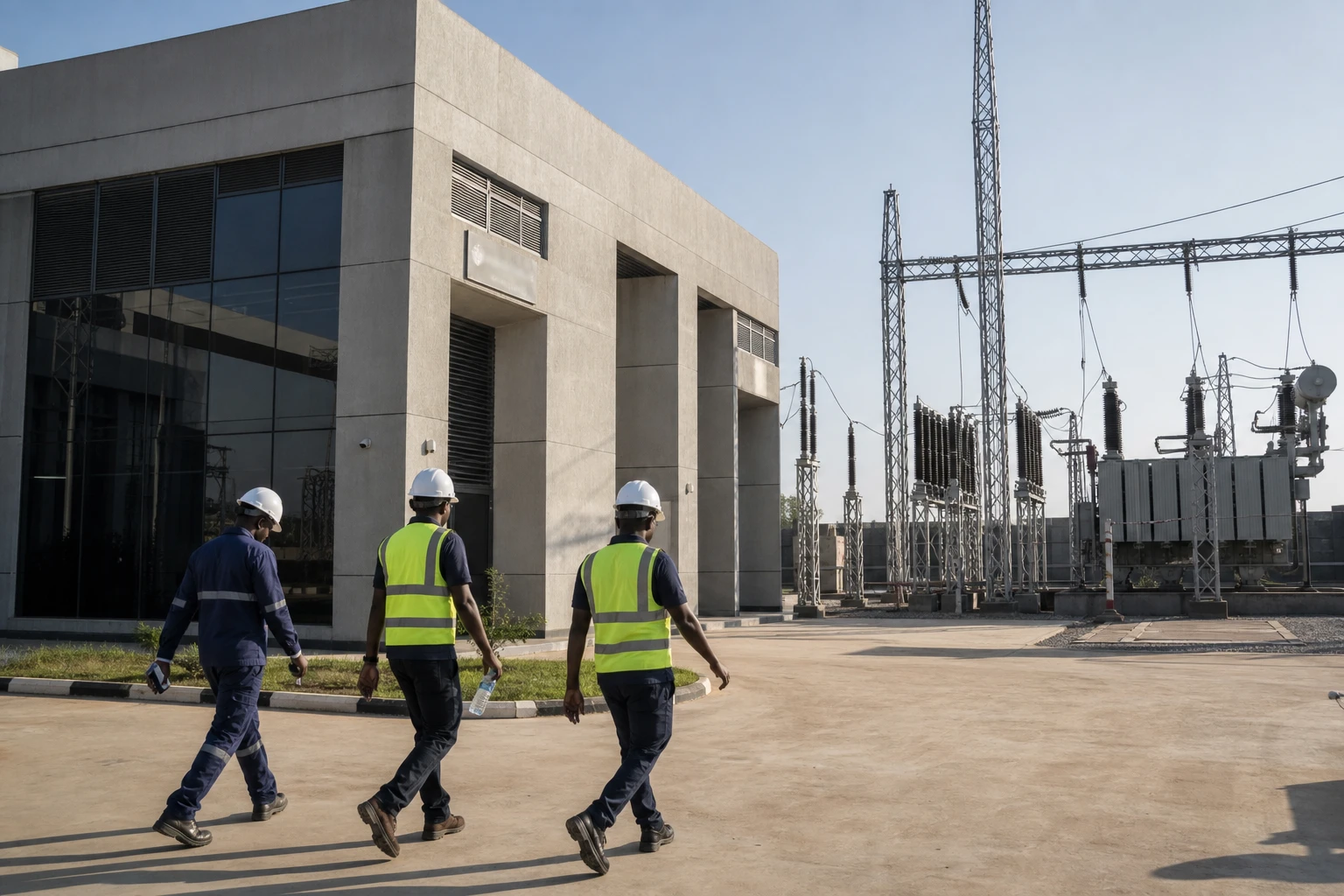
This issue is particularly sensitive in the West Nile sub-region, long distant from major centres of consumption. Kampala, the capital, still accounts for most industrial and urban demand. But new investment is also seeking to address pockets of energy isolation within the country. In this context, building 132 kV lines and substations is no minor engineering detail. It is the backbone that allows energy policy to deliver on its promises.
What is known about Ituka and the project timeline
The Ituka project was developed by AMEA Power, an Emirati group active in several African markets. Its plant has a capacity of 24 MWp, with up to 20 MWac due to be fed into the grid via the 132 kV Lira-Gulu-Nebbi-Arua line. The asset also includes a 25 MVA substation. Electricity will be sold to the Uganda Electricity Transmission Company Limited, or UETCL, under a 20-year power purchase agreement.
The project did not come about overnight. The Ugandan government approved it in 2022 at a tariff of $0.08 per kilowatt-hour. The power purchase agreement and implementation agreement were signed in September 2023. Financing was then consolidated during COP28, with a commitment of about $19 million in debt from the Emerging Africa Infrastructure Fund, before construction officially began in August 2024.
AMEA Power describes Ituka as its first asset in Uganda. At the groundbreaking ceremony in August 2024, the group had already said the project would be the first and largest grid-connected solar site in the West Nile region. The company also confirmed that the project is being developed by Ituka West Nile Uganda Limited, a project company registered in Uganda.
A growing grid, but almost at capacity for solar and wind
The figures from the Electricity Regulatory Authority are clear. At the end of 2025, Uganda had installed capacity of 2,098.6 MW, including 1,721.7 MW of hydropower and 111.3 MW of solar power. Hydropower therefore remains the backbone of the system, while solar still accounts for a small share, despite its growth.
But the equation has become more difficult. In October 2025, the ERA said the grid’s technical capacity to absorb new solar and wind projects had already been fully committed, and lowered the firm absorption limit for these technologies from 250 MW to 200 MW. In short, the challenge is no longer simply to issue licences. It is also to prevent growth in variable generation from destabilising the system.
This shift matters to investors and households alike. For operators, it means a project can be technically ready, financed and authorised, while the grid may still be unable to absorb it without constraints. For consumers, it can delay the arrival of a more diversified electricity supply. For underserved areas in the north-west, however, every megawatt connected remains a tangible sign of improved access.
Why West Nile matters to Uganda’s energy strategy
The West Nile region has long relied on costly and limited solutions. One of Ituka’s advantages is that it uses the 132 kV Lira-Gulu-Nebbi-Arua line, a key part of the national grid. UETCL has documented this corridor in its infrastructure projects, specifically to improve the reliability of supply in the north and north-west of the country.
The impact is therefore twofold. On the one hand, the state and the public-sector buyer hope to secure a cleaner and more stable supply. On the other, communities in West Nile can hope for better service, which would benefit small businesses, public services, agro-processing and informal activities that depend on a reliable electricity supply. Kampala is the political capital, but the credibility of the energy transition is also being tested far from major urban centres.
The project also comes at a time when Uganda is setting out long-term ambitions. The ERA says the country wants to diversify its energy mix, reduce its dependence on hydropower and pursue an energy pathway compatible with its climate goals. The authority also cites an energy transition plan aligned with the African Union’s Agenda 2063, a sign that the issue is no longer solely a national one. It affects East Africa’s place in the continent’s energy transition.
A regional signal for East Africa and future investment
Ituka illustrates a change in approach. Private developers can no longer act as if permits and financing are enough. In a member country of the East African Community, renewable-energy projects must now be aligned with grid availability, substations and transmission lines. The issue has become systemic. It extends beyond the project site itself.
The message is relevant to the region. Several East African countries are seeking to attract capital for solar, wind and mini-grids. Uganda’s example shows that power generation must grow alongside transmission. Without this, capacity growth can run up against technical limits, even when social and industrial demand exists.
The next development to watch is therefore not simply the start of a plant’s operations. It is the Ugandan system’s ability to absorb other similar projects without leaving investors waiting or forcing them to defer plans. In a country seeking to combine access, reliability and transition, Ituka is not an endpoint. It is a stress test for the entire power system.