Algeria
 Egypt
 Libya
 Morocco
 Sudan
 Tunisia
 Benin
 Burkina Faso
 Cabo Verde
 Côte d'Ivoire
 Ghana
 Guinea
 Guinea-Bissau
 Liberia
 Mali
 Mauritania
 Niger
 Nigeria
 Senegal
 Sierra Leone
 The Gambia
 Togo
 Cameroon
 Central African Republic
 Chad
 DR Congo
 Equatorial Guinea
 Gabon
 Republic of the Congo
 São Tomé and Príncipe
 Burundi
 Comoros
 Djibouti
 Eritrea
 Ethiopia
 Kenya
 Madagascar
 Malawi
 Mauritius
 Mozambique
 Rwanda
 Seychelles
 Somalia
 South Sudan
 Tanzania
 Angola
 Botswana
 Eswatini
 Lesotho
 Namibia
 South Africa
 Zambia
 Zimbabwe
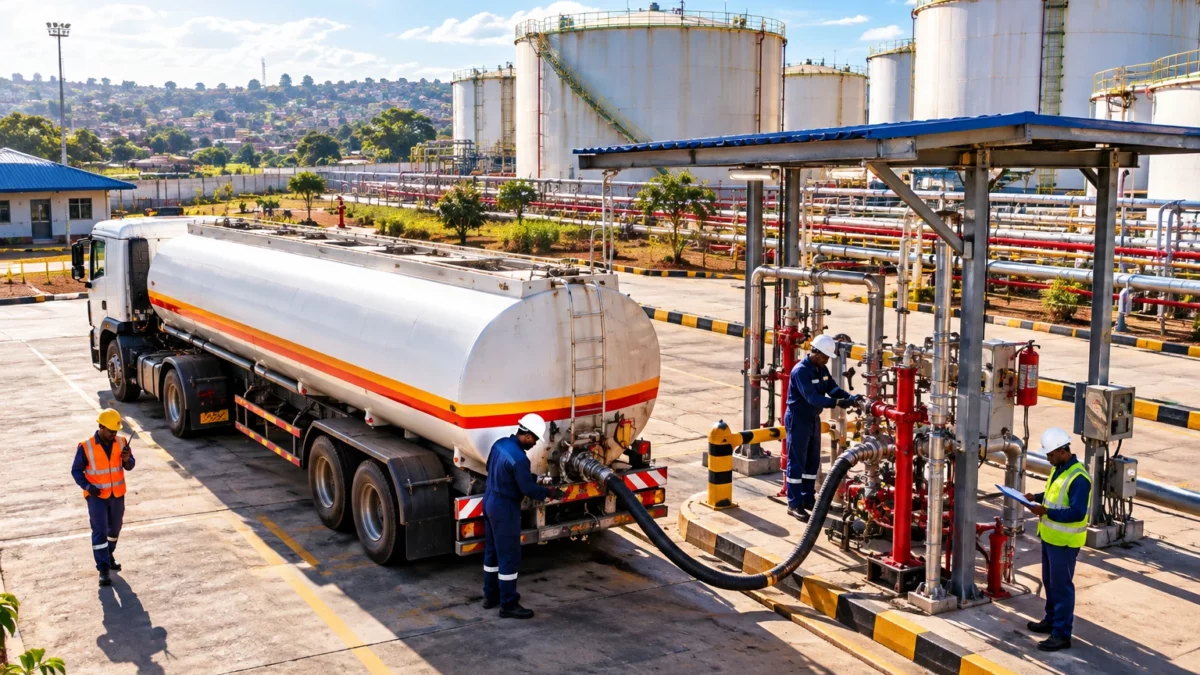
In Kampala, the challenge is no longer simply to produce oil. It is also to decide where to process it, who will finance the facilities and what share of the value will remain in the country. The approach to Nigerian group Dangote places these questions at the heart of Uganda’s industrial strategy.
A national project already under way, but still to be consolidated
Uganda is preparing a 60,000-barrel-a-day refinery at Kabaale, in Hoima district, near the Lake Albert oil fields. The project also includes a 211-kilometre refined-products pipeline to a storage terminal in Mpigi district. The national oil company UNOC presents it as a way to reduce dependence on imported fuels and support petrochemical activities.
This is not, however, a blank slate. Uganda’s Ministry of Energy says implementation agreements have been signed with Alpha MBM Investments, a United Arab Emirates company, for a refinery estimated to cost about $4bn. Dangote’s approach should therefore be understood as a partnership proposal to be considered, not as an announcement that the existing partner is being replaced. The terms of any potential involvement have not been made public.
This distinction matters for public finances as well as investors. A project of this scale requires responsibilities to be shared, financing secured and commercial outlets clarified. Estimates submitted to the Nigerian group still need to undergo technical review, according to accounts of the visit. No investment agreement has been announced.
What was proposed to Dangote
On 14 and 15 November, according to information published after the meeting, a Ugandan delegation led by Monica Musenero Masanza, the Minister of Energy and Mineral Development, and Amina Mukalazi, Minister of State for Privatisation and Investment, visited Dangote’s facilities in Lagos. Officials invited the group to play a role in the Hoima project. The delegation also presented opportunities in fertiliser blending, phosphate processing and salt production.
The government is promoting a local-processing rationale: turning crude oil and certain mineral resources into fuels, fertilisers and chemicals. For farmers, production of fertiliser closer to home could, if it becomes competitive and is well distributed, broaden regional supply. But an industrial site guarantees neither affordable prices nor a reliable supply. Transport networks, buyers and clear rules on access to inputs will also be needed.
The energy stakes are just as tangible. UNOC estimates Uganda’s imports of petroleum products at about $2bn a year. A refinery could cut part of that bill and limit exposure to disruptions in global markets. It would not automatically eliminate imports: the outcome will depend on refining costs, the price of crude, financing, demand and the ability of local products to compete with fuel delivered through existing trade routes.
East Africa’s energy map is being reshaped
Hoima is part of a regional landscape in which several infrastructure projects could complement one another, but also compete for the same capital and markets. In Tanzania, Uganda, the Tanzania Petroleum Development Corporation and Vitol Bahrain signed a memorandum in August 2026 to study an energy hub in Tanga. The project concerns storage and distribution, with infrastructure still to be specified. Ugandan authorities describe it as complementary to the inland refinery.
Ugandan crude oil is also due to reach the Tanzanian coast via the East African Crude Oil Pipeline, or EACOP: a cross-border pipeline intended to link the Lake Albert fields to the port of Tanga. The Hoima refinery, by contrast, would process crude inland. Their functions are therefore not identical. How they fit together will depend on schedules, available volumes and agreements enabling products to be transported and sold in neighbouring countries.
In Kenya, Dangote’s proposed 700,000-barrel-a-day refinery in Lamu reached a public milestone with a groundbreaking ceremony on 30 September 2026, according to the Associated Press. Its announced capacity is far greater than Hoima’s. This does not, however, prove that the project will be completed on schedule or that it will automatically supply neighbouring markets. Uganda’s President Yoweri Museveni has argued for the coexistence of several refineries in the name of co-operation and regional processing.
Value added will depend on implementation choices
For the Ugandan state, attracting an experienced industrial group could help mobilise expertise and financing. For communities near Hoima, the effects will also depend on accessible jobs, training and the management of impacts linked to facilities and pipelines. In towns, consumers will focus above all on fuel prices and availability. In rural areas, access to affordable fertiliser could matter more than production capacity alone.
One governance question remains: who will bear the risks if costs rise or anticipated demand fails to materialise? Contract documents, any guarantees and the allocation of revenues will be decisive. Dangote’s experience in Nigeria can inform discussions, but it is not enough to demonstrate the viability of a different project, in a landlocked country dependent on cross-border corridors.
Across East Africa, the issue is whether the countries of the East African Community (EAC) can co-ordinate their infrastructure and trade, rather than simply setting competing projects alongside one another. The next step to watch is the publication of verifiable details on technical studies, financing and Dangote’s potential role, without losing sight of the agreement already reached with Alpha MBM. For now, Kampala has opened an industrial discussion; investment decisions remain to be made.