Algeria
 Egypt
 Libya
 Morocco
 Sudan
 Tunisia
 Benin
 Burkina Faso
 Cabo Verde
 Côte d'Ivoire
 Ghana
 Guinea
 Guinea-Bissau
 Liberia
 Mali
 Mauritania
 Niger
 Nigeria
 Senegal
 Sierra Leone
 The Gambia
 Togo
 Cameroon
 Central African Republic
 Chad
 DR Congo
 Equatorial Guinea
 Gabon
 Republic of the Congo
 São Tomé and Príncipe
 Burundi
 Comoros
 Djibouti
 Eritrea
 Ethiopia
 Kenya
 Madagascar
 Malawi
 Mauritius
 Mozambique
 Rwanda
 Seychelles
 Somalia
 South Sudan
 Tanzania
 Angola
 Botswana
 Eswatini
 Lesotho
 Namibia
 South Africa
 Zambia
 Zimbabwe

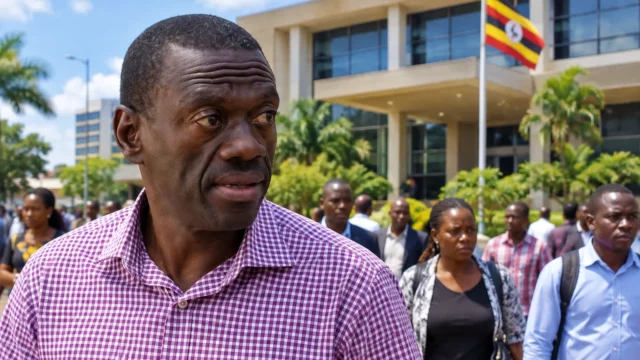
In Uganda, the question of what comes after Museveni is not being played out only at the ballot box. It also touches on the balance between the ruling party, the army and the presidential family. A closed-door meeting of the National Resistance Movement (NRM) brought the debate back to the fore, without any official decision on a successor being announced.
Succession discussed, but details disputed
The NRM’s central executive committee met on Tuesday 10 November 2026. Five people who took part in the meeting told Agence France-Presse that officials had discussed the possibility of General Muhoozi Kainerugaba succeeding his father. The general leads Uganda’s armed forces and has said he intends to stand in the presidential election scheduled for 2031.
According to these participants, several officials expressed reservations. One concern raised was the combination of a senior military role and presidential ambitions. David Calvin Echodu reportedly proposed that Muhoozi first leave the army and gain experience in a civilian role. This proposal, like the details of the discussions, is based on anonymous accounts: it has not been publicly confirmed by the party.
Participants also described a vote that began and was then interrupted. Four members reportedly voted in favour of the prospect of Muhoozi succeeding his father, against three opposed, before the process was halted. These figures come from the same group of sources cited by AFP. They do not constitute an official NRM result and do not establish the position of all 28 committee members.
NRM Secretary-General Richard Todwong rejected on 12 November the account that the leadership had ruled out the general. In a statement, he called it “completely false” and said the committee considers a range of political, social and economic issues. He added that the party’s decisions would be communicated through official channels. The denial does not, however, detail the meeting’s contents or separately confirm or refute the account of the interrupted vote.
Debate in a party that has governed since 1986
Yoweri Museveni has led Uganda since 1986. He won a seventh term following the presidential election on 15 January 2026, according to results declared by the Electoral Commission. It gave him 71.65% of the vote. The opposition challenged the election; the Supreme Court subsequently confirmed Museveni as president-elect after the election petition was withdrawn. This context explains why succession goes beyond an internal discussion: it concerns the continuity of power and national political competition.
The issue had already been discussed at a party meeting on 27 October, according to Stephen Bwire, an NRM official cited in press reports. Museveni reportedly set out the qualities expected of a future leader, including patriotism, pan-Africanism and integrity. Bwire believes his son meets these criteria, while acknowledging that reservations exist within the party. Here too, the content of this presentation has not been published as an official decision.
This potential succession brings together several issues. Muhoozi is both the president’s son and the head of the army. For some officials, the debate is therefore about his civilian experience and the separation of military and political power. For the NRM leadership, presenting a united position is also a matter of cohesion, as personal ambitions and differences between generations of officials may diverge.
Implications for institutions and the public
In Kampala, these discussions could affect the calculations of political leaders and national institutions. In the regions, their effects are less immediate, but the outcome of a transition could influence the representation of local interests and how decisions are made. The practical consequences will nevertheless depend on choices that remain unknown: the NRM has officially selected no candidate, and no succession timetable has been announced.
For Ugandans, the central question is not limited to the identity of the next leader. It also concerns the rules for selecting one, the role of civilians and the military, and the ability of institutions to organise a predictable transfer of power. A confidential meeting alone cannot gauge public opinion or the extent to which party members support the prospect of a Muhoozi presidency.
The debate is also of interest to the East African Community (EAC), a regional organisation bringing Uganda and several neighbouring countries together around economic and political cooperation. Kampala’s institutional choices matter in a region where relations between armies, dominant parties and the executive remain under close scrutiny. But there is no indication at this stage that the EAC is directly involved in the NRM discussion.
A story to follow, without a premature verdict
The information available establishes that there is a public controversy and an official denial. It does not make it possible to determine precisely what happened behind closed doors. The alleged vote details are based on anonymous witnesses; the party, for its part, denies that its leadership rejected Muhoozi, but has published no minutes of the meeting. Confirmed facts must therefore be distinguished from conflicting accounts.
The next step will be an official clarification from the NRM on its procedures and on the status of the general’s presidential ambitions. In the run-up to 2031, statements from the president, the executive committee and military officials will help clarify whether succession remains an exploratory debate or becomes a formalised political choice. For now, the party says no decision to reject him has been taken; the accounts reported, meanwhile, describe reservations and an interrupted vote.