Algeria
 Egypt
 Libya
 Morocco
 Sudan
 Tunisia
 Benin
 Burkina Faso
 Cabo Verde
 Côte d'Ivoire
 Ghana
 Guinea
 Guinea-Bissau
 Liberia
 Mali
 Mauritania
 Niger
 Nigeria
 Senegal
 Sierra Leone
 The Gambia
 Togo
 Cameroon
 Central African Republic
 Chad
 DR Congo
 Equatorial Guinea
 Gabon
 Republic of the Congo
 São Tomé and Príncipe
 Burundi
 Comoros
 Djibouti
 Eritrea
 Ethiopia
 Kenya
 Madagascar
 Malawi
 Mauritius
 Mozambique
 Rwanda
 Seychelles
 Somalia
 South Sudan
 Tanzania
 Angola
 Botswana
 Eswatini
 Lesotho
 Namibia
 South Africa
 Zambia
 Zimbabwe
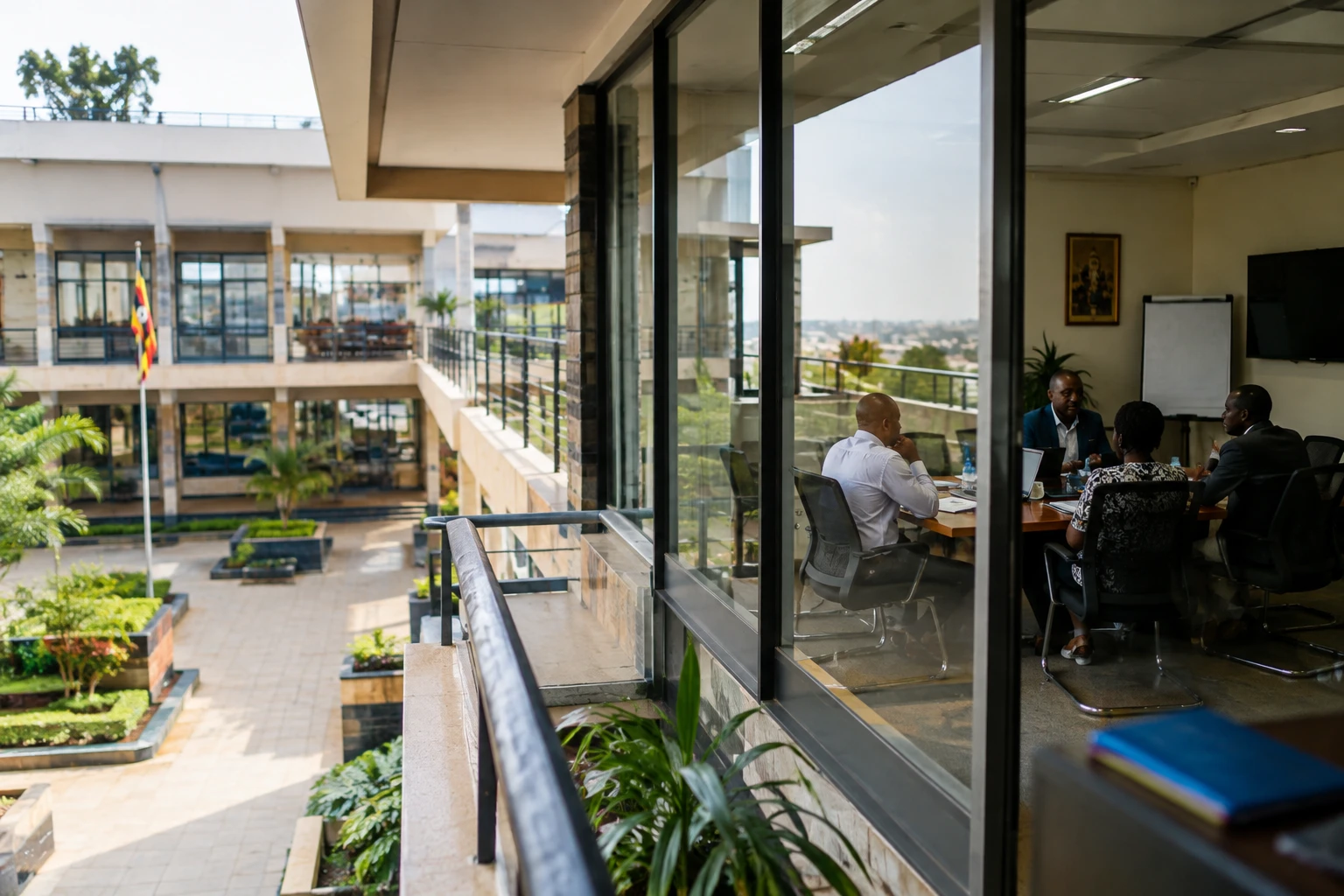
In Uganda, the question of succession is not simply a matter between a father and his son. It tests the ability of the National Resistance Movement (NRM), in power for decades, to manage the transition after Yoweri Museveni without publicly displaying its divisions.
The debate also concerns institutions and citizens. The role of an army chief in a possible succession, the rules of political competition and media freedom all weigh on confidence in public life, in Kampala and across the country’s other regions.
Disagreement comes to light at the top of the NRM
On Tuesday 10 November, the NRM’s executive committee met behind closed doors to discuss succession. According to five party members cited by AFP, a vote on Muhoozi Kainerugaba’s candidacy was halted after participants raised objections. At that point, four members had voted in favour and three against. This partial result does not, therefore, amount to a formal party decision.
The movement’s leadership has not publicly confirmed an official rejection. It is more accurate to describe the episode as an internal disagreement that emerged during the meeting. Ugandan reports have also described tensions around the discussion, while Nigerian media have repeated details of the vote attributed to sources present. The account of the meeting and information attributed to NRM members should therefore be read as testimony about a closed-door deliberation, not as an official statement.
The party’s vice-president, Calvin Echodu, is said to have advised Museveni to remove his son from the army and give him a civilian role. He reportedly also argued that the president should seek another term in 2031, on the grounds that Muhoozi was not yet ready. These remarks, also reported by participants, were not presented as a position formally adopted by the committee.
The weight of the army and the question of political experience
Muhoozi Kainerugaba, 52, leads Uganda’s armed forces. His father, Yoweri Museveni, has governed the country since 1986 and won the presidential election in January 2026, according to results published by the Electoral Commission. The poll opened a new five-year term, running until 2031. The Ugandan Electoral Commission’s report on the 2025-2026 elections provides the institutional framework for this deadline.
The NRM’s discussion is therefore focused on a specific political horizon: the end of the current term. But an announced or mooted candidacy is neither party endorsement nor election. The NRM has yet to determine its selection procedure, while national rules provide for a presidential contest between candidates. The reported proposal to give Muhoozi a civilian post reflects concern about the separation between military responsibilities and political ambitions.
This concern is not abstract. Muhoozi has sparked strong reactions with posts on the social media platform X, including threats against opposition leader Bobi Wine and Vice-President Jessica Alupo. The content and consequences of each statement must be attributed precisely. They nevertheless prompt questions about the restraint expected of a military chief and the place of political debate in a context where the opposition says it faces pressure.
The media climate adds another concern. In June 2026, Nation Media Group outlets were temporarily shut down by the army on orders attributed to Muhoozi. Reporters Without Borders documented the episode and called for editorial independence to be guaranteed. Reporters Without Borders’ account of the temporary media shutdown is a reminder that succession is also being debated in a public sphere where journalists and opposition figures must be able to work without intimidation.
A test of unity for the ruling party
The NRM remains the country’s leading political force. Opposition expressed by several members of its executive committee is therefore significant. It does not prove that the president has lost control of the movement. It does, however, show that choosing a successor may meet with reservations, including among officials expected to preserve party unity.
Interests differ. For Museveni, continuity in power and the stability of his camp are central. For NRM officials, the challenge is also to retain their influence after the president’s departure. For the armed forces, the question concerns their role in political life. For Ugandans, finally, it is about the choices on offer at the next presidential election, but also the possibility of challenging them at the ballot box, in the media and through institutions.
The controversy is therefore not limited to a son’s access to power. It concerns how succession rules are established and whether those rules are credible. The 10 November meeting produced no definitive answer. It brought divisions into the open, and the leadership will have to manage them if it is to prevent an internal battle from further undermining political confidence.
An issue followed across East Africa
Uganda is a member of the East African Community (EAC), a regional organisation bringing together several neighbouring countries for economic and political cooperation. Kampala’s choices therefore have regional significance, particularly when relations between civilian government, the army and institutions are at stake. This does not mean that the EAC’s members share identical political trajectories: each country has its own rules and balance of forces.
At continental level, the issue brings back to the fore a question monitored by the African Union: the regularity of political transitions and respect for constitutional processes. For now, no change of power has taken place. The next signs to watch will be an official clarification from the NRM, Muhoozi’s future political status and how the authorities handle criticism, the media and opposition figures as 2031 approaches.