Algeria
 Egypt
 Libya
 Morocco
 Sudan
 Tunisia
 Benin
 Burkina Faso
 Cabo Verde
 Côte d'Ivoire
 Ghana
 Guinea
 Guinea-Bissau
 Liberia
 Mali
 Mauritania
 Niger
 Nigeria
 Senegal
 Sierra Leone
 The Gambia
 Togo
 Cameroon
 Central African Republic
 Chad
 DR Congo
 Equatorial Guinea
 Gabon
 Republic of the Congo
 São Tomé and Príncipe
 Burundi
 Comoros
 Djibouti
 Eritrea
 Ethiopia
 Kenya
 Madagascar
 Malawi
 Mauritius
 Mozambique
 Rwanda
 Seychelles
 Somalia
 South Sudan
 Tanzania
 Angola
 Botswana
 Eswatini
 Lesotho
 Namibia
 South Africa
 Zambia
 Zimbabwe
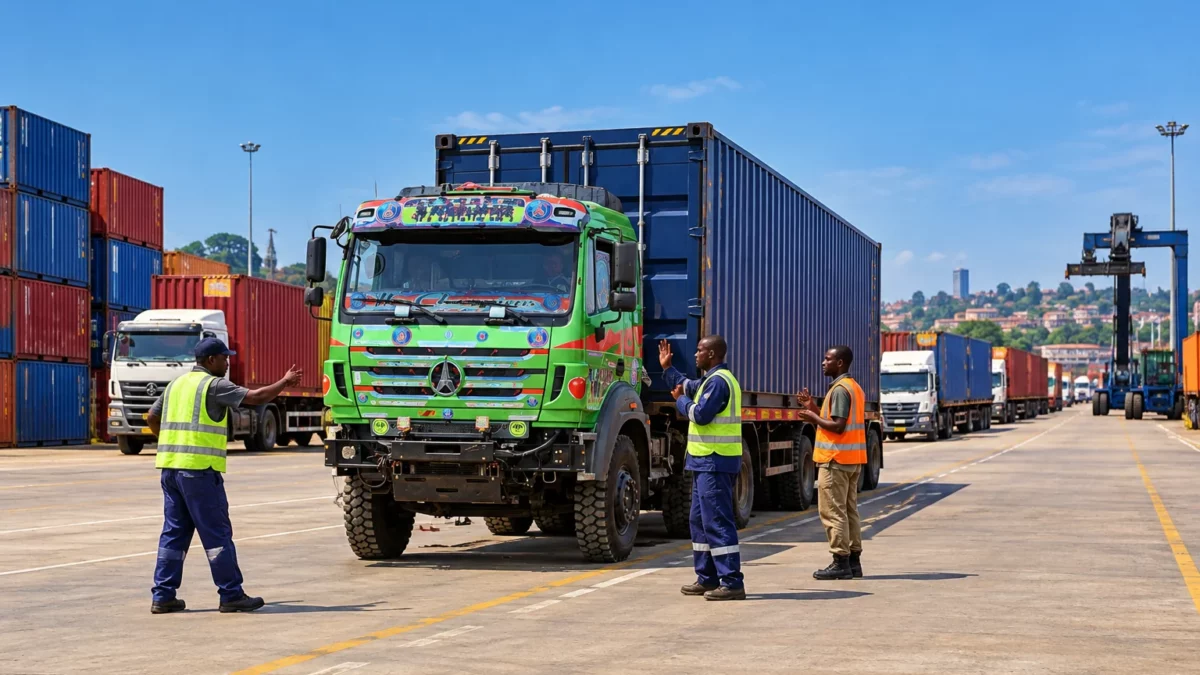
For a landlocked country, the cost of a journey to the port can weigh on the price of goods before they even reach the markets. In Uganda, the planned railway line between Kampala and the Kenyan border is being presented as a response to this challenge. But the project still depends on full funding and access to the land.
A Ugandan link in the East African corridor
The project involves a 272-kilometre standard-gauge line between Malaba, on the border with Kenya, and Kampala, Uganda’s capital. It is intended to connect to the Kenyan railway network and, through it, the port of Mombasa. For Ugandan importers and exporters, the aim is to provide a link to this maritime gateway that complements road transport.
This connection forms part of the ambitions of the East African Community (EAC), a regional organisation that includes Uganda and Kenya, among others. Its railway plan envisages cross-border links along the northern corridor, from Mombasa towards Malaba, with possible extensions to Juba and Kigali. The project’s scope therefore extends beyond domestic transport in Uganda alone, although these extensions depend on separate decisions and funding.
Kenya’s network has already reached Nairobi and Naivasha, but its extension to Malaba has been delayed. The planned connection between the two countries is thus intended to turn national sections into a continuous regional route. Coordinating schedules, standards and services will be as important as laying the tracks.
Full funding still to be secured
On 17 November 2026, State Minister for Works and Transport Fred Byamukama told Parliament that Uganda was targeting financial close in January 2027. This stage involves confirming and putting in place all the necessary funding. It would precede the issuance of a full notice to proceed to the Turkish company Yapı Merkezi, which has been contracted to carry out the works.
The project’s announced cost is 2.7 billion euros. The financing structure presented by the authorities envisages a majority of loans from export credit agencies, supplemented by development institutions and a public contribution. However, the breakdown has varied between announcements: in Parliament, the minister cited about 58% from the former, 25% from the latter and 17% from the state. This differs from the previously announced 60%, 25% and 15% structure.
The Islamic Development Bank approved financing of 650.75 million euros in June 2026. The OPEC Fund, for its part, is considering a potential loan of 150 million euros, which has yet to be approved. These commitments and potential sources of funding do not mean that the overall financing package has already been completed: lenders’ conditions and the remaining share still need to be consolidated. Uganda’s Ministry of Finance confirmed the Islamic Development Bank’s approval, while Parliament specified that the full works remain conditional on financial close.
An initial preparatory phase costing 75 million euros, funded by the state, was carried out by Yapı Merkezi. Completed in October 2026, it covered studies and geotechnical investigations, as well as the installation of equipment related to the project. It reduces some technical uncertainties, but does not constitute authorisation to begin the main construction work.
Land acquisition and compensation, another test for the timetable
The works depend on more than lenders. The government says it has acquired 2,108 of the 3,536 acres required for the railway corridor. In the area between Malaba and Mayuge, about 130 continuous kilometres are available and land acquisition is particularly advanced.
As of 17 November, 7,721 people affected by the project had received compensation, according to figures presented to Parliament. The government estimated the total number of people affected at 12,946. This left 5,225 beneficiaries to be paid, for an announced sum of 472.45 billion Ugandan shillings. The public broadcaster Uganda Broadcasting Corporation reported the same figures the following day. The gap between sections that have been cleared and those where payments are still under way could affect the sequence and pace of the works.
This issue has very concrete implications for the households concerned: progress on the corridor depends on compensation and land acquisition advancing in the areas required. For the state, it is also a matter of securing the route without conflating preparatory works with the full launch of the project.
Expected gains, yet to be measured
The authorities link the railway to lower logistics costs, faster freight transport and less pressure on roads. These are project objectives, not results already observed. Their scale will depend in particular on the continuity of the connection to Mombasa, train frequency, fares and the ability to ensure transfers between rail and road.
For agricultural exporters and businesses importing inputs, a reliable connection could make delivery times more predictable. Road hauliers, railway operators and communities along the route will also be affected by changes in traffic and economic activity. The benefits will therefore be neither automatic nor uniform across sectors or regions.
The contract provides for 48 months of work after the effective start date. If financial close takes place in January 2027 and the full notice to proceed follows quickly, commissioning before 2031 appears unlikely. This timetable remains conditional: any delay in funding, compensation or access to land could push it back.
Regional ambition meets the test of delivery
Uganda is also considering railway extensions to South Sudan, the Democratic Republic of the Congo and Rwanda. These projects remain at a preliminary stage and, as yet, have no completed funding arrangements. The immediate priority therefore remains the Kampala–Malaba link and its connection to the Kenyan network.
For the EAC, the challenge is to make national infrastructure function as a cross-border corridor. For Uganda, the first test will be its ability to secure the funds, complete compensation payments and launch the main works. The milestone announced for January 2027 will show whether this railway moves from preparation to large-scale construction.
Details from the Ugandan Parliament on the project and compensation and the announcement of Islamic Development Bank financing shed light on the two main conditions for the timetable: land and financial close.