Algeria
 Egypt
 Libya
 Morocco
 Sudan
 Tunisia
 Benin
 Burkina Faso
 Cabo Verde
 Côte d'Ivoire
 Ghana
 Guinea
 Guinea-Bissau
 Liberia
 Mali
 Mauritania
 Niger
 Nigeria
 Sierra Leone
 The Gambia
 Togo
 Cameroon
 Central African Republic
 Chad
 DR Congo
 Equatorial Guinea
 Gabon
 Republic of the Congo
 São Tomé and Príncipe
 Burundi
 Comoros
 Djibouti
 Eritrea
 Ethiopia
 Kenya
 Madagascar
 Malawi
 Mauritius
 Mozambique
 Rwanda
 Seychelles
 Somalia
 South Sudan
 Tanzania
 Uganda
 Angola
 Botswana
 Eswatini
 Lesotho
 Namibia
 South Africa
 Zambia
 Zimbabwe
A test of tolerance for Senegal’s public sphere
In Dakar, the debate is not only about three men facing an expedited trial. It touches on a broader question: how far does political criticism extend in Senegal, and when does public speech become an offence? In a country where social media have taken centre stage in discussion of current affairs, the judicial response to a TikTok video is being watched far beyond the capital.
The context is particularly sensitive. Since Bassirou Diomaye Diakhar Faye was elected president on 2 April 2024, and Ousmane Sonko was appointed prime minister the same day, Senegal has undergone a rapid reshaping of its political balance. But the momentum became more fraught in 2025 and 2026, with Sonko’s departure from government on 22 May 2026, followed by his return to the National Assembly and his appointment as head of the institution a few days later. These developments have fuelled competing interpretations within the majority camp itself.
What the three commentators are accused of
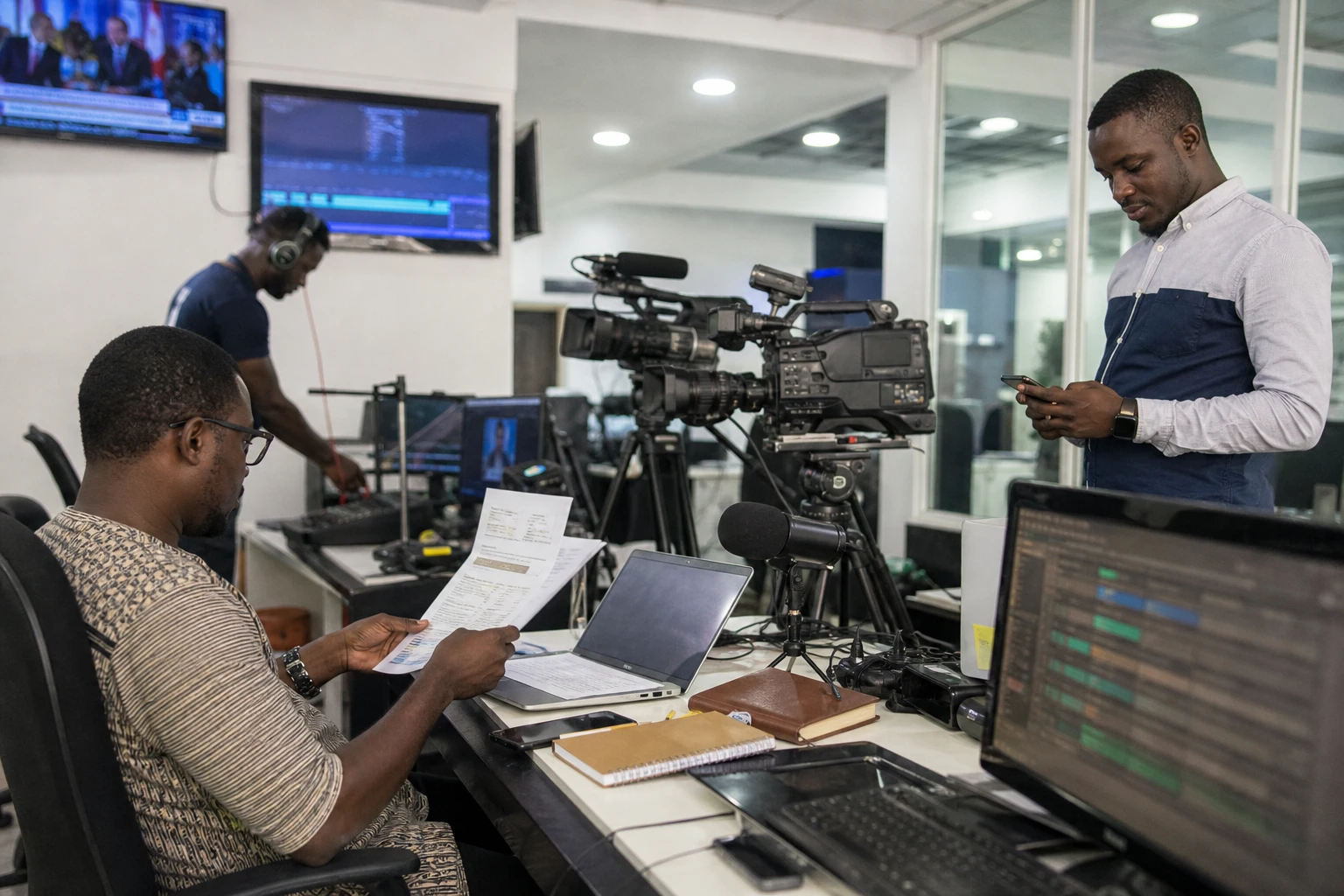
Lamignou Darou, Oustaz Thiep and Ndiaye Touba were arrested on 28 July 2026 in Dakar, at their newsroom, according to information corroborated by several Senegalese media outlets. They are being prosecuted for speech contrary to public morals and insulting the head of state, following a video posted on TikTok. In the clip, they wished misfortune and death on “the one who betrayed the Pastef project”, a phrase interpreted as referring to President Bassirou Diomaye Faye.
The case is proceeding under an expedited procedure, with the detainees brought before the courts as early as 5 August 2026. The pace of the proceedings has heightened attention around the case, particularly as the accused are described as close to Pastef, the party founded by Ousmane Sonko and now in power with a large parliamentary majority. The executive and the political majority thus find themselves in a paradoxical position: their own supporters are being caught up in the same laws that were long used against their opponents.
The defence disputes the charge of “insulting the head of state”. Its argument is a familiar one: in its view, the offence requires the president to be explicitly identified, whereas the video does not name anyone. It also maintains that the three men were not targeting the head of state, but were having a discussion among themselves. This defence rests on a strict interpretation of the law, in a country where Article 254 of the Criminal Code continues to spark heated debate.
Law, politics and the balancing act
In Senegal, Article 254 of the Criminal Code makes insulting the president a criminal offence, punishable by up to two years in prison and fines. Legal sources and explanations published by RTS point out that this provision is distinct from other offences often conflated with it in public debate, notably acts undermining state security. In other words, the issue is not only political; it is also technical, and it weighs on how judges classify remarks made online.
This matters because the repeated use of this offence has fuelled a broader debate on freedom of expression for several months. Amnesty International Senegal has called for Article 254 to be reformed in a recent case. Digital rights observers also point out that the provision has been used several times against activists, commentators and politicians. In Senegal’s media landscape, where the press and social media form a constant arena of controversy, the line between satire, harsh criticism and criminal insult remains fragile.
The defence is also trying to shift the case towards the power struggles within the governing camp. Since Ousmane Sonko’s dismissal as prime minister on 22 May 2026, and the institutional reshuffles that followed, several observers have noted tensions between Pastef’s political factions and the balance presented at the top of the state. Without presuming the intentions of the judicial authorities, the case comes at a moment when Senegal’s majority is still seeking a shared narrative, caught between party loyalty, the exercise of power and institutional discipline.
What the case says about Senegal and West Africa
For Senegalese people, the stakes are tangible. In urban centres, public debate now plays out on phones, in livestreams, podcasts and short videos. In the regions, information often passes through successive intermediaries, amplifying its reach. When a commentator is arrested over a viral clip, the message is not merely legal: it also affects commentators, influencers, activists and everyone who uses digital speech as an extension of national debate.
Regionally, Senegal remains a touchstone in West Africa. A member of ECOWAS, the country is watched for the strength of its institutions and for the way it arbitrates tensions between pluralism, public order and freedom to criticise. In a sub-region marked by military transitions, restrictions on freedoms and electoral timetables under pressure, every sensitive judicial decision in Dakar carries symbolic weight beyond the country’s borders. It also feeds into the continental debate on protecting institutions without criminalising opinion.
Recent convictions linked to remarks on social media show that the case of the three commentators will not be seen as an isolated episode. It is part of a period in which Senegal, while retaining a vibrant political life and a highly active press, is still seeking a balance between state authority and democratic openness. What happens next will depend as much on the court’s decision as on how the authorities interpret the place of criticism in the Republic in the months ahead.