Algeria
 Egypt
 Libya
 Sudan
 Tunisia
 Benin
 Burkina Faso
 Cabo Verde
 Côte d'Ivoire
 Ghana
 Guinea
 Guinea-Bissau
 Liberia
 Mali
 Mauritania
 Niger
 Nigeria
 Senegal
 Sierra Leone
 The Gambia
 Togo
 Cameroon
 Central African Republic
 Chad
 DR Congo
 Equatorial Guinea
 Gabon
 Republic of the Congo
 São Tomé and Príncipe
 Burundi
 Comoros
 Djibouti
 Eritrea
 Ethiopia
 Kenya
 Madagascar
 Malawi
 Mauritius
 Mozambique
 Rwanda
 Seychelles
 Somalia
 South Sudan
 Tanzania
 Uganda
 Angola
 Botswana
 Eswatini
 Lesotho
 Namibia
 South Africa
 Zambia
 Zimbabwe
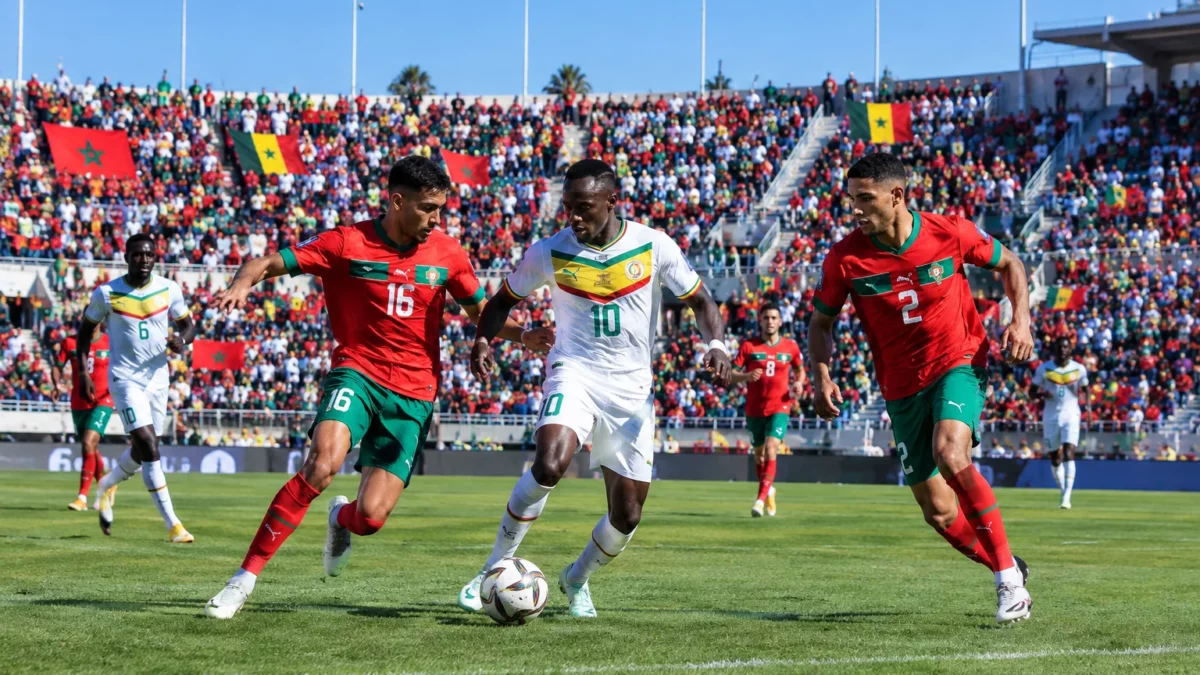
A title won on the pitch, then awarded by administrative decision, before being returned to its original winners: the 2025 AFCON final has seen several rulings in less than a year. Senegal has officially regained the crown, but Morocco is now challenging the procedure that led to the decision.
A final becomes an institutional dispute
The dispute extends beyond the two federations. It tests the ability of the Confederation of African Football (CAF), which organises continental competitions, to enforce its regulations while ensuring that decisions are consistent and credible.
The final was played on 18 January 2026 in Rabat, Morocco. Senegal won 1-0 after extra time in a match marked by the Senegalese players leaving the pitch in protest before returning. Two months later, the CAF appeals jury declared Senegal to have forfeited the match and recorded a 3-0 win for Morocco. The Senegalese Football Federation (FSF) then took the case to the Court of Arbitration for Sport (CAS) in Lausanne.
On 24 November, CAS upheld Senegal’s appeal. It annulled the CAF appeals jury’s decision and reinstated that of the confederation’s disciplinary jury. The result on the pitch, a 1-0 win for Senegal, is therefore confirmed. The decision was unanimous, according to the court’s statement.
Morocco raises a procedural complaint
The Royal Moroccan Football Federation (FRMF) said it was challenging the award and intended to pursue the legal avenues available. It referred in particular to an alleged telephone contact between Ulrich Haas, one of the CAS arbitrators, and Abdoulaye Fall, president of the FSF, about 48 hours before the verdict.
This remains an allegation made by the Moroccan side and is not, in itself, proof of an irregularity. CAS and the Senegalese federation have denied that such an exchange took place. At this stage, publicly available information does not allow the circumstances of the alleged contact to be independently established. It is therefore important to distinguish clearly between the complaint made by Rabat and facts confirmed by the bodies concerned.
The appeal mentioned by the FRMF could be brought before the Swiss Federal Supreme Court. This court does not rehear the sporting dispute or freely reconsider the interpretation of the facts. Its review is limited to specific legal grounds, including certain procedural flaws or breaches of the fundamental guarantees of arbitration. A move before this court would not therefore automatically suspend the sporting effect of the CAS ruling.
Successive decisions with tangible consequences
For Senegalese people, the award ends a period of uncertainty over the status of the title. The trophy had remained in Senegal during the proceedings, although the CAF decision had officially awarded victory to Morocco. For Moroccan supporters, the reversal overturns the decision made in March and fuels a challenge whose arguments will need to be examined within the prescribed legal framework.
These episodes also show why the distinction between the pitch and disciplinary bodies matters. The CAF appeals jury had found that Senegal’s conduct warranted a forfeit under the competition regulations. CAS annulled that decision and reinstated the original result. The award thus closes the sporting question at arbitration level, without preventing a challenge on grounds admissible before the Swiss courts.
The sequence affects the credibility of the CAF as much as that of the federations. A disciplinary decision made after a final can change the identity of the champion, with consequences for players, supporters and the competition’s history. Clear rules, consistent application and transparent procedures are therefore essential, especially when successive decisions appear to contradict one another.
A matter for West African football
The case directly concerns Senegal, whose capital is Dakar, and Morocco, but it resonates throughout the Confederation of African Football. In West Africa, ECOWAS — the regional political and economic cooperation organisation — is not the body with jurisdiction to rule on this sporting dispute. It falls under CAF regulations and international sports arbitration mechanisms.
The next point to watch is the nature of any application to the Swiss Federal Supreme Court and the precise grounds that might be put forward. The court cannot simply replace CAS’s sporting analysis with a fresh assessment of the match. In the meantime, the 24 November award confirms Senegal as 2025 AFCON winners, while the FRMF says it intends to continue its challenge through the avenues it believes remain open.
The Court of Arbitration for Sport’s decision on the 2025 AFCON final confirms the match’s sporting outcome. The CAF had previously published its appeals jury’s decision to award Senegal a forfeit. Moroccan and Senegalese media have also reported the federations’ responses to the alleged contact complaint.