
 Algeria
 Egypt
 Libya
 Sudan
 Tunisia
 Benin
 Burkina Faso
 Cabo Verde
 Côte d'Ivoire
 Ghana
 Guinea
 Guinea-Bissau
 Liberia
 Mali
 Mauritania
 Niger
 Nigeria
 Senegal
 Sierra Leone
 The Gambia
 Togo
 Cameroon
 Central African Republic
 Chad
 DR Congo
 Equatorial Guinea
 Gabon
 Republic of the Congo
 São Tomé and Príncipe
 Burundi
 Comoros
 Djibouti
 Eritrea
 Ethiopia
 Kenya
 Madagascar
 Malawi
 Mauritius
 Mozambique
 Rwanda
 Seychelles
 Somalia
 South Sudan
 Tanzania
 Uganda
 Angola
 Botswana
 Eswatini
 Lesotho
 Namibia
 South Africa
 Zambia
 Zimbabwe
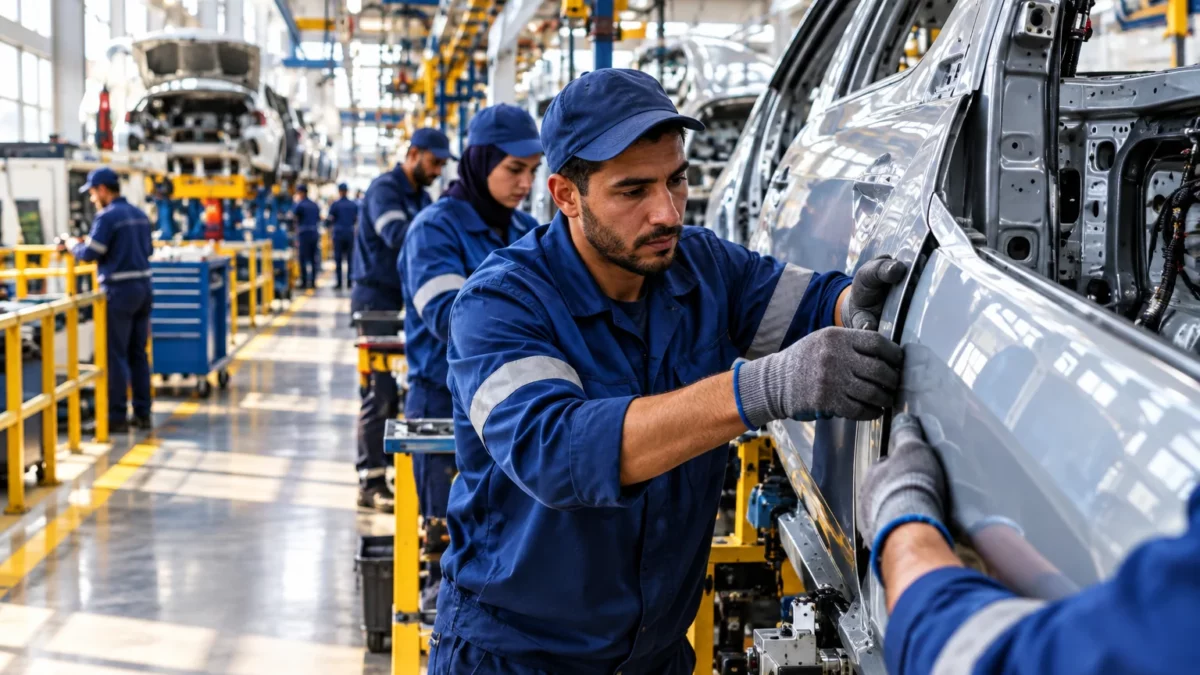
In Kénitra, the battery project is no longer limited to a Moroccan plant. Production of materials for cathodes is also intended to supply two European sites. This arrangement places Morocco at the heart of an industrial chain spread across three countries, but regulatory approval is still pending.
An industrial chain linking Morocco and Europe
Morocco has for several years sought to strengthen its automotive industry, which is already geared towards exports. Kénitra is home to car manufacturing and subcontracting activities, among others. Gotion’s project is part of this trajectory: producing battery components locally, rather than limiting the investment to vehicle assembly.
At regional level, the case concerns North Africa and industrial relations between Morocco and the European Union. The kingdom is not part of the Arab Maghreb Union, whose economic integration remains limited, but it has close trade ties with Europe. In the battery sector, the proximity of European markets and Morocco’s trade agreements strengthen the case for production based in Kénitra.
Lithium iron phosphate, or LFP, is a battery technology that does not use nickel or cobalt in its cathode. Active cathode materials are one of the components needed to manufacture cells, which store electricity in the battery.
Partnership notified, but not yet approved
On 12 November 2026, Morocco’s Competition Council published notice of a proposed concentration between German group Volkswagen and Chinese manufacturer Gotion High-Tech. The procedure allows third parties to submit their observations until 23 November. As of that date, the transaction has not yet been approved.
The arrangement provides for Gotion Power Africa, Gotion’s Moroccan subsidiary, to first establish the joint venture and hold all of its capital. Power Holdco Lux, indirectly controlled by Volkswagen, would then subscribe for new shares representing 49%. Gotion would retain 51%. Despite this majority stake, the notification states that the two groups would exercise indirect joint control.
This Moroccan structure is linked to two other planned joint ventures in Valencia, Spain, and Šurany, Slovakia. The three entities are to be established together: the creation of each depends on that of the other two. In Kénitra, the joint venture would produce LFP active cathode materials. Some of these would be destined for the European sites, which will manufacture battery cells.
Capacities announced by Volkswagen in an investor presentation on 29 October are 100,000 tonnes of cathode materials a year in Kénitra, 30 gigawatt-hours of cells in Valencia and 10 gigawatt-hours in Šurany. A gigawatt-hour measures an amount of energy; here, it is used to describe the plants’ annual production capacity.
A Moroccan project whose scope remains to be clarified
The new joint venture should be distinguished from the gigafactory project that Gotion is already developing in Kénitra under the name Gotion Power Morocco. According to documents published by the African Development Bank, the first phase of this development is designed to produce 20 gigawatt-hours of LFP batteries and 100,000 tonnes of cathode materials annually.
The comparison between these figures and those announced for the joint venture raises a practical question: how will the two structures fit together at the site, particularly in terms of equipment, volumes and supply? The Competition Council’s notification describes the new company and its links with the European plants, but does not fully clarify its scope in relation to the project already being undertaken by Gotion Power Morocco.
The African Development Bank has also announced financing of €100 million for the Gotion Power Morocco project. This support concerns the integrated gigafactory and should not be confused with the amount Volkswagen has announced for taking stakes in the joint ventures in Kénitra and Šurany.
Volkswagen plans to contribute around €470 million by 2030 to acquire 49% stakes in the Moroccan and Slovak entities. The sum therefore covers two sites. Gotion, for its part, plans to invest around €1.1 billion to obtain 49% of the Valencia joint venture. These amounts set out a partnership in which the two groups share their investments and positions across several links in the chain.
Impact to be assessed beyond announced capacity
For the Moroccan authorities, the challenge is to turn investment into sustainable industrial activity: jobs, technical skills, local suppliers and transfers of know-how. The announced volumes indicate the scale of the ambition, but on their own do not reveal the commissioning timetable or the share of procurement that would benefit Moroccan companies.
The effects will not necessarily be the same for all stakeholders and regions. Kénitra could host production activities and the associated jobs, while European manufacturers would be the first beneficiaries of a supply of cathode materials. For small local businesses, the impact will depend in particular on their ability to meet the automotive sector’s requirements for quality, price and reliability.
At continental level, the case illustrates an ambition that remains uncommon: establishing in Africa an industrial stage upstream of vehicle manufacturing. It also highlights that the value created will depend on the degree of local integration, not just on where plants are located. The next immediate milestone is the Competition Council’s review of the transaction after the consultation period ends on 23 November.
The partnership’s practical reach will then depend on approval of all three joint ventures, clarification of how facilities in Kénitra will be shared, and the transition from planned capacity to actual production. For Morocco, the challenge is to consolidate its place in this chain without remaining confined to supplying components for European sites.



