
 Egypt
 Libya
 Morocco
 Sudan
 Tunisia
 Benin
 Burkina Faso
 Cabo Verde
 Côte d'Ivoire
 Ghana
 Guinea
 Guinea-Bissau
 Liberia
 Mali
 Mauritania
 Niger
 Nigeria
 Senegal
 Sierra Leone
 The Gambia
 Togo
 Cameroon
 Central African Republic
 Chad
 DR Congo
 Equatorial Guinea
 Gabon
 Republic of the Congo
 São Tomé and Príncipe
 Burundi
 Comoros
 Djibouti
 Eritrea
 Ethiopia
 Kenya
 Madagascar
 Malawi
 Mauritius
 Mozambique
 Rwanda
 Seychelles
 Somalia
 South Sudan
 Tanzania
 Uganda
 Angola
 Botswana
 Eswatini
 Lesotho
 Namibia
 South Africa
 Zambia
 Zimbabwe
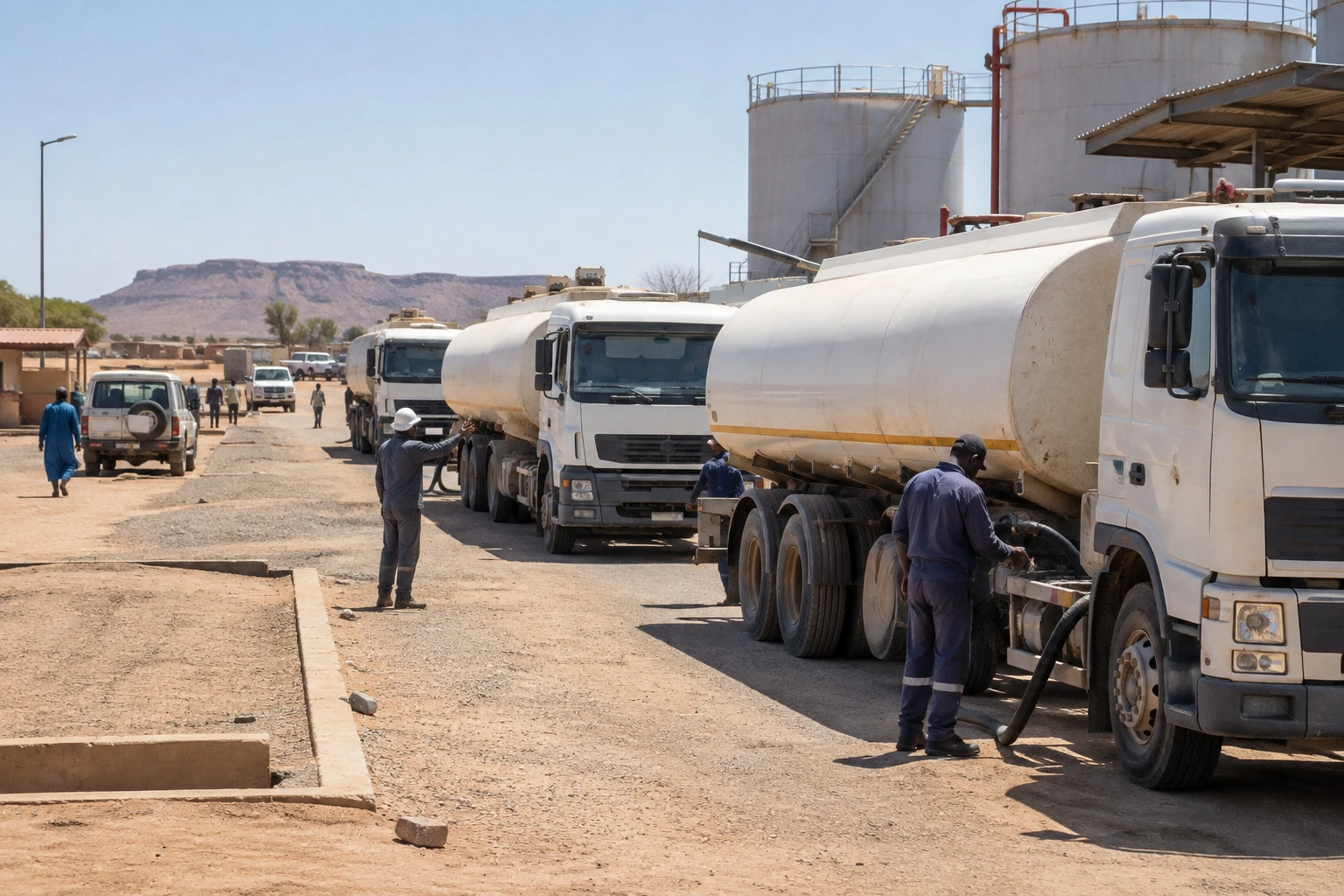
A shipment from Algeria can ease pressure on service stations in northern Niger. But on its own, it does not resolve the question facing households, transport operators and businesses: how can a petroleum-producing country ensure a reliable long-term fuel supply when refining and distribution do not meet all needs, or do not meet them everywhere at the same time?
Shortages reach Niamey
In October, supply difficulties already reported in several cities spread to Niamey. Queues formed outside some service stations. On 23 October, the Nigerien News Agency reported an improvement in the situation in the capital after several days of shortages. This respite did not mean that pressure had eased across the rest of the country. The ANP report on fuel supplies in Niamey and a report by the Ivorian News Agency, based on on-the-ground observations, describe this gradual improvement.
To contain the pressure, the authorities banned exports of premium petrol and diesel, except where surplus supplies are authorised, under official provisions published by the Ministry of Trade and Industry. A statement issued on 19 October also restricted service station opening hours and provided for designated on-duty outlets. Sales outside service stations were banned in localities with at least one service station. These measures are intended to reserve more products for the domestic market, but they also make it harder to access fuel outside opening hours, particularly for workers and activities that depend on travel. The ministry’s statement on opening hours and distribution sets out these rules.
The Agadez convoy and its figures
On Sunday 1 November 2026, a convoy from Algeria was received in Agadez. The Nigerien News Agency reported that 53 tankers were carrying 1.65 million litres, ordered by the Nigerien Petroleum Products Company (SONIDEP), which is responsible for domestic marketing. Algeria’s APS news agency, meanwhile, reported around 50 trucks and a total of 1,600 tonnes of petrol from the Sbaa refinery in the Adrar region. Both accounts agree that a substantial shipment has arrived, but they give different quantities and descriptions of the products. The figures should therefore be kept distinct rather than combined. APS confirms the delivery from Adrar; Aïr Info reports the convoy’s arrival in Agadez.
According to the ANP, SONIDEP made the purchase as part of co-operation between Niamey and Algiers, at a preferential price whose amount has not been made public. The delivery could bolster stocks in the north and ease local constraints. Without further data on volumes distributed and stocks available, however, its impact on the national situation or pump prices cannot be measured.
Producing oil is not enough
The gap between oil resources and fuel availability reflects an entire supply chain: extraction, refining, transport, storage and distribution. A weakness at any one of these stages can cause shortages, even when a country produces crude. The Zinder Refinery Company (SORAZ) remains a central link, but its installed capacity does not translate into guaranteed production every day of the year.
On 5 October, Oil Minister Hamadou Tini presented figures to the Consultative Council for the Refoundation showing discrepancies between SORAZ deliveries to SONIDEP and the volumes dispatched by the latter. For the first eight months of 2026, the reported gap amounted to 196.62 million litres of premium petrol and 52.60 million litres of diesel. The minister cautioned, however, that these discrepancies alone did not prove the existence of fraud or clandestine exports. He called for them to be examined alongside data on production, stocks, imports, consumption and cross-border movements. The ANP details the figures presented by the minister.
This caution matters: an accounting discrepancy signals a need for explanation, but does not necessarily identify its cause. For the authorities, the challenge is to reconcile the flows and allocate volumes. For consumers, the outcome is more directly measured by availability at service stations, waiting times and the reliability of travel. Restrictions may help distribute stocks, but they cannot replace reliable logistics or transparent monitoring of quantities.
An energy partnership to watch
The delivery is part of a developing energy relationship between Niger and Algeria. In August 2026, Sonatrach announced the first deliveries of Jet A1, the fuel used by aircraft, to SONIDEP under a contract between the two state-owned companies. The use of imports for several products shows that the issue goes beyond petrol sold to motorists: it also concerns aviation and the economic activities that depend on it. Sonatrach announced the start of Jet A1 deliveries to Niger.
The regional context also matters. Niger’s withdrawal from ECOWAS, effective since 29 January 2025, has reshaped its institutional relations in West Africa, while trade and commercial routes remain essential to its economy. This delivery illustrates an alternative supply route oriented towards Algeria, but does not in itself demonstrate that existing channels are being replaced. ECOWAS confirmed the effective date of the withdrawal of Niger, Mali and Burkina Faso.
The next milestone, then, will be not simply the arrival of more trucks, but the ability to make supply flows predictable: publishing comparable data, monitoring stocks and ensuring that restrictions do not merely shift shortages from one city to another. For Nigeriens, the immediate issue is regular access to fuel. For Niamey and its regional partners, it is also about consolidating commercial supplies that can be sustained over time.



