Algeria
 Egypt
 Libya
 Morocco
 Sudan
 Tunisia
 Benin
 Burkina Faso
 Cabo Verde
 Côte d'Ivoire
 Ghana
 Guinea
 Guinea-Bissau
 Liberia
 Mali
 Mauritania
 Niger
 Nigeria
 Sierra Leone
 The Gambia
 Togo
 Cameroon
 Central African Republic
 Chad
 DR Congo
 Equatorial Guinea
 Gabon
 Republic of the Congo
 São Tomé and Príncipe
 Burundi
 Comoros
 Djibouti
 Eritrea
 Ethiopia
 Kenya
 Madagascar
 Malawi
 Mauritius
 Mozambique
 Rwanda
 Seychelles
 Somalia
 South Sudan
 Tanzania
 Uganda
 Angola
 Botswana
 Eswatini
 Lesotho
 Namibia
 South Africa
 Zambia
 Zimbabwe
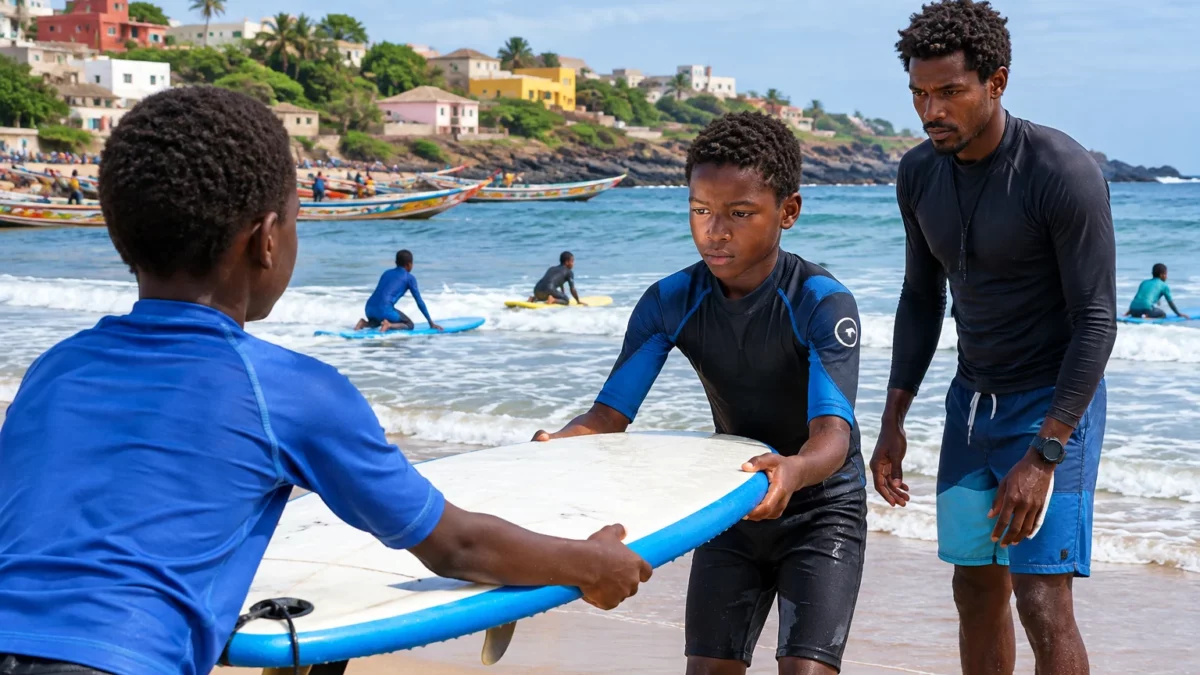
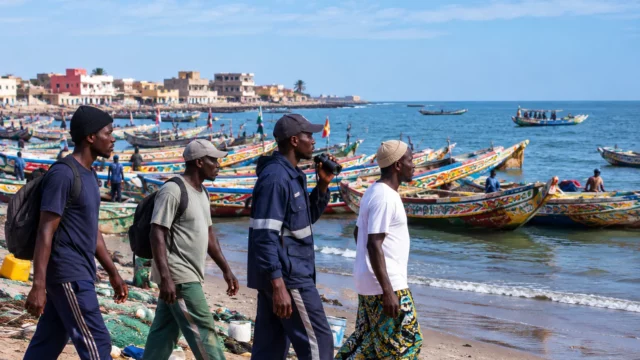
In Ngor, a coastal district of Dakar, access to surfing depends on more than the waves. Children who want to learn also need to find a board, suitable clothing and time with an instructor. A local school is trying to reduce these barriers, but teaching alone is not yet enough to open a path to the elite level.
Learning with whatever is available in Ngor
Ibra Samb has known these obstacles since childhood. Before becoming a professional surfer and instructor, he would watch surfers on the beach. Unable to afford a board, he and his friends practised on pieces of wood salvaged from near the fishing pirogues.
Today, Samb and his friend and colleague Chérif Fall have founded the Anda school. Alongside paid lessons, they organise free weekly sessions for children in Ngor, with the help of volunteers. The young people, both girls and boys, learn the basic movements on the sand before going into the water. Groups include children aged 7 to 14, according to several reports published in November 2026 by Africanews and Sport News Africa.
Among the pupils is Katy Samb, 13, the instructor’s niece. She hopes to become a professional surfer. “I feel free,” she says in an account reported by these media outlets. Her experience is a reminder that learning to surf can also build confidence and visibility for girls, in a sport long associated in Senegal with visitors and people able to pay for equipment and training.
Few boards, costly progress
The free school meets demand that exceeds its resources. There are not always enough boards for all the children. They sometimes have to share them. Wetsuits and suitable clothing are also in short supply, while volunteers cannot supervise an unlimited number of beginners. These difficulties have been reported by Senegalese and regional media, as well as by the Associated Press, which followed a session in Ngor in September 2026.
The costs do not end with learning. For young people aiming to compete, travel abroad and visa procedures make it harder to access international circuits. Sporting progress therefore also depends on financial resources, sustained coaching and the ability to take part in events regularly.
Senegalese surfing is not starting from scratch. Dakar’s coastline has been home to schools, camps and surfing communities for years. Ngor has been known to international surfers since the documentary “The Endless Summer” was filmed there in the 1960s. But a renowned destination does not automatically make a sport accessible to local people. The question is who has access to boards, lessons and the means to travel.
Youth Games bring visibility, but not yet medals
In November 2026, the Youth Olympic Games held in Senegal put Dakar at the centre of international sporting attention. Surfing featured among the demonstration and engagement sports, without medal events. The distinction matters: demonstrations can raise awareness of the sport, but they do not guarantee regular funding or competition pathways for young Senegalese.
Oumar Sèye, president of the Senegalese Surfing Federation, nevertheless said that demonstrations by African surfers had attracted fresh attention. According to the Associated Press, 25 African surfers took part in the presentations. This visibility could help clubs attract partners and gain recognition for local talent. But it remains an opportunity, not a permanent support mechanism.
Senegalese sports authorities, for their part, point out that surfing remains poorly organised and is still associated with tourists and affluent groups. The challenge is therefore also institutional: the federation, clubs, local authorities and the ministry responsible for sport must work out how to support a sport that does not yet have resources comparable to those of more established disciplines.
Protecting the coastline beyond competition
The development of surfing also depends on the condition of the ocean. In its report, the Associated Press cites a warning from Babacar Thiaw, founder of Surfrider Sénégal, about pollution from wastewater and plastic waste. Deteriorating water quality threatens the health of young surfers and undermines the appeal of the beaches. In Ngor, the coastline is a sporting space, a place to live and an economic resource.
This reality is a reason not to reduce the development of surfing to buying equipment alone. Access to boards and regular lessons can open up the sport, but safety, water quality and the upkeep of surf spots also matter. Needs vary among stakeholders: children need regular access, clubs need equipment and instructors, while athletes aiming for international competition have to fund travel and events.
Across West Africa, Ngor’s experience raises a broader question: how can coastal communities benefit from sports that also attract visitors and investment? The point is not to present Senegal as a homogeneous whole, or to equate its waves with an achievement already secured. It is to turn occasional visibility into tangible opportunities, particularly for girls and young people from coastal neighbourhoods.
For the Anda school, the next challenge is sustainability: securing more equipment, maintaining free sessions and supporting young people beyond their first waves. The prospect of access to the professional circuit remains distant. But in Ngor, children learning today no longer have to improvise a board from wood to get into the water.