Egypt
 Libya
 Morocco
 Sudan
 Tunisia
 Benin
 Burkina Faso
 Cabo Verde
 Côte d'Ivoire
 Ghana
 Guinea
 Guinea-Bissau
 Liberia
 Mali
 Mauritania
 Niger
 Nigeria
 Senegal
 Sierra Leone
 The Gambia
 Togo
 Cameroon
 Central African Republic
 Chad
 DR Congo
 Equatorial Guinea
 Gabon
 Republic of the Congo
 São Tomé and Príncipe
 Burundi
 Comoros
 Djibouti
 Eritrea
 Ethiopia
 Kenya
 Madagascar
 Malawi
 Mauritius
 Mozambique
 Rwanda
 Seychelles
 Somalia
 South Sudan
 Tanzania
 Uganda
 Angola
 Botswana
 Eswatini
 Lesotho
 Namibia
 South Africa
 Zambia
 Zimbabwe
A Saharan neighbourhood with stakes far beyond declarations
Between Bamako and Algiers, geography imposes its own rules. A border of more than 1,300 kilometres cannot be managed through statements or symbolism, but through practical choices: security, the movement of goods, energy, intelligence and political trust.
For Mali, this relationship matters at a time when the Transition is seeking to untangle several knots at once: stabilise the north, secure routes, contain pressure on supplies and preserve diplomatic room for manoeuvre in a Sahel undergoing change. For Algeria, it concerns a Saharan-Sahelian zone that it has long regarded as a direct security area, not a distant periphery.
Dialogue resumes after a brief but serious rupture
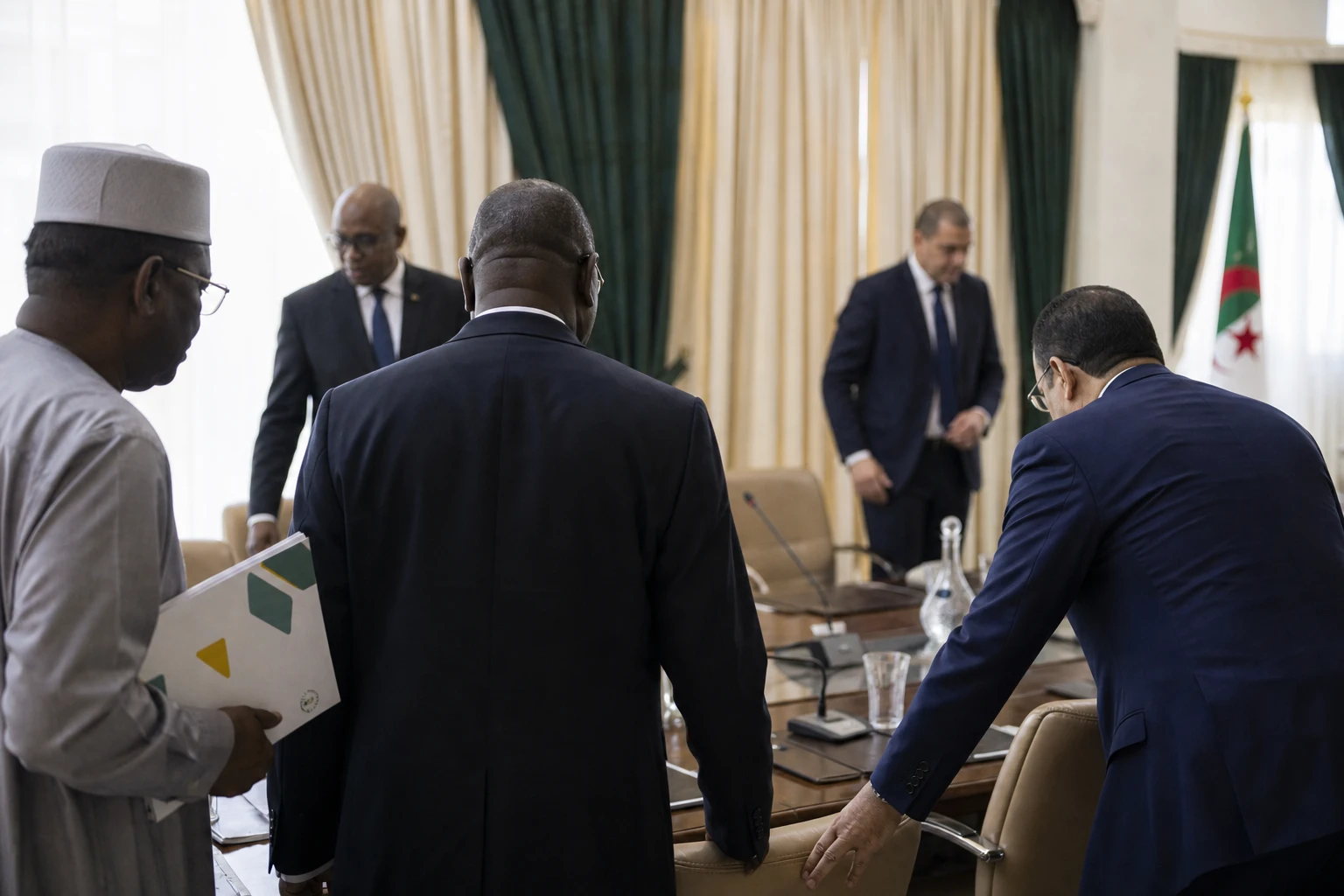
The announced visit to Algiers by Mali’s Prime Minister, Major General Abdoulaye Maïga, on Monday 24 August 2026, comes amid a rapid thaw between the two capitals. The head of the Malian government is due to be received by his Algerian counterpart, Sifi Ghrieb, and to deliver a message from the president of the Transition, Army General Assimi Goïta, to Abdelmadjid Tebboune.
The visit comes a few weeks after the return of the ambassadors. Algiers first ordered its ambassador to Bamako back on 10 July 2026. On the same day, the Malian government announced the return of its representative to Algiers and the reopening of its airspace to civilian and military aircraft travelling to or from Algeria. On 9 August 2026, a telephone conversation between Sifi Ghrieb and Abdoulaye Maïga paved the way for the official invitation subsequently sent to Bamako.
This normalisation follows a crisis that erupted in spring 2025, after a Malian military drone was destroyed during the night of 31 March to 1 April. The two countries had then recalled their ambassadors and restricted air links. The episode lasted more than a year and weakened a relationship long presented as strategic.
Security, borders and the economy: the three issues back on the table
The first issue is security. Northern Mali and southern Algeria meet in a Saharan area crossed by trafficking, smuggling and armed groups. In this corridor, coordination between military command centres remains a key instrument. The Joint Operational Military Staff Committee in Tamanrasset, established to address cross-border threats, had lost momentum during the crisis. Its renewed activity would once again serve as a useful indicator of a bilateral thaw.
The second issue is economic. Mali continues to face recurring strains on energy and supplies. In this context, Algeria could once again become a fuel supplier and a more reliable transit partner for the north of the country. In large cities, the impact is felt first at petrol stations, in transport and in the cost of goods. In inland regions, it is quickly reflected in the cost per kilometre and the price of a sack of rice or cement.
The third issue is diplomatic. Bamako is seeking to show that it can diversify its support without abandoning its red lines on sovereignty. Algeria, for its part, has reaffirmed its commitment to Mali’s territorial integrity. This position remains important to the Malian authorities because it concerns the north, national cohesion and how to address local crises without excessive internationalisation.
A useful neighbourhood for the Sahel, not just the two capitals
The resumption of dialogue between Malians and Algerians goes beyond the bilateral relationship. It also concerns the Confederation of Sahel States, which Bamako joined with Burkina Faso and Niger to build a new framework for political and security cooperation. At the same time, Algeria continues to act as a bridge to Sahelian countries, even when regional balances are under strain.
The timing therefore matters. If Abdoulaye Maïga’s visit confirms the signals sent since 10 July, it could reopen practical channels: security meetings, border coordination, logistical facilitation and discussions on trade flows. But it will not resolve everything. The disagreements that have emerged since 2025 will not disappear in a single, however cordial, meeting.
The continental significance is clear. In the central Sahel, every bilateral rapprochement can ease a local tension or, conversely, create a new axis of alignment. The Mali-Algeria relationship will therefore also say something broader about the role now played by Sahelian capitals in an African architecture where former regional mediation efforts, new confederations and security interests overlap. The real test will come after Algiers, in the two countries’ ability to turn renewed contact into lasting mechanisms.