Egypt
 Libya
 Morocco
 Sudan
 Tunisia
 Benin
 Burkina Faso
 Cabo Verde
 Côte d'Ivoire
 Ghana
 Guinea
 Guinea-Bissau
 Liberia
 Mali
 Mauritania
 Niger
 Nigeria
 Senegal
 Sierra Leone
 The Gambia
 Togo
 Cameroon
 Central African Republic
 Chad
 DR Congo
 Equatorial Guinea
 Gabon
 Republic of the Congo
 São Tomé and Príncipe
 Burundi
 Comoros
 Djibouti
 Eritrea
 Ethiopia
 Kenya
 Madagascar
 Malawi
 Mauritius
 Mozambique
 Rwanda
 Seychelles
 Somalia
 South Sudan
 Tanzania
 Uganda
 Angola
 Botswana
 Eswatini
 Lesotho
 Namibia
 South Africa
 Zambia
 Zimbabwe
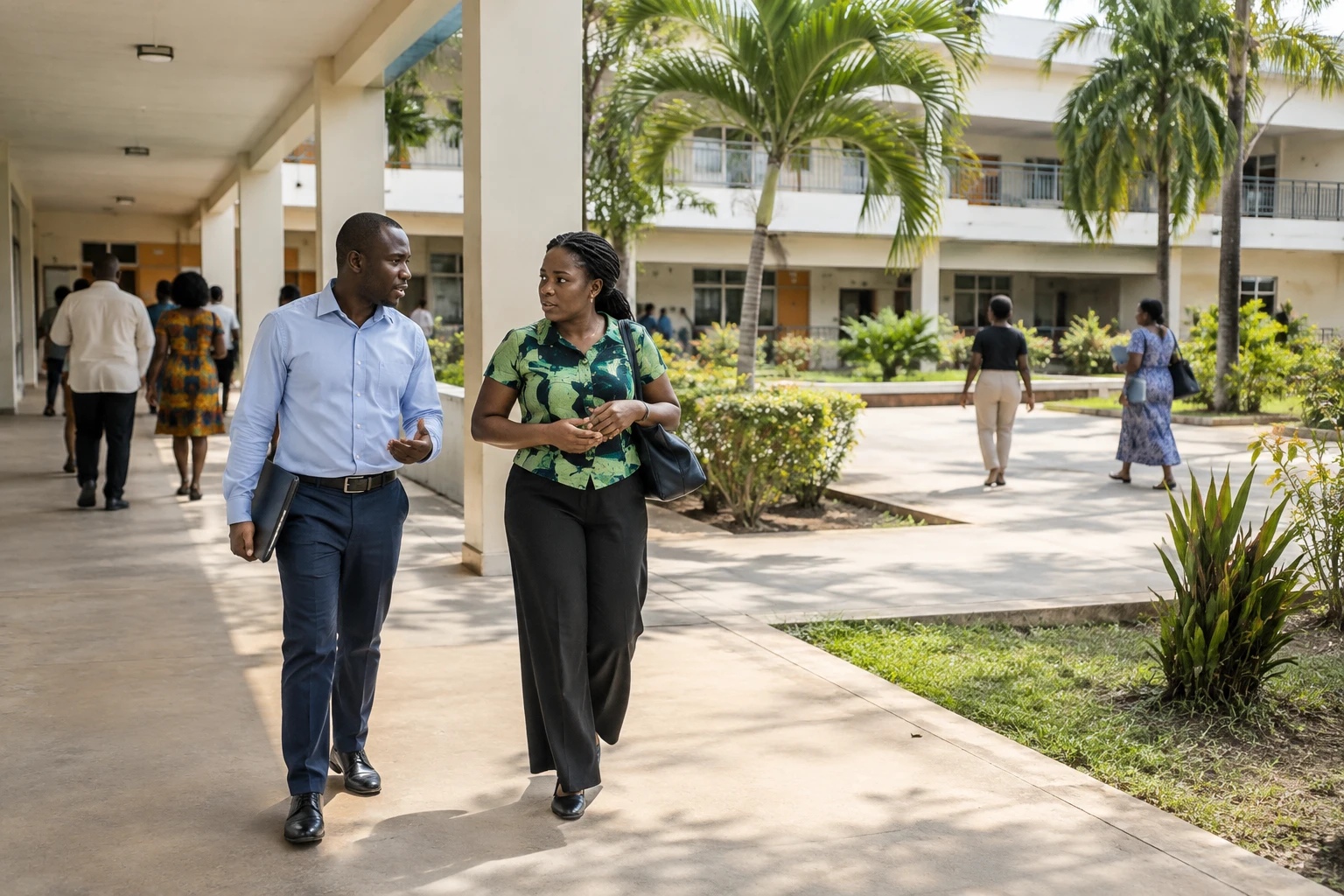
Extending educational cooperation beyond technical workshops: this is the possibility opened up between Abidjan and Algiers at a time when Côte d’Ivoire is seeking to strengthen both its teaching workforce and the quality of learning. For pupils, the issue is tangible: finding trained teachers for classrooms that are multiplying.
A partnership with a long-term perspective
Cooperation between Côte d’Ivoire and Algeria is not starting from scratch. The two countries have established a partnership in technical education and vocational training, notably following a memorandum of understanding signed in 2016. In August 2023, Ivorian and Algerian officials discussed training trainers, scholarships and placements for Ivorian pupils.
This cooperation has already led to training exchanges. In December 2023, the Ivorian government announced that learners would be sent to Algeria and Morocco for higher technician courses. The fields mentioned included industrial electricity, refrigeration and air conditioning, as well as surveying. Staff training was therefore already on the agenda, but mainly in technical occupations.
The new strand under consideration would cover a broader field: teachers in preschool, primary and general secondary education. This would be a notable development, bringing bilateral cooperation closer to foundational learning and the initial and continuing training of teachers.
A proposal raised, with no timetable announced
The Ivorian government’s account states that the Minister of National Education, Literacy and Technical Education, N’Guessan Koffi, received Algeria’s ambassador, Selma Bakhta Mansouri, on Tuesday 27 October 2026. Their discussions covered cooperation on teacher training, the organisation of education systems and the development of technical education.
At this stage, no timetable, budget or operational programme has been made public. The meeting therefore signals an intention to cooperate, not yet an agreed arrangement. The details remain to be defined: which staff would be involved, where and by whom the training would be delivered, and how the skills acquired would be recognised in the Ivorian system.
This distinction matters. A diplomatic exchange can open discussions, but putting them into practice in schools will depend on concrete decisions and resources being committed. Without these, it is impossible to assess how many teachers would be involved or what effects are expected for pupils.
Reconciling workforce numbers and needs
Côte d’Ivoire has greatly expanded its school network. The government’s record lists 902 public secondary schools in 2025, compared with 294 in 2011. The Ivorian Press Agency also reports that 4,900 contract teachers of mathematics and physics-chemistry completed a second six-week training session on 22 August 2026.
These figures point to two related but distinct challenges. Building or opening schools improves access to education; having enough teachers who are prepared for the job determines how pupils are supported. Needs are not necessarily distributed in the same way between Abidjan, other cities and rural areas. Any useful cooperation will therefore need to identify where the shortages lie and which subjects or levels should be prioritised.
According to information released by the government, the pathway announced for Ivorian contract teachers includes pedagogical supervision and assessment over two years before possible entry into the civil service. This kind of support illustrates why training should not be reduced to a one-off session: classroom support, mentoring and continuing professional development can matter as much as initial courses.
Algerian experience could provide opportunities to exchange practices or deliver joint training. But adapting it to the Ivorian context will be crucial. Curricula, languages of instruction, class sizes and working conditions differ between regions and schools. Cooperation would therefore benefit from involving Ivorian training institutions, teachers and local officials, rather than transferring a model without adjustment.
A partnership to be defined within a regional framework
This opening also comes amid a West African landscape in which governments are seeking to strengthen skills and technical fields. The Economic Community of West African States (ECOWAS), a regional cooperation organisation, provides an important framework for exchanges among its members. Algeria is not a member: the Ivorian project is therefore a bilateral initiative, complementing West African cooperation rather than being led by ECOWAS.
For Côte d’Ivoire, the potential benefits are twofold: to enrich teacher training and strengthen ties already established in technical education. For Algeria, the partnership extends educational exchanges with a West African country. But the real impact of this next step will depend on verifiable results: a formal agreement, measurable objectives, identified funding and a published timetable.
The next development to watch is therefore not just the possible signing of an agreement. It will be how the two states define the groups concerned and link the initiative with existing Ivorian programmes. It is at this level — sustained training, better support for teachers and consideration of regional needs — that the cooperation can be judged.