Egypt
 Libya
 Morocco
 Sudan
 Tunisia
 Benin
 Burkina Faso
 Cabo Verde
 Côte d'Ivoire
 Ghana
 Guinea
 Guinea-Bissau
 Liberia
 Mali
 Mauritania
 Niger
 Nigeria
 Senegal
 Sierra Leone
 The Gambia
 Togo
 Cameroon
 Central African Republic
 Chad
 DR Congo
 Equatorial Guinea
 Gabon
 Republic of the Congo
 São Tomé and Príncipe
 Burundi
 Comoros
 Djibouti
 Eritrea
 Ethiopia
 Kenya
 Madagascar
 Malawi
 Mauritius
 Mozambique
 Rwanda
 Seychelles
 Somalia
 South Sudan
 Tanzania
 Uganda
 Angola
 Botswana
 Eswatini
 Lesotho
 Namibia
 South Africa
 Zambia
 Zimbabwe
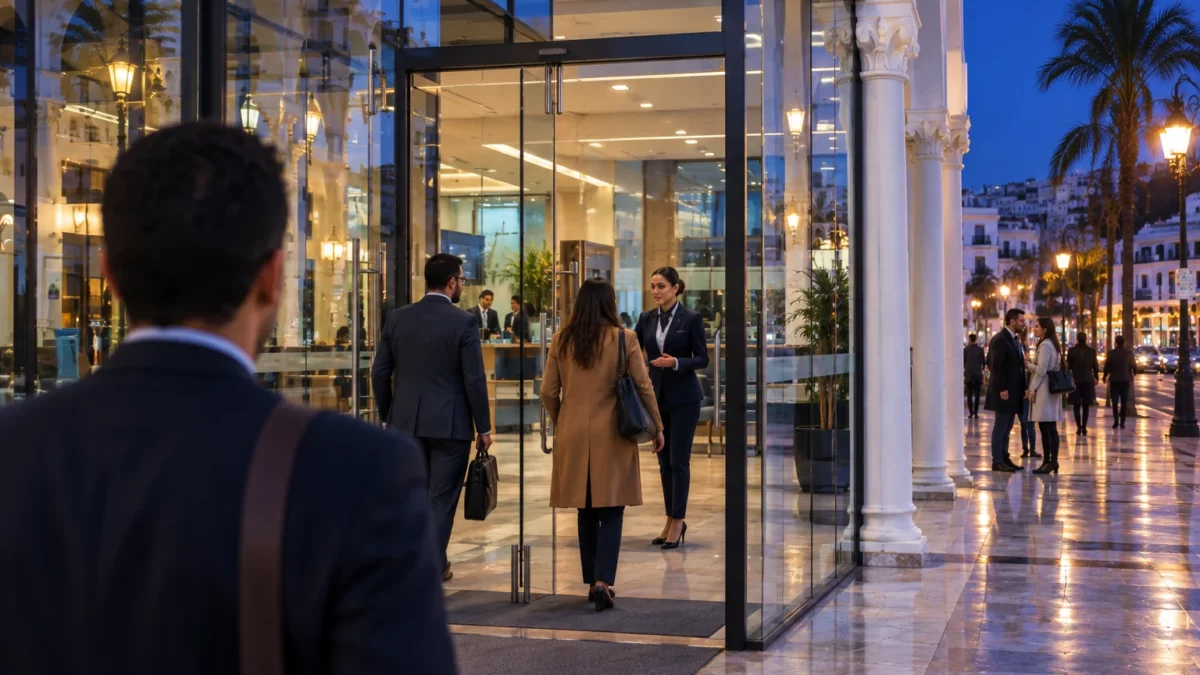
For companies that pay suppliers abroad or organise international trade transactions, changing banks is not simply a matter of replacing a branch. In Algeria, HSBC’s announcement concerns mainly this type of clientele: the British bank plans to gradually wind down the activities of its wholesale banking branch in Algiers.
An exit targeting a specialised business
HSBC Bank Middle East Limited announced on 12 November 2026 its intention to cease its activities in Algeria, following a strategic review of its branch. The group describes the decision as a choice to simplify and focus on markets where it believes it has better prospects and a clearer competitive advantage. The Algerian press also reported the announcement, confirming that it is indeed a planned withdrawal from the national market. HSBC’s announcement on the gradual cessation of its activities in Algeria and TSA Algérie’s report are consistent on this point.
The bank has been present in the country since 2008. It did not operate a retail network comparable to those of banks that also serve individual customers. Its Algiers branch focused on wholesale banking, meaning services for companies, multinationals and financial institutions: payments, international trade and access to financial markets. The announced departure therefore does not mean the closure of a network of current accounts for the Algerian population as a whole.
No precise timetable for the cessation has been announced. HSBC says it has begun discussions with its clients and plans to keep them informed over the coming months. The bank also says it intends to support its clients and employees during the transition and meet its regulatory and contractual obligations until the process is complete. The practical arrangements for companies, employees and partners therefore remain to be clarified.
Between global strategy and local constraints
The group first points to a portfolio-based rationale. A specialised branch with no retail banking business may have fewer sources of revenue and fewer economies of scale than an operation serving both individual and business customers. For an international group, compliance, staffing and infrastructure costs must be weighed against the revenue generated. HSBC has not, however, published figures that would make it possible to assess the profitability of its Algerian branch. It would therefore be unwise to present any specific financial cause as an established fact.
The regulatory context also matters for a business focused on international payments. In Algeria, current transactions with foreign countries and foreign-currency accounts fall under a framework set by the Bank of Algeria. Licensed banks act as intermediaries in processing foreign trade and foreign exchange transactions. This framework governs transfers and cross-border payments; on its own, it is not enough to explain HSBC’s decision. The bank has not publicly detailed the extent to which these rules influenced its choice. The foreign exchange regulations published by the Bank of Algeria set out the applicable texts, including an amendment dated 23 July 2026.
The withdrawal is also a reminder that the presence of a foreign bank is measured not only by its name or global size. It depends on how well its model fits the needs of the local market. For the large companies that used HSBC, the immediate challenge will be continuity of payments, trade finance and other relevant services. SMEs that were not among its direct clients, like individual customers, are not the first to be affected. Employees and corporate clients, meanwhile, are awaiting details on deadlines, contracts and replacement solutions.
A trajectory to be viewed in the context of the Maghreb
The case forms part of HSBC’s broader strategy to reduce or reorganise some of its activities. But each transaction has a distinct scope. In South Africa, the transfer of activities to FirstRand Bank was completed on 27 February 2026, according to the group’s interim report. In Egypt, HSBC concluded an agreement on 2 August 2026 covering only its retail banking business, which is to be transferred to Emirates NBD Egypt. Its corporate banking and financing activities are to be retained there, subject to regulatory approval, with completion expected in the second half of 2027. These examples shed light on the group’s refocusing, but do not show that the reasons are the same from one country to another. HSBC’s 2026 interim report details these transactions.
At the regional level, Algeria is a member of the Arab Maghreb Union (AMU), which brings together five countries and lists economic integration and a free-trade area among its objectives. This ambition has not yet created a unified Maghreb banking market: national rules and cross-border procedures remain decisive for companies. The AMU’s stated economic objectives provide the institutional framework, but do not change the practical conditions to which banks must adapt in each country.
The significance of the announcement therefore goes beyond the choice of a British group. It raises a practical question for Algerian businesses: which banks will be able to take over the services needed for international trade, with what guarantees of continuity and within what timeframe? The answer will depend on the information HSBC provides, the solutions it offers its clients and the oversight of the Algerian authorities. At this stage, the only certainty is the intention to end its activities; the timetable and arrangements for the exit remain open.