
 Egypt
 Libya
 Morocco
 Sudan
 Tunisia
 Benin
 Burkina Faso
 Cabo Verde
 Côte d'Ivoire
 Ghana
 Guinea
 Guinea-Bissau
 Liberia
 Mali
 Mauritania
 Niger
 Nigeria
 Senegal
 Sierra Leone
 The Gambia
 Togo
 Cameroon
 Central African Republic
 Chad
 DR Congo
 Equatorial Guinea
 Gabon
 Republic of the Congo
 São Tomé and Príncipe
 Burundi
 Comoros
 Djibouti
 Eritrea
 Ethiopia
 Kenya
 Madagascar
 Malawi
 Mauritius
 Mozambique
 Rwanda
 Seychelles
 Somalia
 South Sudan
 Tanzania
 Uganda
 Angola
 Botswana
 Eswatini
 Lesotho
 Namibia
 South Africa
 Zambia
 Zimbabwe
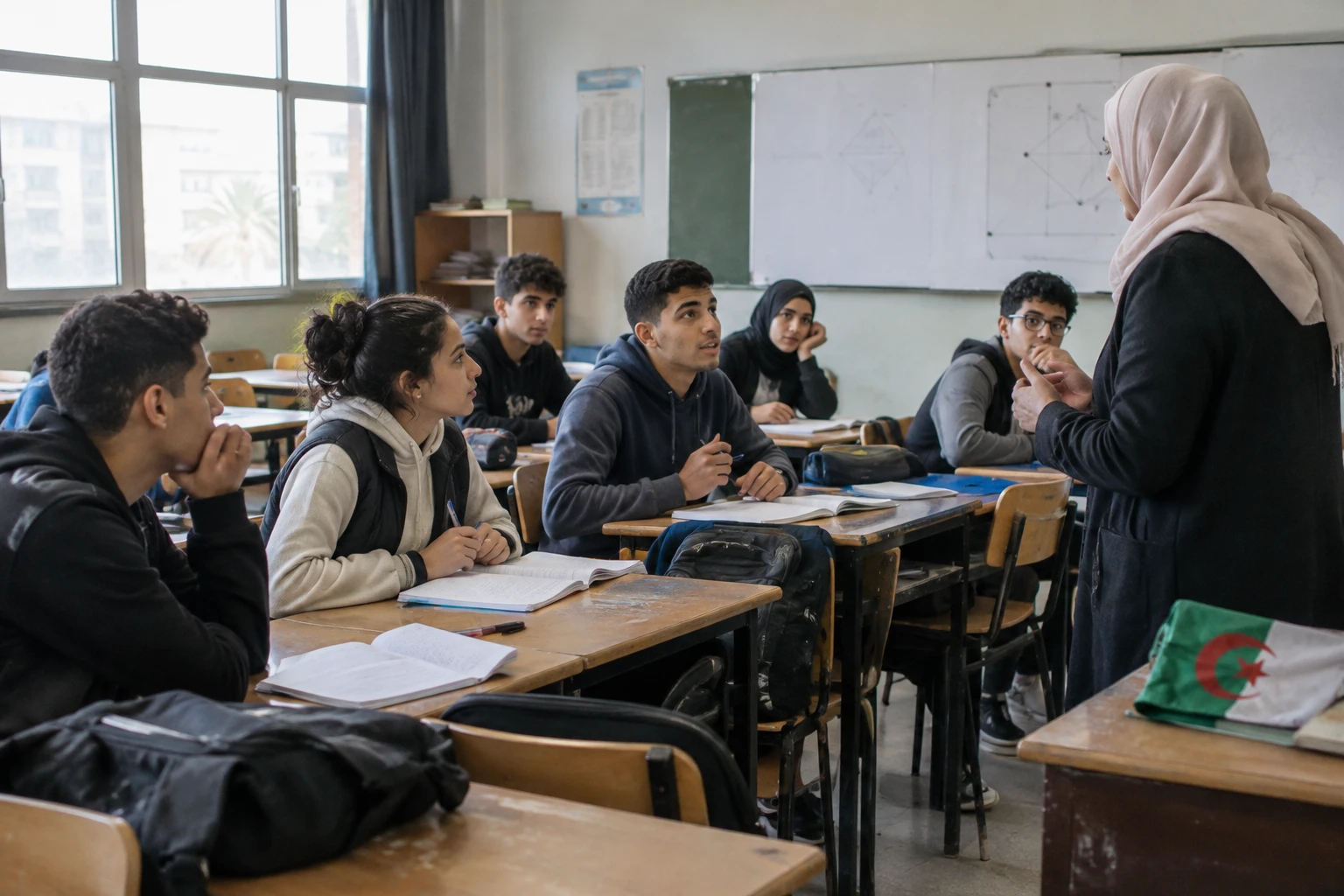
A flag can tell a story far broader than the gathering where it appears. In France, a Franco-Algerian association’s call not to display the Algerian emblem during school students’ protests raises a delicate question: how can the memory of a symbol be preserved without turning it into a dividing line between young people taking part in demonstrations?
A school mobilisation becomes national
Since late September, school students and university students have been mobilising in France to denounce, among other things, lessons without teachers, overcrowded classes and the state of some school buildings. The movement has spread beyond the Paris region. On 1 October, the interior ministry recorded action at 1,027 establishments, 222 of which were blockaded. These figures describe disruptions reported by the authorities, not the number of young people mobilised.
On Thursday 8 October, the ministry counted 71,500 people at demonstrations, including 24,500 in Paris. On the same day, it also reported that 55,000 people had gathered outside schools, only some of whom joined the marches. These official figures give an indication of the scale of the movement, but do not sum up either its demands or the different circumstances at each school. Le Monde’s report of the 8 October figures corroborates the numbers attributed to the ministry.
On the evening of 8 October, education minister Édouard Geffray announced the deployment of 3,000 supply teachers to the most struggling secondary schools. School student and university student organisations judged this response insufficient and maintained their call for a new day of action on Tuesday 13 October. The debate is therefore primarily about access to lessons and school resources, although incidents on the sidelines of some gatherings have also attracted attention.
An association’s appeal, not a position shared by the whole diaspora
Against this backdrop, the Union franco-algérienne de Normandie (UFAN) urged Franco-Algerian families to talk to their children about the use of the Algerian flag during blockades. The association believes that demands relating to schools concern French society and wants to prevent the emblem from shifting the debate towards immigration or national identity. It is not asking young people to give up demonstrating.
The appeal, reported by Algerian media, is the position of an association. It does not automatically represent Franco-Algerians, or the entire Algerian diaspora in France. The distinction matters: young people can take part in mobilisations as pupils and citizens, whatever their origins, while families may have particular views on the significance of a national symbol.
A Franco-Algerian influencer from Toulouse, known by the pseudonym “nasnas toulouse”, has also argued that the flag should be reserved for moments of collective pride, such as national celebrations or sporting victories. He said, among other things: “This flag was not made for negative things.” This is his view. It does not settle the debate over the possible uses of the emblem in public spaces. TSA Algérie reported the UFAN’s appeal and the arguments put forward.
An emblem tied to a history of struggle and memory
The sensitivity surrounding the flag stems from its association with the development of the Algerian national movement and the struggle for independence. Its history cannot be reduced to a single episode or founder: forms of the emblem circulated in nationalist mobilisations before its colours and symbols became those of independent Algeria.
On 8 May 1945, in Sétif, the flag’s presence at a demonstration is associated with the young Bouzid Saâl, who was killed by French police. Repression then spread to Sétif, Guelma and Kherrata. The episode remains a major landmark in Algerian national memory. It helps explain why, for many Algerians and their descendants, the flag evokes sacrifices and a hard-won sovereignty rather than a mere decorative symbol. A report from Sétif on the memory of 8 May 1945 recalls Bouzid Saâl’s place in this history.
In France, the flag also appears at diaspora gatherings, sporting celebrations and political demonstrations. Its presence at a school student mobilisation is therefore not, in itself, enough to establish that the movement is pursuing an agenda linked to Algeria. In Aurillac, a photograph showing the flag amid a blockade circulated on social media and prompted questions about its relationship to the demands concerning schools. Removed from its context, the image can easily become a source of identity-based controversy.
Identities that are not mutually exclusive
The issue also has a generational dimension. For Franco-Algerian school students, family ties and everyday life in France are not necessarily at odds. They can take part in a movement concerning their school while also feeling an emotional connection to Algeria’s history. The association, by contrast, argues for separating the national symbol from demands relating to schools so that the debate is not diverted from education. Both observations can coexist without turning the association’s appeal into a collective instruction.
The issue is part of a Franco-Algerian relationship in which colonial history, family memories and the experiences of the diaspora remain present in public debate. But the current mobilisation concerns French institutions first and foremost: the government and education authorities in France are responsible for the expected responses on teacher cover, buildings and learning conditions. Pupils at the schools concerned are experiencing the practical effects of missing lessons; families and staff, meanwhile, have to contend with the consequences of blockades and possible closures.
At regional level, Algeria is a member of the Arab Maghreb Union (AMU), which brings together five North African countries. The organisation does not direct French school debates, but this case highlights the transnational role of diasporas in the circulation of symbols and memories. What happens next will depend above all on the responses to school students’ demands and on the public debate’s ability not to confuse the demonstrators’ identities with the subject of their mobilisation. The AMU lists its five member states.



