Algeria
 Libya
 Morocco
 Sudan
 Tunisia
 Benin
 Burkina Faso
 Cabo Verde
 Côte d'Ivoire
 Ghana
 Guinea
 Guinea-Bissau
 Liberia
 Mali
 Mauritania
 Niger
 Nigeria
 Senegal
 Sierra Leone
 The Gambia
 Togo
 Cameroon
 Central African Republic
 Chad
 DR Congo
 Equatorial Guinea
 Gabon
 Republic of the Congo
 São Tomé and Príncipe
 Burundi
 Comoros
 Djibouti
 Eritrea
 Ethiopia
 Kenya
 Madagascar
 Malawi
 Mauritius
 Mozambique
 Rwanda
 Seychelles
 Somalia
 South Sudan
 Tanzania
 Uganda
 Angola
 Botswana
 Eswatini
 Lesotho
 Namibia
 South Africa
 Zambia
 Zimbabwe
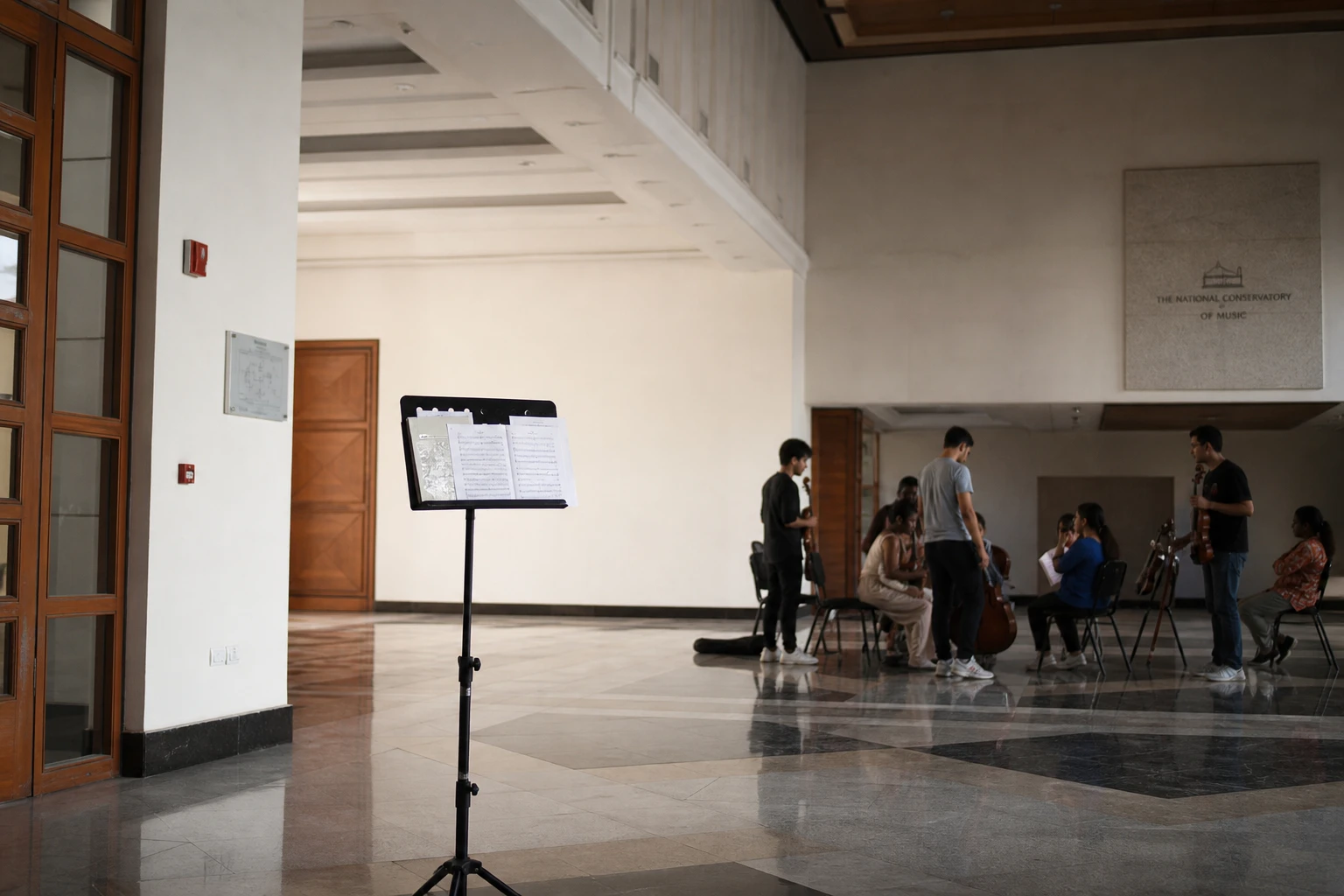
In Cairo, music rarely travels in a straight line. It moves from a conservatoire to a noisy street, from a studio to an artistic residency, then returns to the stage with a different hue. It was precisely this movement that guided a small group of young musicians brought together in Egypt this year to invent a shared work before taking it to a symphony orchestra.
A musical laboratory on the edge of the desert
The starting point was far from a neutral setting. The residency opened in Dahshur, south of Cairo, at a site associated with film and artistic creation, before continuing in the Egyptian capital. The choice was no accident. In Egypt, Cairo remains a major hub for musical training, with its institutions, schools and a scene where classical traditions, popular music and contemporary composition meet.
The project is part of the work of the Mediterranean Youth Orchestra, an ensemble founded in the 1980s and supported by the Aix-en-Provence Festival. The orchestra brings together young artists from several shores of the Mediterranean and organises intercultural creative sessions in different countries around the basin. According to the festival, Egypt hosted one of these sessions this year, in partnership with El Dahshureya and the Cairo National Conservatoire.
This framework gives a sense of the project’s scope. It is not simply about getting instrumentalists to rehearse. It is about forging a common language between musical traditions that do not share the same methods, gestures or writing conventions.
Composing without a score, then learning to listen
The week of work brought together five young artists: two singers, a pianist, a trombonist and an oud player. They came from Tunisia, Greece, France and Egypt. None of them knew one another beforehand. The group worked under the mentorship of saxophonist and composer Fabrizio Cassol, a regular presence in OJM projects. The principle was clear: start with orality — with memory, the ear and improvisation — before putting anything into a score.
This method reverses the habits of the classical orchestra. Where a symphonic institution would ordinarily require a precise reading of the musical text, the creative process began with voice, exchange and discussion. In this kind of workshop, the score comes later. It fixes material born of the collective. The festival notes that the OJM gives a central place to young artists from varied musical backgrounds, from classical music to jazz and traditional Mediterranean music.
For Amina el Abd, an Egyptian singer involved in the workshop, the experience shifted familiar reference points. She worked in a collective setting, unlike an approach to learning centred on individual practice. Confronting other ways of working meant that everyone had to explain their choices, justify a melodic line and accept disagreement. This is often where a shared work takes shape: not in quick consensus, but in the friction between methods.
French trombonist Jules Regard also highlighted the encounter between two ways of making music. On one side, a sometimes very solid grounding in theory. On the other, a more intuitive, immediate approach. The value of a workshop like this lies precisely in that mixture. It does not erase differences. It turns them into a resource.
What a residency with many voices reveals
At first glance, the event might seem like a simple festival episode. In reality, it says something broader about the cultural Mediterranean. In this region, artistic exchange is not limited to big names or prestigious stages. It also depends on training spaces where young creators learn to understand one another across languages, schools and repertoires.
Egypt has an important place here. The country has a cultural richness that extends far beyond Cairo, but the capital still concentrates a decisive share of resources, conservatoires and professional networks. For young Egyptian musicians, taking part in a Mediterranean workshop offers a double opening: first, towards peers from abroad; and then towards performance circuits that reach beyond the national market. In a sector where access to major stages remains unequal, these bridges matter.
The fact that the work’s first version is then to be adapted for a symphony orchestra in France extends this logic. The creation is born in Cairo, but immediately travels. It moves between Mediterranean orality and European orchestral writing. This back-and-forth says a great deal about contemporary cultural diplomacy: it relies less on declarations than on concrete forms of cooperation involving artists, institutions and host venues.
This experience should also be viewed on a continental scale. The African Union often speaks of integration, mobility and the circulation of knowledge. In practice, culture sometimes offers the most flexible and visible illustration of these ideas. A residency such as this one connects North Africa with southern Europe, while giving a real place to African voices, here Egyptian and Tunisian ones. It shows that the Mediterranean is not only a front line of tension or borders. It is also a space for working together, where young professionals build shared repertoires.
The next moment to watch for is on stage. The symphonic version of this creation is to be heard after the residency, as the collective work moves into orchestral performance. It is often at this point that the original idea truly reveals itself: no longer as a workshop, but as a musical form capable of holding its own before an audience and surviving a change of scale.