
 Algeria
 Libya
 Morocco
 Sudan
 Tunisia
 Benin
 Burkina Faso
 Cabo Verde
 Côte d'Ivoire
 Ghana
 Guinea
 Guinea-Bissau
 Liberia
 Mali
 Mauritania
 Niger
 Nigeria
 Senegal
 Sierra Leone
 The Gambia
 Togo
 Cameroon
 Central African Republic
 Chad
 DR Congo
 Equatorial Guinea
 Gabon
 Republic of the Congo
 São Tomé and Príncipe
 Burundi
 Comoros
 Djibouti
 Eritrea
 Ethiopia
 Kenya
 Madagascar
 Malawi
 Mauritius
 Mozambique
 Rwanda
 Seychelles
 Somalia
 South Sudan
 Tanzania
 Uganda
 Angola
 Botswana
 Eswatini
 Lesotho
 Namibia
 South Africa
 Zambia
 Zimbabwe
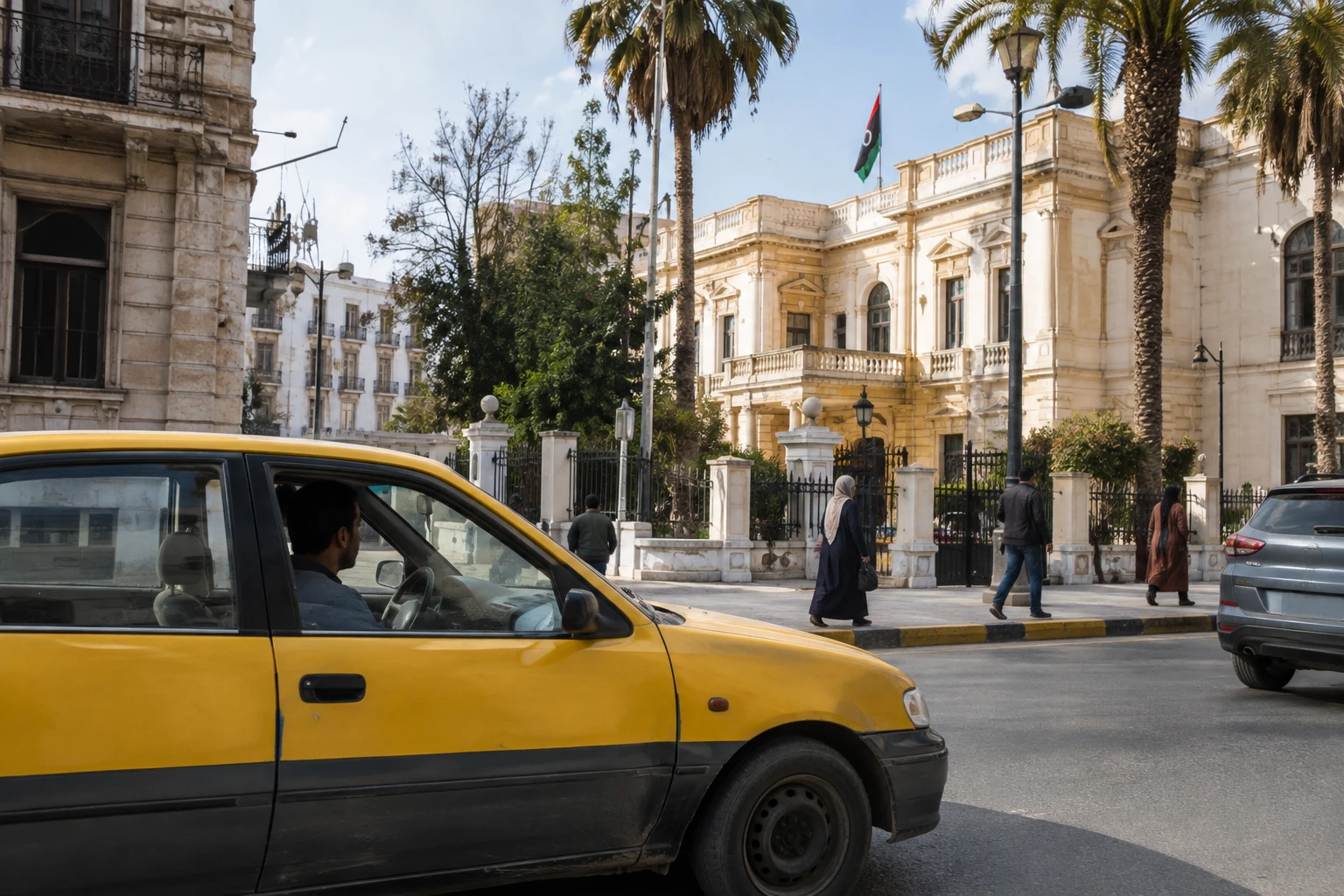
An embassy can reopen its doors without erasing a country’s fault lines. In Libya, the reopening of Egypt’s historic headquarters in Tripoli marks a diplomatic rapprochement, but also a test: of Cairo’s ability to engage with the authorities in western Libya amid a still-divided political landscape.
A historic headquarters in a still-fragmented Libya
Since the fall of Muammar Gaddafi in 2011, Libya has struggled to reunify its institutions. The Government of National Unity, led by Abdelhamid Dbeibah, is based in Tripoli. In the east, rival authorities and the House of Representatives retain their own political clout. This division complicates national decision-making and relations with neighbouring countries.
The country does not belong to a single regional economic organisation that captures its alliances. It is, among other groupings, a member of the Community of Sahel-Saharan States, CEN-SAD, which brings together countries in North Africa and the Sahel. The new health agreement with Egypt was signed on the sidelines of a meeting of its Executive Council in Tripoli.
The bilateral context also matters. Cairo has long maintained close ties with actors in eastern Libya, while the Tripoli government has relied on other regional partners. In recent years, however, Egypt has stepped up its engagement with authorities in the west. The resumption of activities at its mission in Tripoli in 2021 had already signalled this shift. The ceremony on 7 November 2026 concerns the historic headquarters, and is therefore not the first return of Egyptian diplomats to the Libyan capital.
Diplomacy and health cooperation on the agenda
On 7 November, Egyptian Foreign Minister Badr Abdel Aati reopened the building in the presence of Taher Al-Baour, an official at Libya’s Ministry of Foreign Affairs. The minister described the headquarters as a place of memory and a possible “bridge for continued cooperation and coordination” between the two countries. He also thanked the Libyan authorities for their support for the renovation work.
The visit also produced another concrete agreement. Badr Abdel Aati and Libya’s Health Minister, Mohamed Al-Ghouj, signed a memorandum of understanding aimed at developing exchanges between their administrations. According to the Libyan news agency LANA, the text provides in particular for the sharing of expertise, medical training, epidemiological surveillance, disease prevention and pharmaceutical cooperation. These areas are detailed in LANA’s report on the health agreement.
The rapprochement also has a political dimension. On the sidelines of the ceremony, Egypt’s top diplomat met Hanna Tetteh, the UN Secretary-General’s Special Representative for Libya and head of the United Nations Support Mission in Libya (UNSMIL). He reaffirmed Cairo’s support for a political settlement based on a Libyan-led dialogue. This diplomatic position does not mean that disagreements between Libya’s rival camps have been resolved.
Economic interests, but imbalanced trade
For Egypt, Libya is an immediate neighbour, a trading partner and a potential arena for cooperation in energy, construction, infrastructure and services. The reopening of a permanent headquarters can facilitate diplomatic and consular work. It may also make exchanges easier for businesses and Egyptian nationals in Libya. But the existence of an embassy guarantees neither the safety of travel nor the delivery of new projects.
Available figures show a highly uneven trading relationship. According to 2025 data attributed to UN Comtrade, Egyptian exports to Libya reached about $1.49bn, compared with $39.6mn in Libyan exports to Egypt. Goods sold by Egyptian companies include construction materials, plastics, electrical equipment, machinery and food products. These figures describe trade flows; on their own, they do not measure local benefits or market access conditions.
For the Tripoli authorities, the results will depend on implementing the agreements and on the administrations’ ability to coordinate their work. In the health sector, training and the sharing of expertise could involve facilities and professionals. However, the announced memorandum sets out a framework for cooperation: it is not, in itself, evidence that new services or equipment are already available to patients.
A rapprochement to watch at regional level
The return of the historic headquarters allows Cairo to strengthen ties with western Libya without setting aside the security and political issues affecting the country as a whole. Egypt shares a long border with Libya and seeks to preserve channels of dialogue in an environment where internal rivalries overlap with the interests of several regional powers. For Libyans, the challenge is to turn these bilateral rapprochements into useful cooperation without letting them become a substitute for a national political agreement.
The significance of the event therefore extends beyond the relationship between Cairo and Tripoli alone. CEN-SAD provides a regional forum for consultation, while the UN continues its mediation efforts. The next developments to watch will be the effective implementation of the health agreement and the regularity of diplomatic exchanges. The reopening is an important gesture, but stronger ties will depend on the continuity of Libya’s institutions and their ability to act across territorial divisions.



