
 Egypt
 Libya
 Morocco
 Sudan
 Tunisia
 Benin
 Burkina Faso
 Cabo Verde
 Côte d'Ivoire
 Ghana
 Guinea
 Guinea-Bissau
 Liberia
 Mali
 Mauritania
 Niger
 Nigeria
 Senegal
 Sierra Leone
 The Gambia
 Togo
 Cameroon
 Central African Republic
 Chad
 DR Congo
 Equatorial Guinea
 Gabon
 Republic of the Congo
 São Tomé and Príncipe
 Burundi
 Comoros
 Djibouti
 Eritrea
 Ethiopia
 Kenya
 Madagascar
 Malawi
 Mauritius
 Mozambique
 Rwanda
 Seychelles
 Somalia
 South Sudan
 Tanzania
 Uganda
 Angola
 Botswana
 Eswatini
 Lesotho
 Namibia
 South Africa
 Zambia
 Zimbabwe
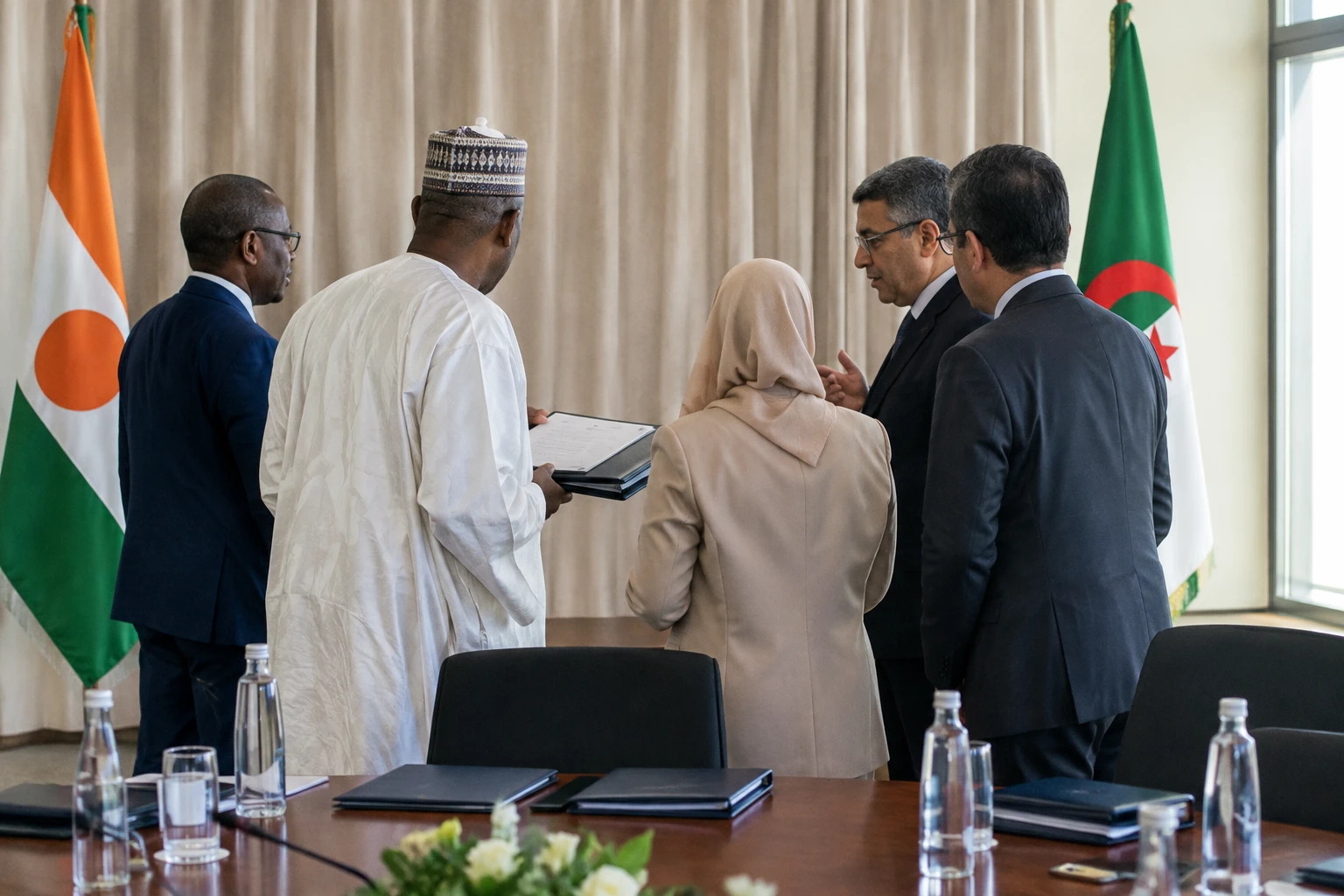
Protecting energy installations in Niger without turning that protection into a lasting military presence: this is the delicate balance now facing Algiers and Niamey. The authorisation granted by the Algerian parliament marks a new stage in their cooperation, but leaves practical questions about the location, size and duration of the deployment unanswered.
A rapprochement after several years of tension
The vote comes as alliances and security arrangements are changing rapidly across the Sahel. Niger has been governed by military authorities since the coup d’état of July 2023. It left the Economic Community of West African States (ECOWAS), the regional economic integration organisation, with Mali and Burkina Faso on 29 January 2025. The three countries have since strengthened their cooperation within the Alliance of Sahel States (AES). ECOWAS is nevertheless maintaining practical arrangements to preserve trade and the movement of people. ECOWAS’s statement on the withdrawal of the three countries makes this clear.
Relations between Algiers and Niamey have had their ups and downs. Algeria condemned the overthrow of President Mohamed Bazoum in 2023, while opposing an external military intervention. In 2025, a crisis between Algiers and Bamako, following the destruction of a Malian drone by the Algerian army, also cooled regional relations. Niger had joined the AES countries in recalling their ambassadors. Since then, high-level contacts have resumed and bilateral cooperation has accelerated.
Political authorisation, but few operational details
On 25 October 2026, both chambers of the Algerian parliament approved the deployment of units of the National People’s Army to Niger. President Abdelmadjid Tebboune formally decided on the deployment the following day, at the request of the Nigerien authorities, according to the Algerian presidency. The stated aim is to protect shared energy and economic interests. Algeria Press Service reports on the presidential decision, while the pan-African news agency APA confirms the vote and the diplomatic sequence. Its report on the deployment says the recently signed military protocol has not been made public.
Algeria’s Constitution, revised in 2020, permits the deployment of military personnel abroad, subject to approval by both chambers. This framework marks a notable shift for a country long committed to non-intervention beyond its borders. Algeria had already provided air support to Niger in August 2026, following an attempted mutiny in Niamey, according to press reports corroborated by APA. The October decision gives this cooperation a more formal political basis.
The authorities have not, however, publicly announced the number of soldiers, their deployment schedule or their exact location. The Madama base in northern Niger, near the Libyan border, has been cited by media outlets as a possibility. It cannot be presented as a confirmed destination. At this stage, no official information also supports claims that a permanent Algerian base will be established.
Energy, security and local benefits
Energy is central to the issue, but cooperation is not limited to the Trans-Saharan Gas Pipeline. Algiers and Niamey are also working together on oil projects, particularly in the Agadez region, where companies linked to the Algerian group Sonatrach operate. In February 2025, Niger, Algeria and Nigeria signed agreements to update the feasibility study and restart oversight of the pipeline intended to carry Nigerian gas through Niger to Algeria. The Nigerien News Agency details these tripartite agreements.
Securing these projects could protect investments and infrastructure while strengthening cooperation between the two states. But it guarantees neither completion of the pipeline nor equitable benefits for the population. For communities in northern Niger, the impact will depend in particular on the jobs created, the revenues generated from resources and how the authorities secure the areas concerned. A military presence could also alter local balances, especially if its mandate and duration remain unclear.
Algerian authorities describe the deployment as protecting shared interests against cross-border threats. This official justification alone does not establish the precise nature of the risks or the mission’s terms. The challenge, therefore, is to distinguish the stated aim from speculation about a lasting presence or a broader role in the security of northern Niger. Such scenarios should remain attributed until the governments publish further details.
A signal that goes beyond bilateral relations
For Algiers, the decision signals more direct involvement in its Sahelian neighbourhood, where instability also affects Algeria’s southern borders. For the authorities in Niamey, it adds a military partner to a strategy of diversifying external support. It does not, however, mean that Algeria is replacing Nigerien arrangements or the other partners already present in the country.
The regional significance will also be measured by how this cooperation fits with the AES, neighbouring countries and continental organisations. Niger’s withdrawal from ECOWAS has not eliminated West African interdependencies: trade and movement remain everyday concerns for residents and businesses. In the coming weeks, the decisive information will be the publication of the mandate, troop numbers and deployment site, as well as guarantees of political oversight. Without these details, the vote authorises a turning point but does not yet make it possible to assess its full significance.



