
 Egypt
 Libya
 Morocco
 Sudan
 Tunisia
 Benin
 Burkina Faso
 Cabo Verde
 Côte d'Ivoire
 Ghana
 Guinea
 Guinea-Bissau
 Liberia
 Mali
 Mauritania
 Niger
 Nigeria
 Senegal
 Sierra Leone
 The Gambia
 Togo
 Cameroon
 Central African Republic
 Chad
 DR Congo
 Equatorial Guinea
 Gabon
 Republic of the Congo
 São Tomé and Príncipe
 Burundi
 Comoros
 Djibouti
 Eritrea
 Ethiopia
 Kenya
 Madagascar
 Malawi
 Mauritius
 Mozambique
 Rwanda
 Seychelles
 Somalia
 South Sudan
 Tanzania
 Uganda
 Angola
 Botswana
 Eswatini
 Lesotho
 Namibia
 South Africa
 Zambia
 Zimbabwe
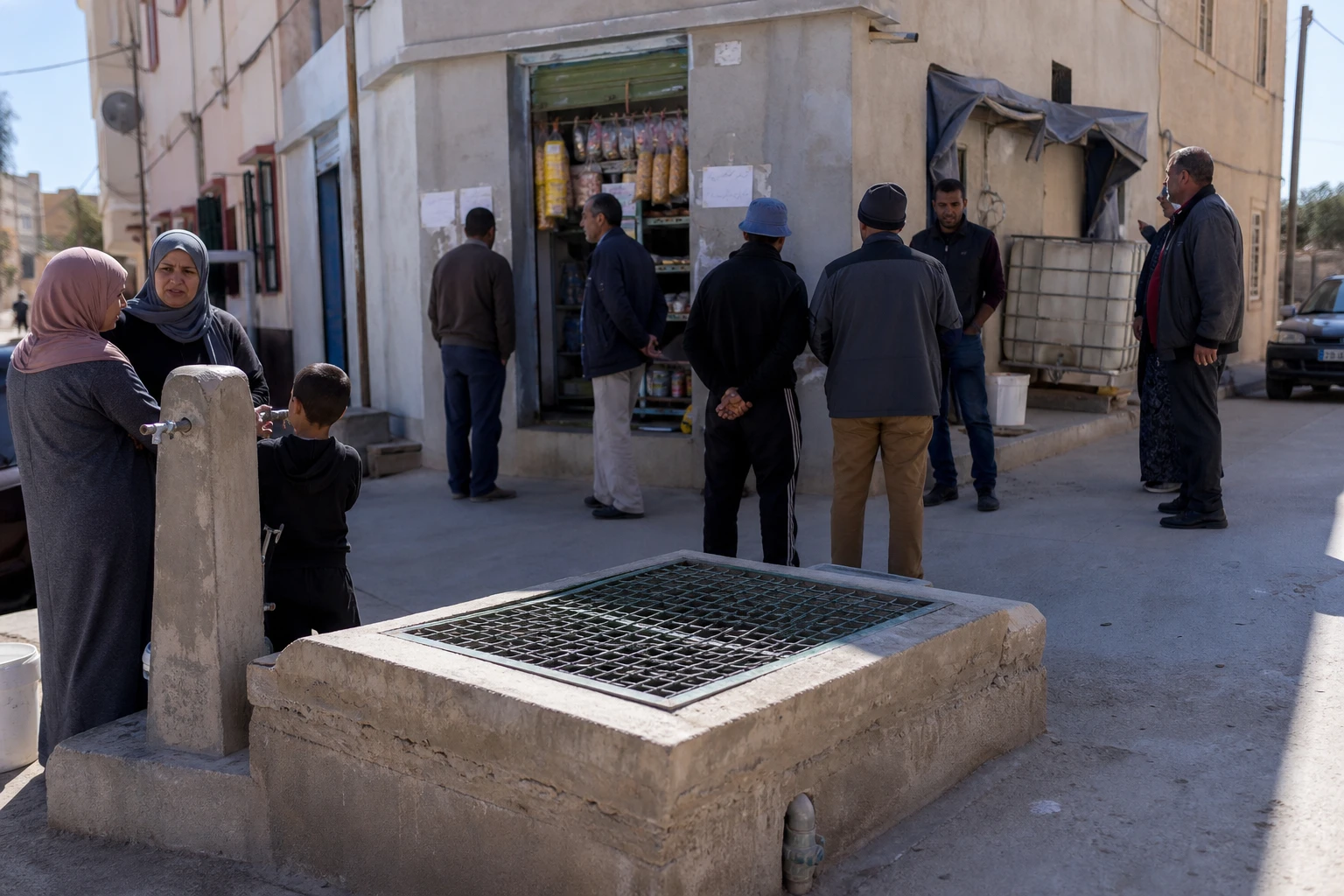
A death that highlights the vulnerability of remote areas
In south-western Algeria, a family tragedy has become a national issue. In Ghassoul, in El Bayadh province, residents accompanied 10-year-old Ayoub to his final resting place after he was found dead following a fall into a dry artesian well. The shock was all the greater because the child had been searched for over four days, as a community watched and clung to hope.
The emotion extends beyond the village itself. It also touches a country where families live amid scattered infrastructure, long distances and water facilities sometimes left unprotected. In rural and desert areas, a simple water source can become a permanent hazard when openings are not secured. This is precisely what the tragedy has brought back into focus.
El Bayadh, a vast and exposed territory
The commune of Brezina is in El Bayadh province, about 550 kilometres south of Algiers. The region is part of the Saharan zone, where access to water still depends on wells, boreholes and networks often far from urban centres. Algeria’s ministry responsible for water resources says groundwater plays a decisive role in the south, where reserves are substantial but must be managed carefully.
At the same time, the state says it is pursuing a policy of securing and expanding water infrastructure. The ministry says it is working to strengthen supply, while Algerian Radio reported in 2025 that nearly 15,000 drilling permits had been granted since 2021 to support agricultural projects in several provinces of the far south. In other words, wells are not merely part of the rural landscape: they are tied to a broader economic and food-security issue.
The facts: four days of efforts, then confirmation of the death
On 2 September 2026, a 10-year-old boy fell into a dry artesian well about 80 metres deep and estimated to be 40 centimetres in diameter, in the Er-Rokn area near Brezina. Civil Protection services deployed teams and construction equipment to attempt a recovery by lateral excavation, a method considered less risky than direct access through the well’s narrow shaft.
According to information made public by rescue workers and reported by Algerian media, the child was found dead on the evening of 5 September, after four days of searches. The next day, his body was buried in Ghassoul cemetery. Civil Protection therefore bore the weight of the rescue attempt, followed by the transfer of the body, in a sequence that became emblematic of the mobilisation of emergency services in Algeria.
The family’s account adds to the picture. A relative of the victim, quoted by the local press, said the child was walking with his brother when the ground collapsed above an opening covered with earth. This account helps explain how the accident happened: a well that has been precariously covered can become exposed again, or conversely deceptive, depending on erosion and foot traffic.
Securing wells: a matter of public prevention
The El Bayadh tragedy raises a simple question: who protects abandoned wells, especially when they are no longer in use? In the countryside, on the desert margins and in agricultural areas, the answer is often unclear. Traditional wells, dug over long periods or left without maintenance, become invisible traps for children, shepherds and sometimes even adult residents.
Algeria’s Civil Protection service nevertheless has a high public profile. It responds to fires, accidents and the most challenging rescue operations. Its director general also went to the scene during the operation, a sign of the importance attached to the case. But the episode also shows the limits of emergency intervention when a risk has been present for a long time. A poorly protected well is not simply an accident: it is a failure of prevention.
For rural families, the issue is immediate. The safety of a well concerns more than its owner. It involves neighbours, local elected officials and technical services. In a region where water is a strategic resource, properly closing an opening, installing a stable cover and marking an abandoned well are acts of collective protection. Ayoub’s death shows this with brutal clarity.
A local case with regional resonance
What happened in Ghassoul extends beyond El Bayadh province. Across the Maghreb and more broadly in North Africa, pressure on water is driving greater reliance on boreholes, deep aquifers and scattered rural water facilities. The issue is therefore not only humanitarian. It concerns water management, land-use planning and the safety of populations in sparsely populated areas.
The recent case also shows that Algerian public opinion reacts strongly to this kind of tragedy. The public response was immediate on social media, then in the streets at the time of the funeral. This reaction reflects a need for practical protection, beyond announcements. It also highlights the place Civil Protection has come to occupy in national life, combining emergency response, public trust and expectations of swift results.
Across the continent, the issue reflects a reality shared by many African countries: access to water is improving, but related infrastructure sometimes remains inadequately secured. Ayoub’s death is therefore not only a local tragedy. It is a reminder that water policy is measured not only in cubic metres or drilling permits, but also in safety standards, maintenance and everyday prevention.



