
 Egypt
 Libya
 Morocco
 Sudan
 Tunisia
 Benin
 Burkina Faso
 Cabo Verde
 Côte d'Ivoire
 Ghana
 Guinea
 Guinea-Bissau
 Liberia
 Mali
 Mauritania
 Niger
 Nigeria
 Senegal
 Sierra Leone
 The Gambia
 Togo
 Cameroon
 Central African Republic
 Chad
 DR Congo
 Equatorial Guinea
 Gabon
 Republic of the Congo
 São Tomé and Príncipe
 Burundi
 Comoros
 Djibouti
 Eritrea
 Ethiopia
 Kenya
 Madagascar
 Malawi
 Mauritius
 Mozambique
 Rwanda
 Seychelles
 Somalia
 South Sudan
 Tanzania
 Uganda
 Angola
 Botswana
 Eswatini
 Lesotho
 Namibia
 South Africa
 Zambia
 Zimbabwe
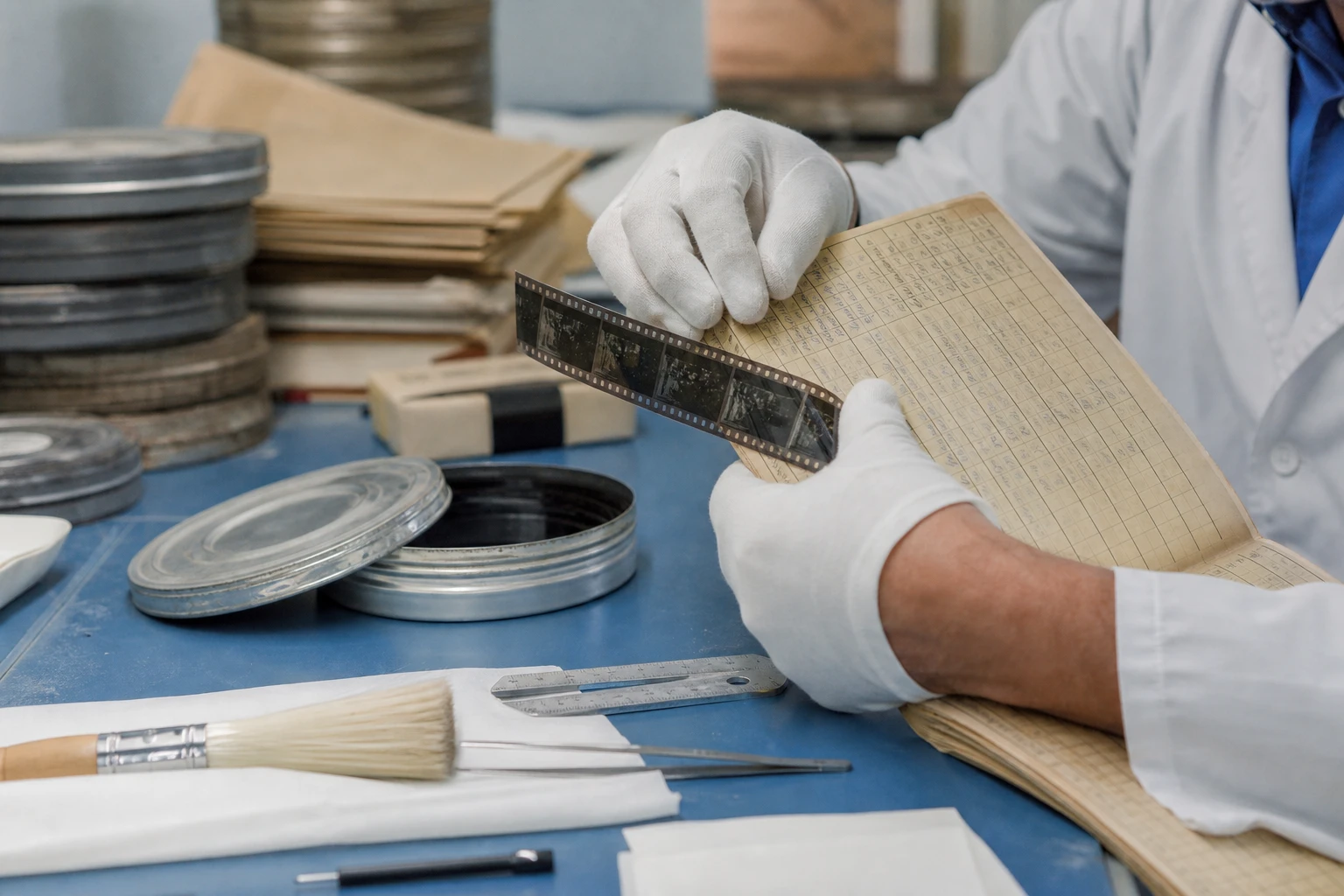
In Béjaïa, one simple question keeps returning: who will preserve the memory of Algerian films?
Cinema does not live only in cinemas, festivals or ceremonies. It also lives in laboratories, in digitised files, and in the precise work of those who know how to clean, scan, correct and save an image before it disappears. In Béjaïa, this reality is taking concrete shape in a digital restoration workshop devoted entirely to a landmark Algerian film.
The stakes go beyond a single work. In Algeria, the country’s film heritage remains scattered across several institutions, sometimes held abroad, and often threatened by the physical deterioration of prints. The issue is therefore not merely one of heritage. It also concerns technical sovereignty, the passing on of expertise and the country’s ability to take back control of its audiovisual archives.
A workshop within a broader Algerian movement
The 21st edition of the Béjaïa Film Meetings is due to take place from 26 September to 1 October 2026, under the theme “Yesterday’s cinema to illuminate today’s cinema”. The event is announced at the Béjaïa Cinematheque and forms part of a gathering that has been a fixture on Algeria’s cultural scene since 2003.
This edition will include an introductory workshop on film restoration, with 16 participants from professional and academic backgrounds. The training is due to take place at the Béjaïa House of Culture and will draw on equipment rarely found in the region: film stock, cleaning, image correction, sound restoration and digital colour grading. The software announced also points to growing expertise in tools used in contemporary post-production workflows.
The choice of Béjaïa is no coincidence. The city is already one of Algeria’s busiest hubs for independent cinema. For a few days, it will become a place of training as well as a meeting point for a generation seeking to work on archives without systematically relying on foreign institutions.
The return of Yasmina, a film born during the war of liberation
The workshop is due to lead to the restoration of Yasmina, a short film shot in 1961 by Djamel Chanderli and Mohammed Lakhdar-Hamina. Algeria’s Ministry of Culture and Arts classifies it among the historic works of national cinema, alongside other titles linked to the 1960-1961 period.
The film tells the story of a child forced into exile after her village is bombed. It was made for the cinema service of the Provisional Government of the Algerian Republic, at a time when images were also used to document the war of liberation and carry the Algerian message beyond the country’s borders. A 35mm print held by the Czech archives is to provide the basis for a 4K scan, highlighting how the country’s national memory has sometimes been preserved outside its territory.
The choice of this film for a public restoration is not merely symbolic. It is a reminder that Algerian cinema was born in struggle, but must also be protected as a shared resource. The works of this pioneering generation form an artistic, political and historical foundation that Algeria is now seeking to document, catalogue and pass on in better conditions.
Training locally to reduce technical dependence
The initiative is part of the work of the Archive Circulation Initiative, a partnership between the Association Jocelyne Saab, the Digital Archives of Algerian Cinema and Tunisian company Muja Films. This exchange of expertise has already stopped in Tunis and then Marseille before reaching Béjaïa. The idea is clear: to pass on restoration skills where films are meant to live, not only where they are processed.
This is crucial for Algeria. Relying systematically on external laboratories is expensive. It also lengthens timelines and maintains technical dependence at a time when the country is seeking to rebuild a more complete film industry, from shooting to archiving. By training technicians locally, the workshop is paving the way for a small core of specialists who could eventually work on other films.
This approach ties in directly with the National Film Conference held in Algiers in January 2025. The recommendations adopted at its conclusion stressed sustainable funding, digitisation, training, infrastructure modernisation and the preservation of archives. The strategic study presented in July 2025 then set out five priorities, including rebuilding the market, diversifying funding, professional training and copyright protection.
What this means for Algerian cinema and the region
For professionals, the need is immediate: restoring a work requires specific skills, from mechanical handling to digital correction. For students, the workshop offers rare access to a complete workflow. For audiences, it means being able to see an old film again in good conditions, without reducing it to a relic. For institutions, finally, it raises a lasting question: how can a national preservation system be built that does not depend on an external partner every time?
The regional significance is clear. From Beirut to Tunis, and from Marseille to Béjaïa, this initiative moves through a Mediterranean and African space where audiovisual archives are often fragile, scattered and poorly resourced. In this context, Algeria is not simply a place of memory. It can also become a centre for training and cooperation, at the crossroads of African and Arab cinemas.
Its continental significance rests on a simple principle: a country that knows how to restore its films is better able to protect its national story. In Africa, where so many historical images have been lost, sold, displaced or damaged, local control of preservation becomes a cultural policy in its own right. In Béjaïa, Algeria is not just restoring a print. It is learning again to hold its filmed memory in its own hands.



