Egypt
 Libya
 Morocco
 Sudan
 Tunisia
 Benin
 Burkina Faso
 Cabo Verde
 Côte d'Ivoire
 Ghana
 Guinea
 Guinea-Bissau
 Liberia
 Mali
 Mauritania
 Niger
 Nigeria
 Senegal
 Sierra Leone
 The Gambia
 Togo
 Cameroon
 Central African Republic
 Chad
 DR Congo
 Equatorial Guinea
 Gabon
 Republic of the Congo
 São Tomé and Príncipe
 Burundi
 Comoros
 Djibouti
 Eritrea
 Ethiopia
 Kenya
 Madagascar
 Malawi
 Mauritius
 Mozambique
 Rwanda
 Seychelles
 Somalia
 South Sudan
 Tanzania
 Uganda
 Angola
 Botswana
 Eswatini
 Lesotho
 Namibia
 South Africa
 Zambia
 Zimbabwe
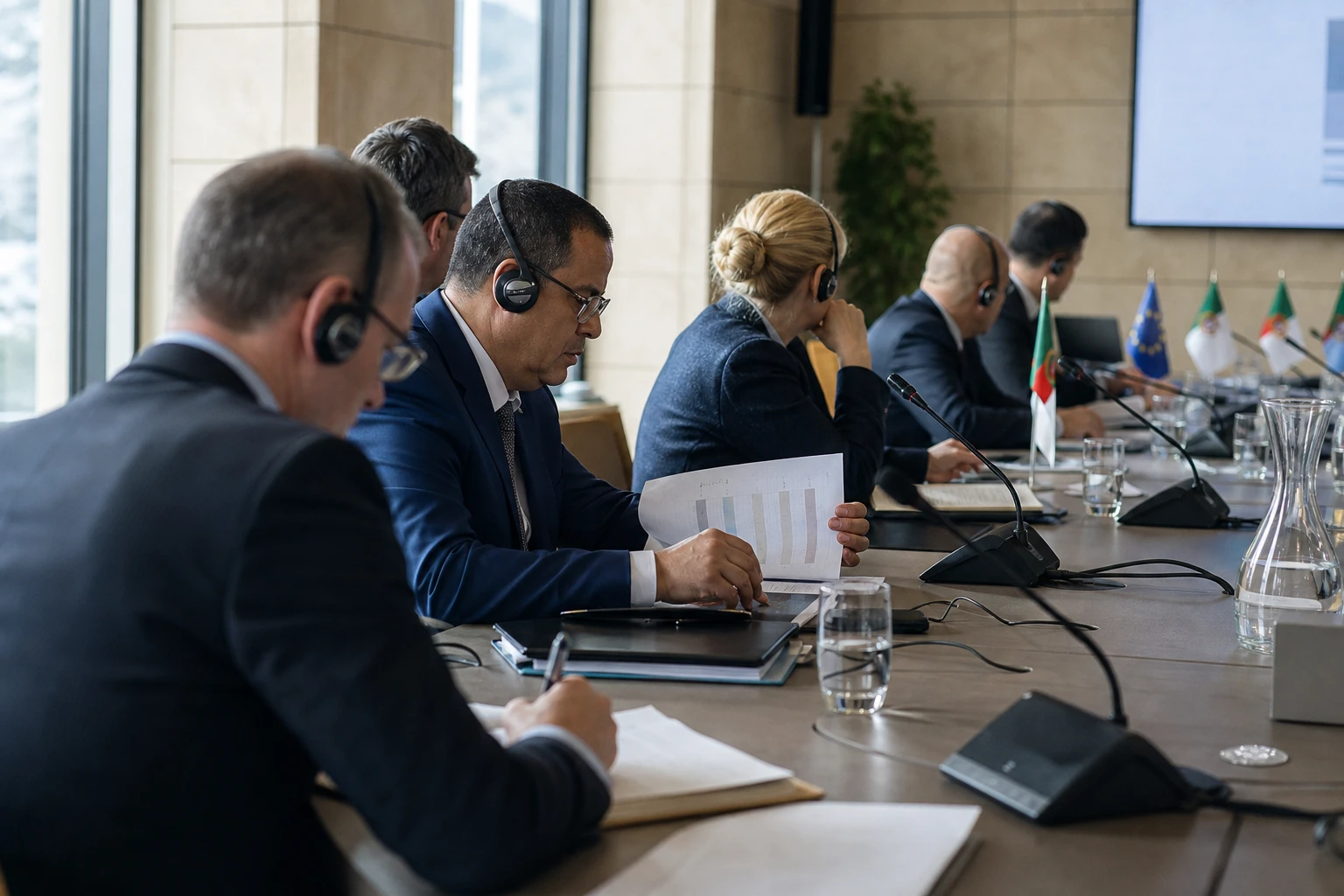
For Algeria, the SoutH2 corridor is more than a pipeline linking the Sahara to Europe. The real question is how much value can be created before export: production, equipment, desalination, maintenance, jobs and initial industrial markets.
A Euro-Maghreb project still taking shape
The SoutH2 Corridor is intended to link Algeria and Tunisia with Italy, Austria and Germany. The proposed route extends for about 3,300 kilometres. It relies largely on the conversion of existing gas networks and on new interconnections between North Africa and central Europe.
The project received formal political backing in Rome on 21 January 2025. Algeria, Tunisia, Italy, Austria and Germany then signed a joint declaration of intent. The European Commission and Switzerland took part in the meeting as observers. The corridor is also among Europe’s projects of common interest, meaning infrastructure considered strategic for the European Union’s networks.
In August 2026, Algeria’s Minister of Energy and Renewable Energy, Mourad Adjal, proposed holding a new meeting with the countries concerned in Algeria. The initiative aimed to speed up technical and economic decisions. It does not, on its own, establish that a second ministerial meeting has already taken place in Algiers.
The timetable therefore remains open. The project’s promoters envisage the corridor entering service in the early 2030s, with capacity potentially reaching several million tonnes of renewable hydrogen a year. However, studies, purchase contracts and financing for the facilities still have several stages to clear.
Financing will determine the Maghreb’s role
The first challenge concerns upstream investment. Producing renewable hydrogen requires solar and wind power plants, electrolysers, water treatment units, storage capacity and strengthened electricity networks.
Electrolysis separates water into hydrogen and oxygen using electricity. In theory, about nine litres of pure water are needed to produce one kilogram of hydrogen. In practice, treatment, losses and cooling operations increase consumption.
At an announced capacity of four million tonnes a year, the theoretical scale exceeds 36 million cubic metres of water. This volume is not yet a definitive estimate of the project’s consumption. It nevertheless illustrates the importance of the issue for Algeria and Tunisia, two countries facing mounting pressure on their water resources.
Desalination can reduce competition with drinking water and agricultural use. However, it requires electricity and infrastructure, as well as careful management of saline discharges. The climate solution will therefore be credible only if the energy used by desalination plants remains largely renewable.
There is also a risk of unbalanced financing. European networks may benefit from EU mechanisms intended for strategic infrastructure. By contrast, Algerian and Tunisian facilities will need to attract substantial capital before export revenues are guaranteed.
European certification will affect costs
Hydrogen destined for the European market will have to comply with the rules for renewable fuels of non-biological origin, often referred to by the acronym RFNBO. These rules must demonstrate that the electricity used comes from renewable sources and delivers a significant reduction in emissions.
European requirements include the additionality of renewable capacity, its geographical proximity and the temporal correlation between electricity production and hydrogen production. For Algerian and Tunisian producers, these criteria could increase costs and delay the launch of the first facilities.
Certification is thus becoming an industrial issue. It will determine which equipment is accepted, what data must be collected and which bodies can verify the origin of the electricity. It will also affect the final price paid by European buyers.
The corridor cannot move forward on the basis of broad announcements. Partners will have to specify volumes, prices, delivery guarantees and the allocation of risks. Without long-term purchase contracts, banks will struggle to finance facilities on this scale.
Producing in Algeria, rather than crossing Algeria
Algiers is seeking to make SoutH2 part of a broader industrial strategy. In October 2024, Sonatrach and Sonelgaz signed a memorandum of understanding with Germany’s VNG, Italy’s Snam, SeaCorridor and Austria’s Verbund. The partners are to assess the feasibility of an integrated chain, from production in Algeria to transport to Europe.
This chain could create scope for local equipment manufacturing. Sonatrach has notably held discussions with Bosch on a national sector that would include studying the production of electrolysers. A separate agreement with Siemens Energy covers maintenance and digitalisation.
Turning these memorandums into industrial activity will be decisive. An electrolyser factory, maintenance workshops and training centres would retain more value in Algeria than a simple injection point on a network intended for export.
The same issue applies to Tunisia. The country is working on a national hydrogen network, the Tunisian Hydrogen Backbone, intended to link production areas to the corridor. In southern Tunisia, projects are also seeking to produce renewable hydrogen or ammonia for export.
Local demand should not be overlooked. Gabès’s chemical and fertiliser industries could provide markets for some of Tunisia’s production. In Algeria, hydrogen could also gradually help decarbonise certain industrial activities, rather than being shipped entirely to Europe.
A test for the Euro-African energy partnership
The precedent of Desertec remains in people’s minds. Launched in 2009 around a large-scale solar project intended in particular for Europe, it fuelled criticism over the place afforded to producing territories and local needs. SoutH2 will have to avoid reproducing that imbalance.
For Algeria, the project is part of an already extensive energy relationship with Europe, particularly Italy. For Tunisia, it could strengthen links with the European market, but also increase its dependence on decisions made beyond its borders.
At African Union level, the project raises a broader question: how can clean energy be exported without exporting only the resource and the jobs associated with it? The answer will depend on industrial clauses, access to water, training and the role given to African markets.
The next milestones will therefore be practical: publication of feasibility studies, clarification of financing, selection of initial projects, purchase contracts and definition of certification mechanisms. SoutH2’s success will be measured less by the length of the pipeline than by the share of the value chain that remains in North Africa.