Egypt
 Libya
 Morocco
 Sudan
 Tunisia
 Benin
 Burkina Faso
 Cabo Verde
 Côte d'Ivoire
 Ghana
 Guinea
 Guinea-Bissau
 Liberia
 Mali
 Mauritania
 Niger
 Nigeria
 Senegal
 Sierra Leone
 The Gambia
 Togo
 Cameroon
 Central African Republic
 Chad
 DR Congo
 Equatorial Guinea
 Gabon
 Republic of the Congo
 São Tomé and Príncipe
 Burundi
 Comoros
 Djibouti
 Eritrea
 Ethiopia
 Kenya
 Madagascar
 Malawi
 Mauritius
 Mozambique
 Rwanda
 Seychelles
 Somalia
 South Sudan
 Tanzania
 Uganda
 Angola
 Botswana
 Eswatini
 Lesotho
 Namibia
 South Africa
 Zambia
 Zimbabwe
When expertise leaves the country, but not the nation
In Algeria, the question of the scientific diaspora is no longer simply a matter of calling on people to return. The focus is shifting towards a more pragmatic idea: bringing researchers based abroad together with laboratories in Algiers, without requiring them to leave permanently or making a symbolic repatriation. The new High Council for the National Scientific Community Abroad is part of this approach, presented as a networking tool rather than a prestigious institution.
This shift matters in a country whose public universities produce a large number of graduates, but where the bridges between research, innovation and industry remain too fragile. The Sidi Abdellah Scientific and Technological Hub in Algiers is now the setting for this new approach: anchoring science in visible institutions, then opening it up to the outside world.
An institution at the highest level of the state
The High Council was approved at a Council of Ministers meeting on 21 June 2026, chaired by Abdelmadjid Tebboune and devoted in part to scientific research and digitalisation. Several associations and Algerian professionals based abroad subsequently welcomed its creation, seeing it as a strong political signal to the scientific diaspora.
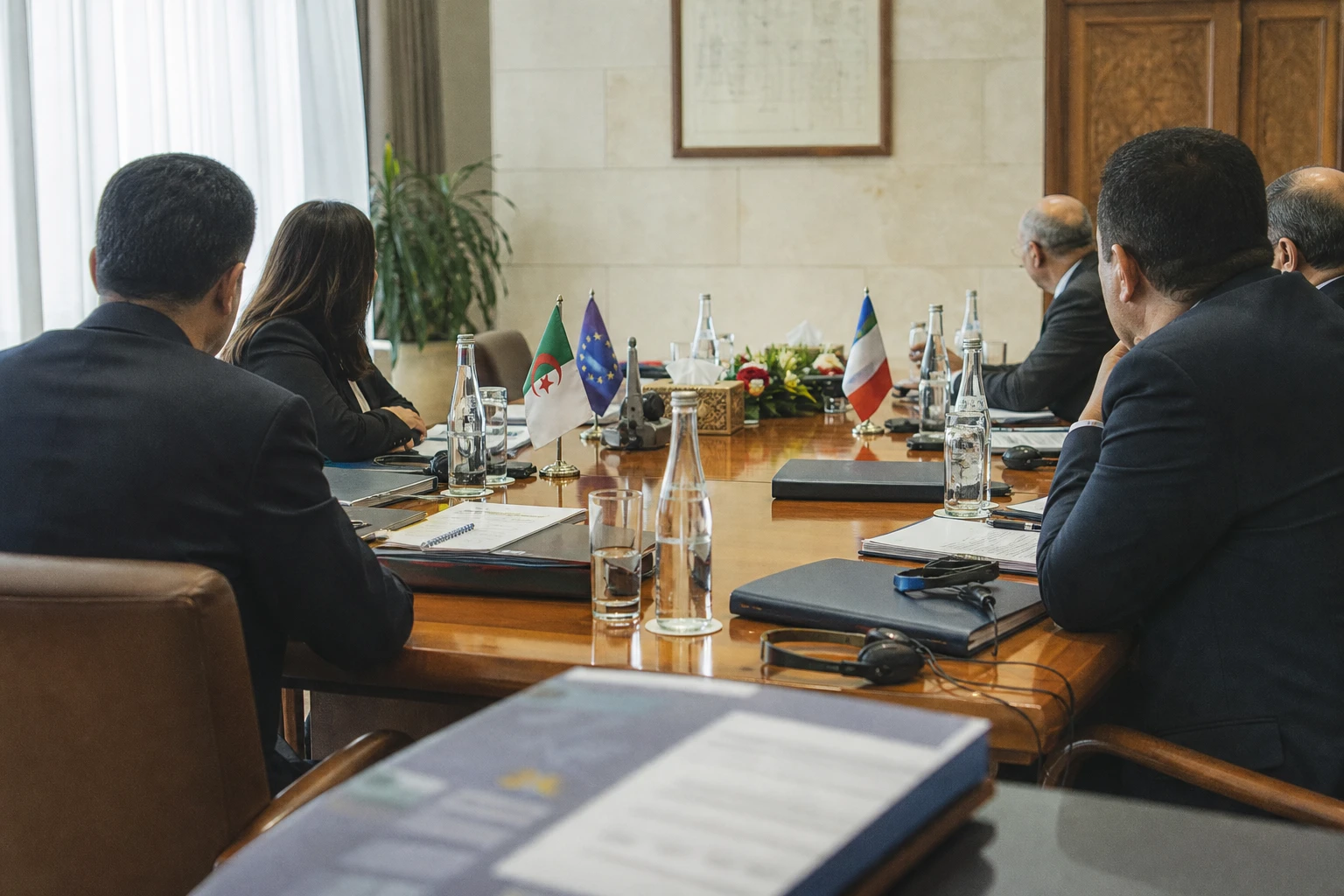
The inaugural meeting opened on 28 June 2026 in Sidi Abdellah, with 31 Algerian researchers and experts based abroad, according to APS. The body was presented as autonomous administratively and financially, and placed directly under the authority of the presidency. This institutional detail is significant: it shows that science in Algeria is being treated as a strategic issue, not simply as an aspect of higher education.
The Minister of Higher Education and Scientific Research, Kamel Baddari, described the creation of the council as the fulfilment of a presidential commitment to Algerian scientists abroad. On the same day, the coordinating committee’s chair, Professor Elias Zerhouni, highlighted the political will behind the initiative. The aim is clear: to give institutional form to ties that sometimes existed informally, but lacked a stable framework and continuity.
Melikechi, a figure connecting Algiers and Boston
The first practical extension of this framework took shape around physicist Noureddine Melikechi. On 12 August 2026, Kamel Baddari received him in Algiers as a founding member of the High Council. The ministry said the meeting focused on the Council’s initial steps and on an academic mobility plan between the Sidi Abdellah Scientific and Technological Hub and the University of Massachusetts Lowell.
The project envisages exchanges of teachers and students, as well as technology transfer in areas considered strategic. This detail matters. It shows that the aim is not merely to organise conferences or protocol visits, but to create a practical exchange of methods, equipment and expertise between Algerian and American institutions.
Melikechi’s career gives this development added significance. A professor at the University of Massachusetts Lowell, he is described by his university as a member of NASA’s Mars Science Laboratory mission and a contributor to the analysis of spectroscopic data from ChemCam, the instrument aboard the Curiosity rover. NASA says ChemCam analyses rocks, soil and Martian dust on a very small scale.
Born in 1958 in Thénia and educated at the Houari Boumediene University of Science and Technology, then at Sussex, Melikechi has built his career across Algeria, the United Kingdom and the United States. His profile illustrates a central point: the scientific diaspora is not an abstract pool of talent. It consists of careers, laboratory networks, access to equipment, publications and academic responsibilities. These are the assets Algerian institutions are now seeking to harness.
The physicist has also received a NASA Group Award for work with the ChemCam team, a detail confirmed by his university biography. This kind of recognition carries weight when it comes to technology transfer: this is not a symbolic figure, but a scientist already integrated into high-level research networks.
Zerhouni, institutional experience and the logic of building bridges
The High Council also draws on figures able to connect different institutional worlds. Elias Zerhouni is the most visible example. The NIH says he led the institution from 2002 to 2008. Johns Hopkins also says he held senior positions at the university, following a medical and academic career in the United States.
The biographical detail matters less for the personal story than for what it says about the system Algiers has in mind. The Council is not looking only for prestigious researchers. It wants intermediaries able to speak the language of Algerian universities, North American research networks and public administrations. That is often what makes the difference between an announcement and genuine co-operation.
This approach reflects a broader trend. Across several African countries, governments are trying to build more structured links with professionals based outside the continent. Algeria is part of this movement, with one distinctive feature: coordination runs through the presidency and the Ministry of Higher Education, giving the issue greater political weight than a conventional university programme.
What Algeria can gain, and what it will need to measure
For Algiers, the challenge is twofold. The country wants to avoid a one-way brain drain that impoverishes universities and slows innovation. At the same time, it wants to turn that same diaspora into a resource for co-operation. The calculation is rational: a researcher in Boston, Paris or Montreal can supervise doctoral students, provide access to a laboratory, negotiate a joint project or support a patent application without changing their place of residence.
But success will not depend on the names announced alone. It will be measured through concrete indicators: signed projects, funding secured, actual mobility, jointly supervised theses, co-authored publications, shared equipment and, potentially, industrial benefits. Without these, the High Council would remain just another advisory body. With them, it would become a lever of scientific sovereignty.
Across the continent, Algeria’s initiative resonates in North Africa, where competition over knowledge, artificial intelligence, health and space technologies is intensifying. It also concerns the continent as a whole, where the African Union has for several years promoted the idea of an economy based on skills, research and innovation. By elevating the issue to state level, Algeria is sending a simple message: the diaspora is not merely part of the nation’s past; it can become an infrastructure for development.
The next test will be whether the initiative lasts. The High Council will have to show that it can produce more than an inaugural photograph. The coming months will reveal whether the bridge between Sidi Abdellah and major foreign universities leads to measurable co-operation, or remains a well-worded promise.