Algeria
 Libya
 Morocco
 Sudan
 Tunisia
 Benin
 Burkina Faso
 Cabo Verde
 Côte d'Ivoire
 Ghana
 Guinea
 Guinea-Bissau
 Liberia
 Mali
 Mauritania
 Niger
 Nigeria
 Senegal
 Sierra Leone
 The Gambia
 Togo
 Cameroon
 Central African Republic
 Chad
 DR Congo
 Equatorial Guinea
 Gabon
 Republic of the Congo
 São Tomé and Príncipe
 Burundi
 Comoros
 Djibouti
 Eritrea
 Ethiopia
 Kenya
 Madagascar
 Malawi
 Mauritius
 Mozambique
 Rwanda
 Seychelles
 Somalia
 South Sudan
 Tanzania
 Uganda
 Angola
 Botswana
 Eswatini
 Lesotho
 Namibia
 South Africa
 Zambia
 Zimbabwe
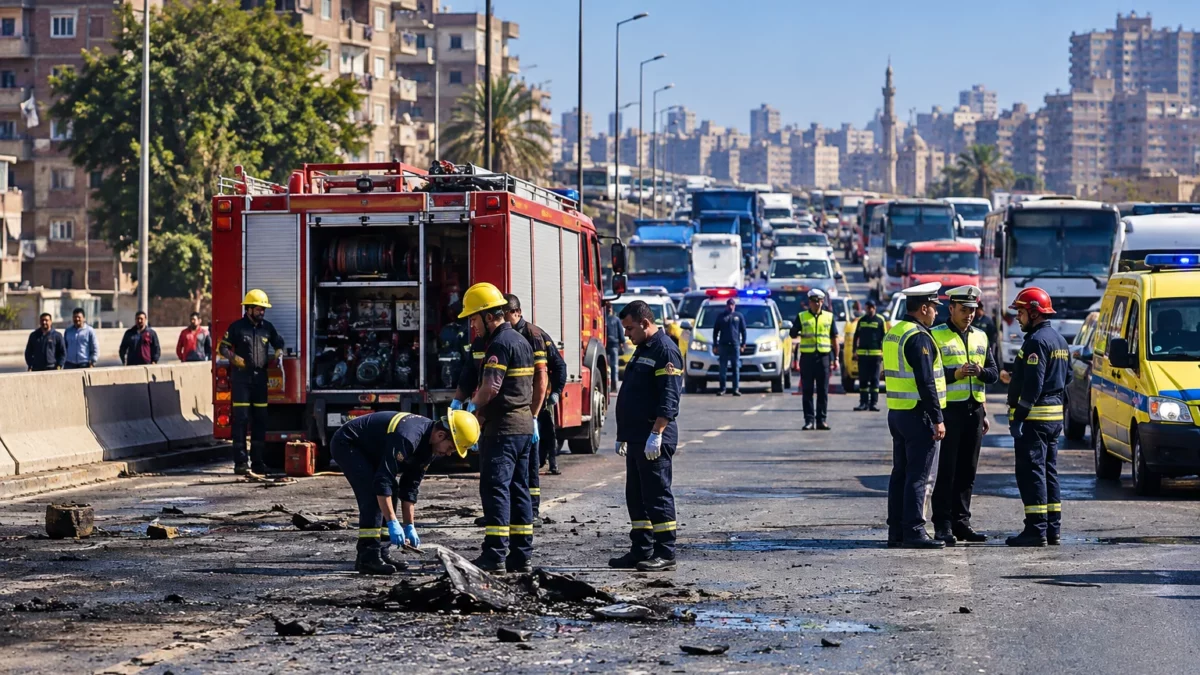
On Cairo’s ring road, a tanker truck accident turned a busy route into a fire trap. Beyond the human toll, the Warraq tragedy raises a practical question for residents of the Egyptian capital: how can road users be protected when heavy traffic, the transport of hazardous materials and emergency response converge?
Fire on a major Greater Cairo road
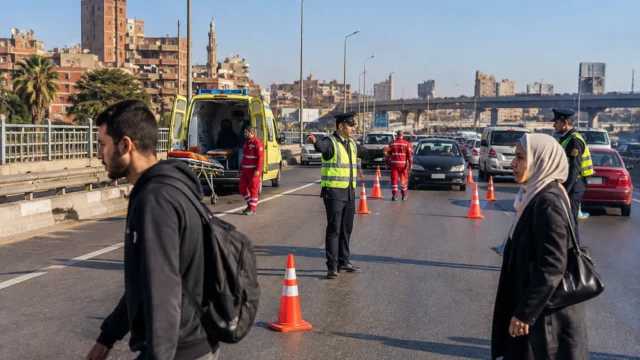
The incident occurred on Wednesday 25 November 2026, on the ring road around Cairo, near the Warraq district in the Imbaba area of Giza governorate. The road links the capital with several neighbouring governorates and carries heavy traffic every day.
A truck carrying petroleum products caught fire after an accident. The flames spread to nearby vehicles. Hundreds of people gathered close to the scene, while families waited for news of their relatives at hospitals in the area.
The death toll changed as rescue operations continued. Egypt’s health ministry ultimately reported 31 deaths and 21 injuries. These figures were also reported by several Egyptian and international media outlets. The initial counts were different, citing 30 deaths and varying numbers of injured people. This changing toll is a reminder of why figures established in the first hours should be presented as provisional.
The authorities deployed ambulances and transferred the injured to several facilities, including Imbaba General Hospital. President Abdel-Fattah al-Sissi offered his condolences to the families and called for the injured to receive the necessary care. The public prosecutor’s office has opened an investigation to determine the precise circumstances of the accident.
A local tragedy with national road safety implications
Warraq is in a densely populated urban area, where residential neighbourhoods sit alongside major roads. The closure or disruption of a section of the ring road also affects travel towards Giza and neighbouring governorates. The consequences therefore extend beyond the motorists involved, affecting residents, workers and emergency services.
The tragedy is part of a wider problem. According to Egypt’s statistics agency CAPMAS, road accidents caused 5,260 deaths in 2024, down from 5,861 in 2023. The annual fall in deaths does not erase the scale of the risk. The number of people injured, meanwhile, increased in 2024, reaching 76,362, compared with 71,016 the previous year.
These national statistics do not, by themselves, explain what happened in Warraq. They do, however, show that road safety remains a long-term challenge for Egypt. The causes of an accident must be established by the investigation, rather than automatically inferred from general trends such as speed, vehicle condition or infrastructure.
In an accident involving an inflammable cargo, safety also depends on specific factors: transport conditions, the truck’s mechanical condition, separation of traffic flows and the ability to contain a fire quickly. The investigation will have to establish which of these played a role in this case. At this stage, it would be premature to assign definitive responsibility.
Expectations for action beyond the investigation
For families, the immediate priorities are identifying the victims, supporting the injured and obtaining reliable information. For the authorities, the investigation must establish the sequence of events and check whether the rules governing the transport of petroleum products were followed. Medical follow-up for the injured and transparency about the findings also matter in the days after a tragedy of this scale.
The response does not rest solely with drivers. It also involves monitoring heavy goods vehicles, planning routes for hazardous materials and co-ordinating the police, firefighters, ambulance services and hospitals. On a road as busy as Cairo’s ring road, emergency services must be able to respond without worsening traffic jams or putting other road users at risk.
Regionally, Egypt is a North African country and a member of the African Union. It is not part of the Arab Maghreb Union. The Warraq case is therefore not one involving a single regional bloc, but it reflects a shared concern across the continent: reducing road deaths while developing transport networks essential to trade and everyday life.
What happens next will depend on the investigation’s findings and the measures made public. The next developments to watch are the prosecutor’s conclusions, the condition of the injured and any decisions on transporting inflammable cargo on Greater Cairo’s main roads.
For context on the available data, consult the CAPMAS statistical report on road deaths in 2024. Details of the accident were cross-checked against information published by Ahram Online, Daily News Egypt and the Associated Press.