Algeria
 Libya
 Morocco
 Sudan
 Tunisia
 Benin
 Burkina Faso
 Cabo Verde
 Côte d'Ivoire
 Ghana
 Guinea
 Guinea-Bissau
 Liberia
 Mali
 Mauritania
 Niger
 Nigeria
 Senegal
 Sierra Leone
 The Gambia
 Togo
 Cameroon
 Central African Republic
 Chad
 DR Congo
 Equatorial Guinea
 Gabon
 Republic of the Congo
 São Tomé and Príncipe
 Burundi
 Comoros
 Djibouti
 Eritrea
 Ethiopia
 Kenya
 Madagascar
 Malawi
 Mauritius
 Mozambique
 Rwanda
 Seychelles
 Somalia
 South Sudan
 Tanzania
 Uganda
 Angola
 Botswana
 Eswatini
 Lesotho
 Namibia
 South Africa
 Zambia
 Zimbabwe
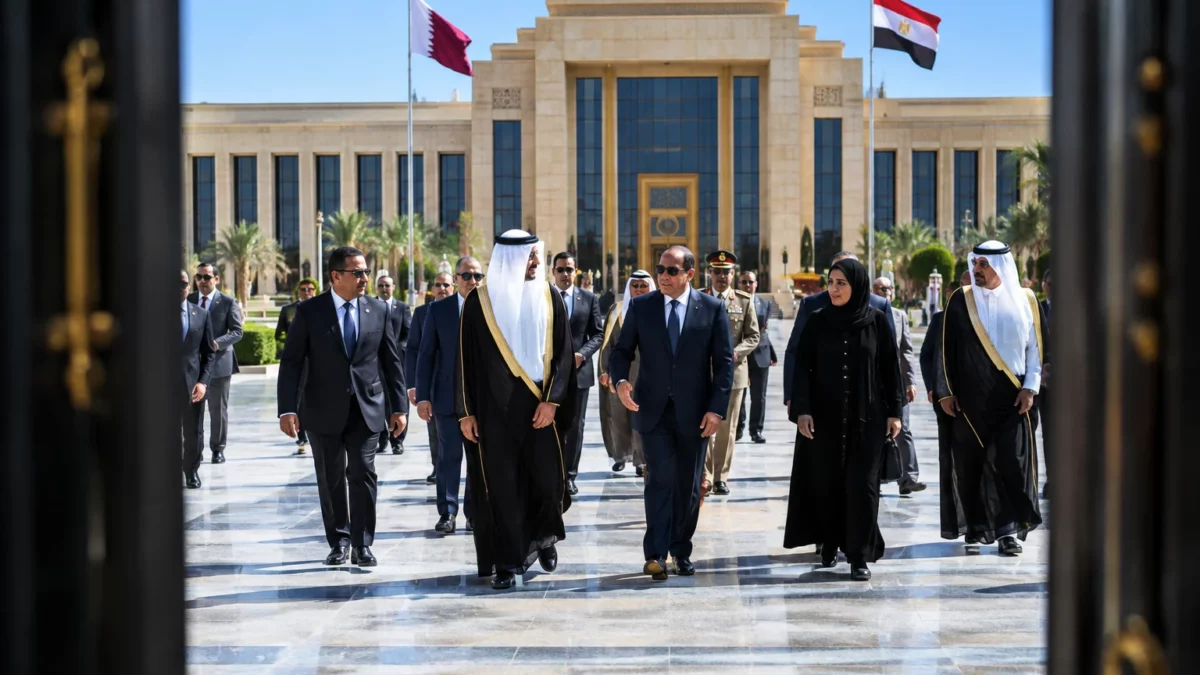
In June 2022, the resumption of dialogue between Egypt and Qatar played out on two closely linked fronts: economic interests and regional security. In Gaza, the two countries have useful diplomatic channels. In Cairo, the meeting was also meant to give tangible substance to the rapprochement launched after several years of estrangement.
A rapprochement still in its early stages
Emir Sheikh Tamim bin Hamad Al Thani’s visit to Egypt took place on 24 and 25 June 2022. It was his first official visit to the country since 2015, according to reports published at the time. President Abdel Fattah Al-Sisi received him at Al-Ittihadiya Palace in Cairo for bilateral talks. The Egyptian presidency’s account of the 25 June talks confirms the venue and that discussions took place.
The visit came after the 2017 diplomatic crisis. Egypt, along with Saudi Arabia, the United Arab Emirates and Bahrain, had severed relations with Doha. The Al-Ula reconciliation in January 2021 paved the way for the restoration of ties. The emir’s visit therefore marked an important political milestone, without instantly erasing disagreements or guaranteeing that announced exchanges would quickly translate into projects.
Economy and energy: turning statements into trade
The two leaders expressed their determination to strengthen co-operation and increase economic exchanges. Energy was also among the areas of interest. The Egyptian statement presented the visit as a sign of progress in bilateral relations, while Egyptian media reported that the talks covered investment and economic ties. These announcements set out a political direction; on their own, they do not prove that contracts have been signed or results already achieved.
The economic context gives this ambition practical significance. According to figures from CAPMAS, Egypt’s public statistics agency, the value of trade between the two countries reached $128.4 million in 2024, up from $72.1 million in 2023. This figure, published later by Egypt’s State Information Service, shows an increase, but should not be confused with an assessment of the 2022 visit. Rather, it is a reminder that economic ties continued to evolve after the diplomatic rapprochement. Egyptian data on bilateral trade in 2024 also detail recorded exports, imports and investment.
For Egypt, attracting capital and broadening its markets serve national economic objectives. For Qatar, the talks offer opportunities for investment and co-operation with a large regional market. But the benefits are not automatically shared across the population: their reach depends on the sectors involved, the jobs created and whether announced projects are delivered. In energy, investment choices can also have different effects on companies, public finances and consumers.
Gaza, a central issue for regional co-ordination
The talks also covered the Gaza Strip and the Palestinian question. Al-Sisi advocated the establishment of an independent Palestinian state on the lines of 4 June 1967, with East Jerusalem as its capital, a position reiterated in the presidential statement. This is the Egyptian president’s diplomatic position, not an agreement reached between the parties to the conflict.
Cairo’s role is partly explained by its geographical proximity to Gaza and its relations with regional actors. Doha, for its part, has specific diplomatic channels. Co-ordination between the two capitals can therefore matter to mediation efforts, although it is not enough to guarantee a ceasefire or a political settlement. In May 2025, the two governments issued a joint statement on their mediation efforts in Gaza, showing that this co-operation continued well beyond the 2022 visit. The joint Egyptian-Qatari statement on mediation in Gaza sets out the official terms.
Significance beyond the two capitals
This relationship operates across the Arab world and the Middle East, while also directly concerning North Africa. Egypt is a member of the African Union, but the framework for this visit was primarily bilateral and Arab: it was neither an African Union initiative nor a meeting of the Arab Maghreb Union. This distinction matters when understanding where issues are negotiated and which actors can influence them.
For the public, the economic stakes are measured less by announcements than by investment delivered, jobs and the trade that follows. On the Palestinian issue, the stakes are more immediate: the ability of mediators to keep channels open and secure verifiable progress. The June 2022 visit symbolised normalisation between Cairo and Doha. What followed depended — and still depends — on turning that understanding into lasting co-operation and concrete diplomatic results.