Algeria
 Libya
 Morocco
 Sudan
 Tunisia
 Benin
 Burkina Faso
 Cabo Verde
 Côte d'Ivoire
 Ghana
 Guinea
 Guinea-Bissau
 Liberia
 Mali
 Mauritania
 Niger
 Nigeria
 Senegal
 Sierra Leone
 The Gambia
 Togo
 Cameroon
 Central African Republic
 Chad
 DR Congo
 Equatorial Guinea
 Gabon
 Republic of the Congo
 São Tomé and Príncipe
 Burundi
 Comoros
 Djibouti
 Eritrea
 Ethiopia
 Kenya
 Madagascar
 Malawi
 Mauritius
 Mozambique
 Rwanda
 Seychelles
 Somalia
 South Sudan
 Tanzania
 Uganda
 Angola
 Botswana
 Eswatini
 Lesotho
 Namibia
 South Africa
 Zambia
 Zimbabwe
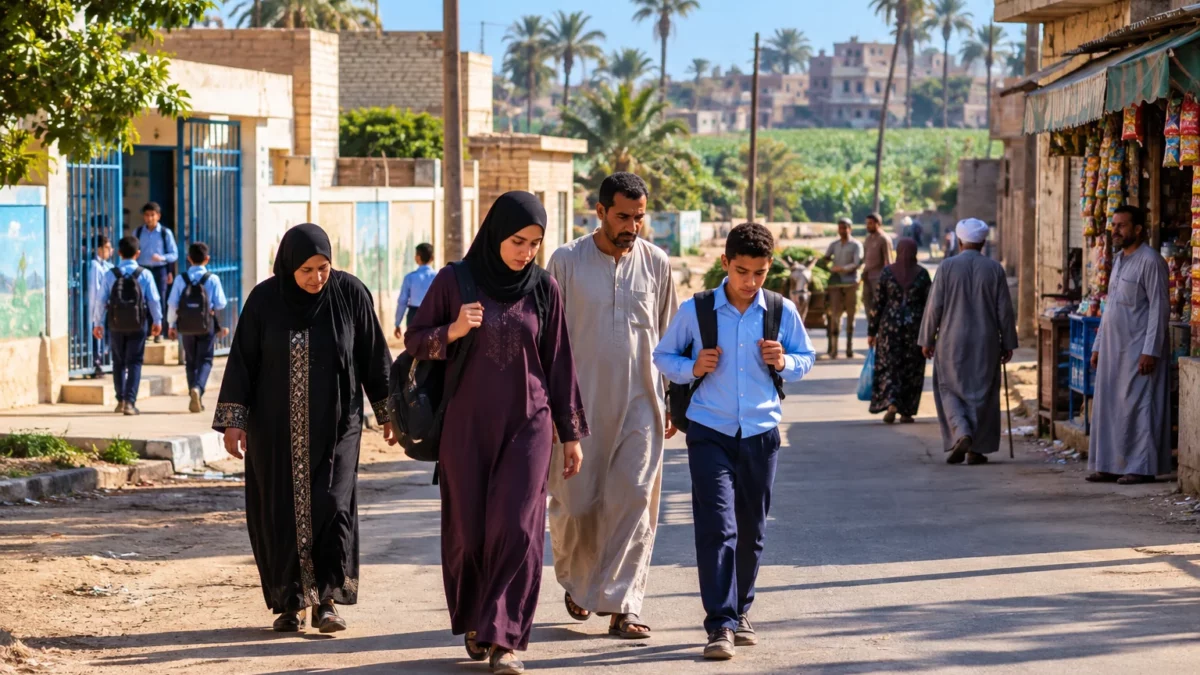
In Geziret Fadel, in the Nile Delta, exile is not merely a memory passed down to children. It continues to weigh on families’ efforts to secure schooling, healthcare and career prospects, even after several generations of Palestinians have settled in Egypt. The war in Gaza has also revived an old fear: that displacement could become permanent.
A status passed down without guaranteeing stability
In 1948, Shamma Abu Hussein left Beersheba, in what is now southern Israel, with her family. Now 90, she remembers a flight lasting several days to Egypt. Her mother died on the journey, she says. Her story, recounted in a report from Geziret Fadel in October 2026, is that of a community whose descendants were born on Egyptian soil but do not necessarily hold citizenship.
The village in Sharqiya province is home to around 4,000 Palestinians, according to information gathered locally. This figure refers to the village, not the Palestinian community across the country as a whole. Residents interviewed say that renewing residence permits and paying fees related to education or administrative procedures can place a heavy burden on family budgets.
Selmi Soliman al-Namouli, a 63-year-old agricultural labourer, says he is treated as a foreigner in official dealings, although he, his father and his children were all born in Egypt. His daughter was unable to continue her studies at university because the family could not afford it. His nephew Farid, now 25, also left school before higher education and works in a village shop.
An Egyptian trajectory marked by change
The current situation is rooted in a contrasting political history. Under Gamal Abdel Nasser, Palestinians had relatively broad access to education and employment. But from 1978, administrative rules increasingly subjected them to procedures applicable to foreigners, particularly for residence, work and university fees. The United Nations High Commissioner for Refugees (UNHCR) historical overview documents this shift.
The debate in Cairo centres on two concerns that coexist. The Egyptian authorities regularly affirm their support for Palestinians and reject any forced transfer or permanent settlement outside their territory. At the same time, families already established in Egypt describe the practical effects of a status that does not grant them the same rights as citizenship. Refusing to naturalise them in the name of the right of return does not, by itself, resolve the obstacles they face in everyday life.
Assistance arrangements create an additional difficulty. Unlike Jordan, Lebanon and Syria, Egypt is not among the areas where UNRWA, the United Nations agency for Palestinian refugees, provides its usual services. UNHCR, meanwhile, generally does not include Palestinians in its protection programme in Egypt. Some displaced families from Gaza have received one-off assistance, including from the Egyptian Red Crescent, but this does not amount to a regular safety net covering the entire community.
Gaza has increased pressure, but the figures remain uncertain
Since the war in Gaza began in October 2023, tens of thousands of Palestinians have arrived in Egypt. Estimates vary according to the dates and counting methods used. Palestinian officials cited in a study published in 2025 put the number of arrivals from Gaza at more than 120,000. Other public estimates have given lower figures. The absence of a common status and a complete register makes it impossible to present a single total as certain.
These arrivals do not mean that the Rafah crossing was opened without restriction for permanent settlement. Some of those evacuated entered for medical treatment; others held dual nationality or left Gaza under particular circumstances. The Egyptian government opposes the permanent displacement of the Palestinian population to Sinai or other parts of the country, fearing that an imposed departure could jeopardise the right to return to Gaza.
This position is shaped by geography as well as politics: Egypt shares the Rafah border with Gaza and plays a central role in regional discussions on aid and ceasefires. Cairo advocates keeping Palestinians on their land, while the conditions for receiving those already in Egypt remain a separate issue, particularly visible in schools, public services and residence procedures.
Everyday rights and the right of return
For residents of Geziret Fadel, the immediate issue is not always returning to a place that younger people have never known. It is also being able to study, work and access healthcare without every formality becoming a financial or administrative obstacle. Rural families, such as those dependent on agriculture or small businesses, have less room to absorb repeated fees than households better established in large cities.
Egypt’s asylum law, adopted in 2024, created a new national framework for protection claims. However, a report by the Refugees Platform in Egypt, published through the AIDA legal information database, identifies shortcomings and says implementation remains incomplete. Palestinians continue to face a particular situation: their access to ordinary protection mechanisms does not automatically follow from their presence in the country.
The phrase “permanent Nakba”, used by Lubnah Shomali of the Palestinian organisation BADIL, expresses the continuity of displacement and uncertainty. It is her analysis, not a legal category. Across the region, the issue brings two imperatives into tension: preserving Palestinians’ right of return and guaranteeing concrete rights to people who have lived for decades in neighbouring countries.
For Egypt, a member of the African Union and a North African actor, monitoring therefore extends beyond border crossings. It also concerns implementation of the new asylum framework, access to education and healthcare, and developments in Gaza. In Geziret Fadel, Shamma Abu Hussein’s story is a reminder that preventing another exodus and protecting families already displaced are related, but distinct, challenges.