Algeria
 Egypt
 Libya
 Morocco
 Sudan
 Tunisia
 Benin
 Burkina Faso
 Cabo Verde
 Côte d'Ivoire
 Ghana
 Guinea
 Guinea-Bissau
 Liberia
 Mali
 Mauritania
 Niger
 Nigeria
 Senegal
 Sierra Leone
 The Gambia
 Togo
 Cameroon
 Central African Republic
 Chad
 DR Congo
 Equatorial Guinea
 Gabon
 Republic of the Congo
 São Tomé and Príncipe
 Burundi
 Comoros
 Djibouti
 Eritrea
 Ethiopia
 Kenya
 Madagascar
 Malawi
 Mauritius
 Mozambique
 Rwanda
 Seychelles
 Somalia
 South Sudan
 Tanzania
 Angola
 Botswana
 Eswatini
 Lesotho
 Namibia
 South Africa
 Zambia
 Zimbabwe
A power line or water network does not transform an economy on its own. Households must be able to connect to it, and local businesses must have the means to produce. Only under these conditions can external aid support growth in Uganda, rather than fund equipment with no lasting benefits.
National priorities rooted in East Africa
In Kampala, the government presents its tenfold growth strategy as a means of accelerating the country’s economic transformation. It focuses in particular on agro-industry, tourism, minerals, and science, technology and innovation. The stated aim is to raise gross domestic product to $500 billion by 2040.
This ambition is also part of a regional framework. Uganda belongs to the East African Community (EAC), which brings several countries in the region together around economic co-operation and integration projects. Electricity, agricultural trade and cross-border infrastructure therefore affect the markets available to Ugandan producers, as well as connections with neighbouring countries.
The challenge is tangible. According to World Bank data, 55.3% of Uganda’s population had access to electricity in 2024, compared with 44.8% in rural areas. These two indicators measure access among the population, not the quality of service or its cost to households and businesses. The gap between towns and the countryside nevertheless remains significant.
Co-operation announced in Kampala
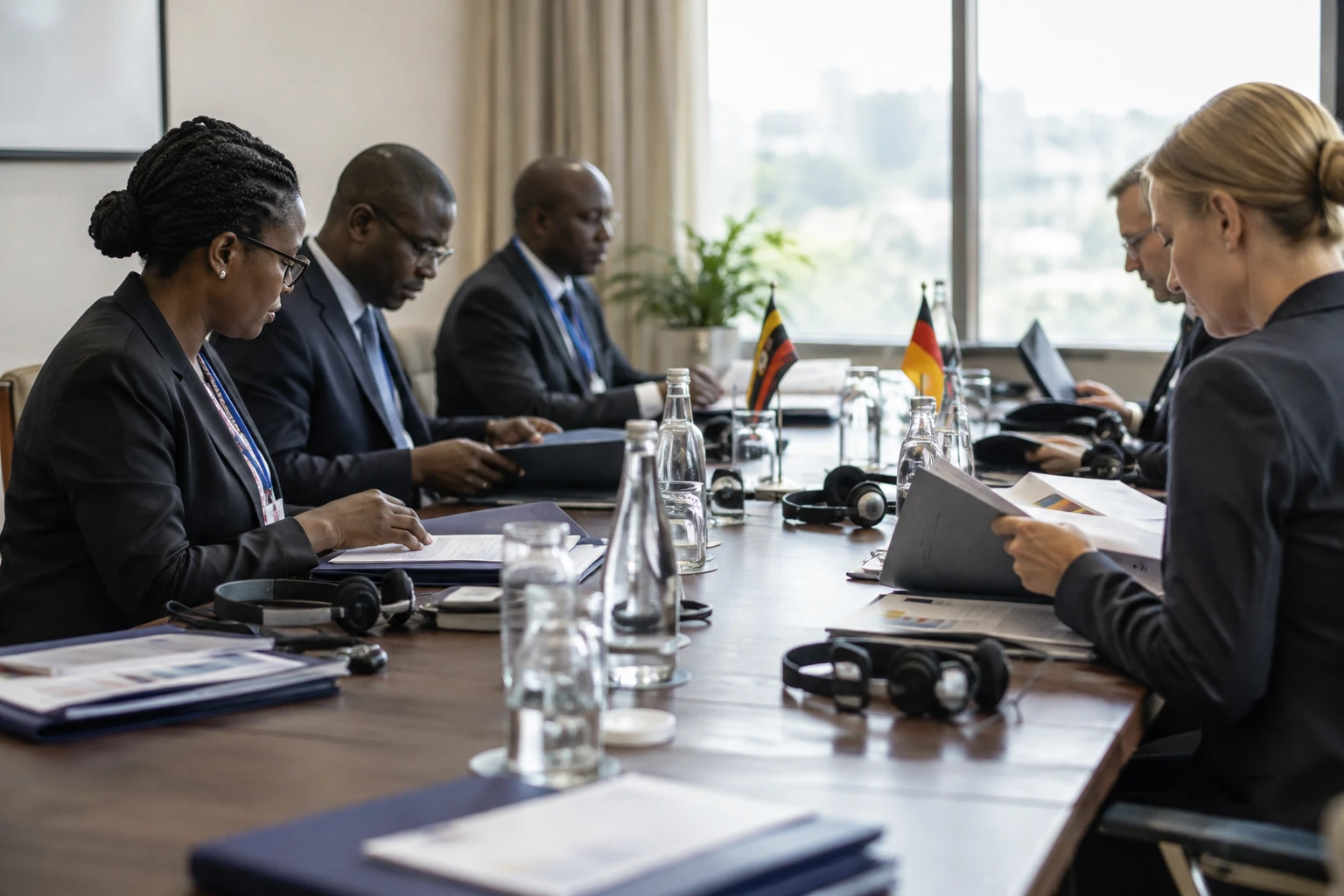
The Ugandan and German governments concluded their co-operation negotiations on 3 November 2026 in Kampala. Uganda’s Ministry of Local Government confirms that agreements were signed on that date. It details €10 million for the proposed SCALE project and €3 million for PARWEST, two initiatives linked to local economic development and communities hosting refugees.
A total package of €50 million, including financial and technical components in water, electricity, agro-industry and the local economy, has also been reported. However, the public information consulted does not make it possible to independently verify the full amount or its detailed allocation. These reported figures should therefore be distinguished from the €13 million that the ministry confirms for SCALE and PARWEST.
Projects cited in the reported allocation include the electrification of the West Nile region, for which €18 million is earmarked. The region borders the Democratic Republic of the Congo and South Sudan. Access to electricity could help farms and businesses operate there. But the impact will depend on the construction timetable, connection costs and the network’s ability to provide a reliable service.
The negotiations extend a long-standing partnership, established in 1962 according to German institutional information. Berlin committed €58.4 million in grants in 2020, followed by €68.8 million in 2022. These earlier amounts illustrate the continuity of co-operation, without guaranteeing that every project will meet its objectives or that the new sums have already been disbursed.
From infrastructure to productive activity
For rural farms, electricity can make it possible to process, preserve or package crops closer to where they are grown. This can reduce losses and open up markets. For small businesses, the challenge is also to replace costly or unreliable energy sources. However, a new line is not enough if tariffs remain unaffordable or productive equipment is lacking.
Water projects have an equally direct impact on households and economic activity. More convenient and reliable access can reduce the time spent collecting water, support local services and contribute to agricultural production. The benefits may therefore vary between areas: urban centres often have more developed networks, while rural and border areas depend more heavily on infrastructure expansion.
The Ministry of Local Government presents SCALE and PARWEST as tools to attract investment, support businesses and strengthen local economies. It says the co-operation builds on a partnership launched in 2018 and also targets communities hosting refugees. Confirmation of the two funding allocations does not, however, in itself provide information about the final beneficiaries, timelines or expected results in each district.
Ugandan authorities are seeking to link international aid to their own economic strategy. This approach calls for monitoring not only financial commitments, but also contracts awarded, jobs created and the share of value added retained in the country. Local processing of agricultural products and raw materials remains crucial if investment is to benefit producers and workers beyond major construction projects.
An implementation test for the region too
German co-operation is taking place in a context in which African governments are seeking to fund their priorities while broadening economic partnerships. For Uganda, the regional challenge is to better connect national infrastructure with trade involving its EAC neighbours. More accessible energy can support local industries; inadequate connections or high costs can, by contrast, limit that advantage.
The next step will be implementation: specifying the amounts actually committed, publishing timetables and monitoring project results. It will be important in particular to distinguish announced funding from disbursements, and then to check whether equipment reaches the targeted areas. The partnership’s real contribution to the economic goal set for 2040 will be measured at this level — in villages, businesses and host communities.