
 Egypt
 Libya
 Morocco
 Sudan
 Tunisia
 Benin
 Burkina Faso
 Cabo Verde
 Côte d'Ivoire
 Ghana
 Guinea
 Guinea-Bissau
 Liberia
 Mali
 Mauritania
 Niger
 Nigeria
 Senegal
 Sierra Leone
 The Gambia
 Togo
 Cameroon
 Central African Republic
 Chad
 DR Congo
 Equatorial Guinea
 Gabon
 Republic of the Congo
 São Tomé and Príncipe
 Burundi
 Comoros
 Djibouti
 Eritrea
 Ethiopia
 Kenya
 Madagascar
 Malawi
 Mauritius
 Mozambique
 Rwanda
 Seychelles
 Somalia
 South Sudan
 Tanzania
 Uganda
 Angola
 Botswana
 Eswatini
 Lesotho
 Namibia
 South Africa
 Zambia
 Zimbabwe
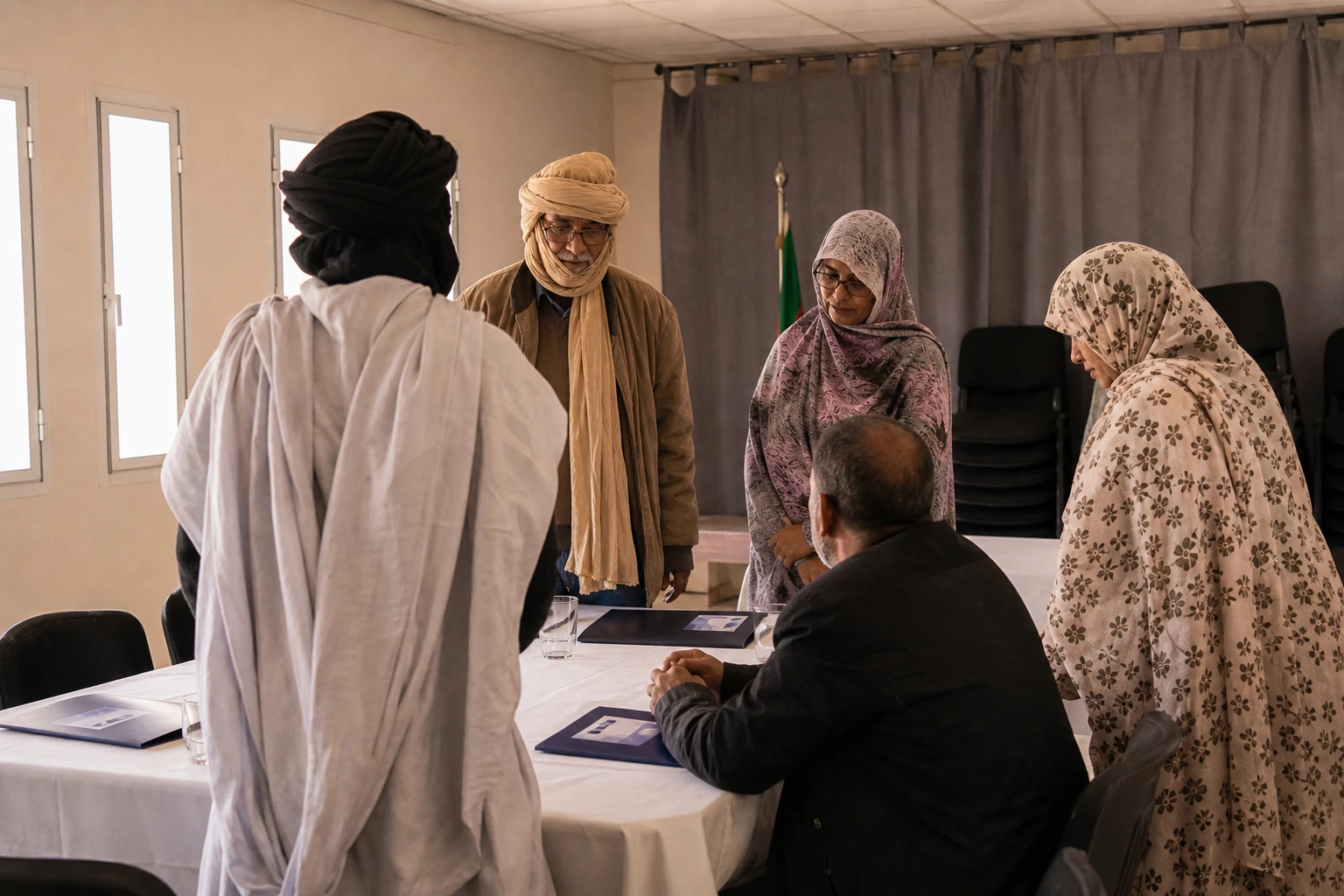
Just weeks before a new decision on the UN mission in Western Sahara, the issue of Sahrawi refugees in Tindouf is back at the centre of the debate. Their exile has lasted for more than 50 years. For the UN High Commissioner for Refugees (UNHCR), this can no longer be regarded as a temporary situation.
An enduring exile with no political way out
On 25 September 2026, UN High Commissioner Barham Salih devoted part of his address to the Security Council to Sahrawi refugees hosted in south-western Algeria. He described their situation as “untenable” and “unsustainable”, after several decades without a definitive settlement.
The statement was made at a meeting on the state of forced displacement around the world. According to the text of the UNHCR address, more than 117 million people are currently forcibly displaced worldwide. Sudan, Yemen, the Democratic Republic of the Congo and Ukraine were among the biggest crises discussed before the Council’s 15 members.
The Sahrawi case accounts for a smaller share of global statistics. Yet it remains exceptional for its longevity. Children born in the camps have become parents, while several generations have grown up without a clear prospect of return, lasting settlement or resettlement.
UNHCR traditionally advocates three durable solutions for refugees: voluntary return, integration in the host country or resettlement in another country. In the case of the Sahrawis, Barham Salih stressed that any solution must start from their own aspirations, so they can make “informed and voluntary” choices.
Tindouf: a humanitarian issue directly tied to the conflict
The first Sahrawi refugees arrived in Algeria in 1975 and 1976, after Spain’s withdrawal and the entry of Moroccan and Mauritanian forces into Western Sahara. Five camps now bear the names of cities in the territory: Laâyoune, Smara, Dakhla, Aousserd and Boujdour.
The camps are on Algerian territory, near Tindouf, but are administered by the Polisario Front. Rabat disputes this arrangement. Algiers, for its part, regards it as a humanitarian reception and continues to support the Sahrawis’ right to self-determination.
The exact number of people living in the camps remains disputed. No census accepted by all parties has resolved the controversy. The World Food Programme nevertheless says it assists more than 133,000 people every month. Humanitarian organisations have also warned of falling funding and deteriorating food rations.
These figures describe humanitarian needs. They cannot automatically be used to determine the composition of any potential electorate. This distinction is essential in a case where demographic data are tied to the political claims of both parties.
Dependence on international aid also affects residents in different ways. In the camps, it directly affects the most vulnerable families. It also undermines local activities, social services and employment opportunities. Young people have less scope to build a future without leaving the region.
MINURSO: mandate renewal and strategic review
The diplomatic calendar gives added weight to UNHCR’s message. By 31 October 2026, the Security Council must consider the future of the United Nations Mission for the Referendum in Western Sahara, MINURSO.
Resolution 2797, adopted on 31 October 2025, extended the mission’s mandate until 31 October 2026. It also asked the Secretary-General to present a strategic review of MINURSO’s future, taking into account the evolution of political discussions.
The text calls on the parties to negotiate on the basis of Morocco’s autonomy proposal. It nevertheless retains the reference to a political solution that ensures the self-determination of the people of Western Sahara. This wording invites opposing interpretations.
Morocco sees it as an endorsement of its autonomy plan. The Polisario Front and Algeria, meanwhile, insist on the principle of the Sahrawi people’s free choice. The resolution therefore does not resolve the central contradiction between autonomy under Moroccan sovereignty and the possibility of a process leading to independence.
The discussion before the Special Committee on Decolonisation shows that this ambiguity remains at the heart of international debate in 2026. Several African delegations continue to stress that the territory’s final status cannot be separated from the will of its people.
For Algeria, a humanitarian and regional issue
Algiers is directly involved in the humanitarian crisis, having hosted the camps for half a century. But the issue extends far beyond relations between Algeria and Morocco.
The conflict has blocked any lasting revival of the Arab Maghreb Union for years. The regional organisation brings together Algeria, Morocco, Tunisia, Libya and Mauritania. The conflict also weighs on economic cooperation, regional movement and security coordination in the Maghreb.
The populations do not experience the effects of this rivalry in the same way. Political leaders defend positions of principle and strategic interests. Camp residents, by contrast, face daily uncertainty. In the territories administered by Morocco, investment and infrastructure underpin a different development model, but the territory’s political status remains disputed.
The question of natural resources adds an economic dimension to the issue. Bou Craa’s phosphates, Atlantic fishing and agricultural activities around Dakhla are presented by Rabat as drivers of development in the “Southern Provinces”. The Polisario Front and its supporters contest the exploitation of these resources without the explicit consent of the Sahrawi people.
In October 2024, the Court of Justice of the European Union annulled the fisheries and agriculture agreements concluded between the European Union and Morocco concerning Western Sahara. The judges distinguished between the population living in the territory and the people of Western Sahara, a significant part of whom remain outside the territory, notably in the Tindouf camps.
The next vote must link protection with a political solution
Barham Salih’s message is not a settlement plan. Rather, it sets a limit: a solution that leaves tens of thousands of people dependent on aid indefinitely cannot be called durable.
The next renewal of MINURSO will therefore be watched for more than its technical aspects. It will show whether the Security Council intends to maintain the status quo, increase diplomatic pressure or clarify the mission’s future role.
For the Sahrawis in Tindouf, the issue is not limited to continued aid. It also concerns the right to take part in a decision about their future. For Algeria, it touches on the security of the Maghreb and the consistency of its support for self-determination. For the African Union, it is a reminder that an unresolved decolonisation conflict continues to weigh on regional integration.
The vote expected before 31 October 2026 will not be enough to resolve the conflict. It will, however, show whether the international community still treats the camps as an isolated humanitarian emergency or as one of the central elements of a political settlement.



