Algeria
 Egypt
 Libya
 Morocco
 Sudan
 Tunisia
 Benin
 Burkina Faso
 Cabo Verde
 Côte d'Ivoire
 Ghana
 Guinea
 Guinea-Bissau
 Liberia
 Mali
 Mauritania
 Niger
 Nigeria
 Sierra Leone
 The Gambia
 Togo
 Cameroon
 Central African Republic
 Chad
 DR Congo
 Equatorial Guinea
 Gabon
 Republic of the Congo
 São Tomé and Príncipe
 Burundi
 Comoros
 Djibouti
 Eritrea
 Ethiopia
 Kenya
 Madagascar
 Malawi
 Mauritius
 Mozambique
 Rwanda
 Seychelles
 Somalia
 South Sudan
 Tanzania
 Uganda
 Angola
 Botswana
 Eswatini
 Lesotho
 Namibia
 South Africa
 Zambia
 Zimbabwe
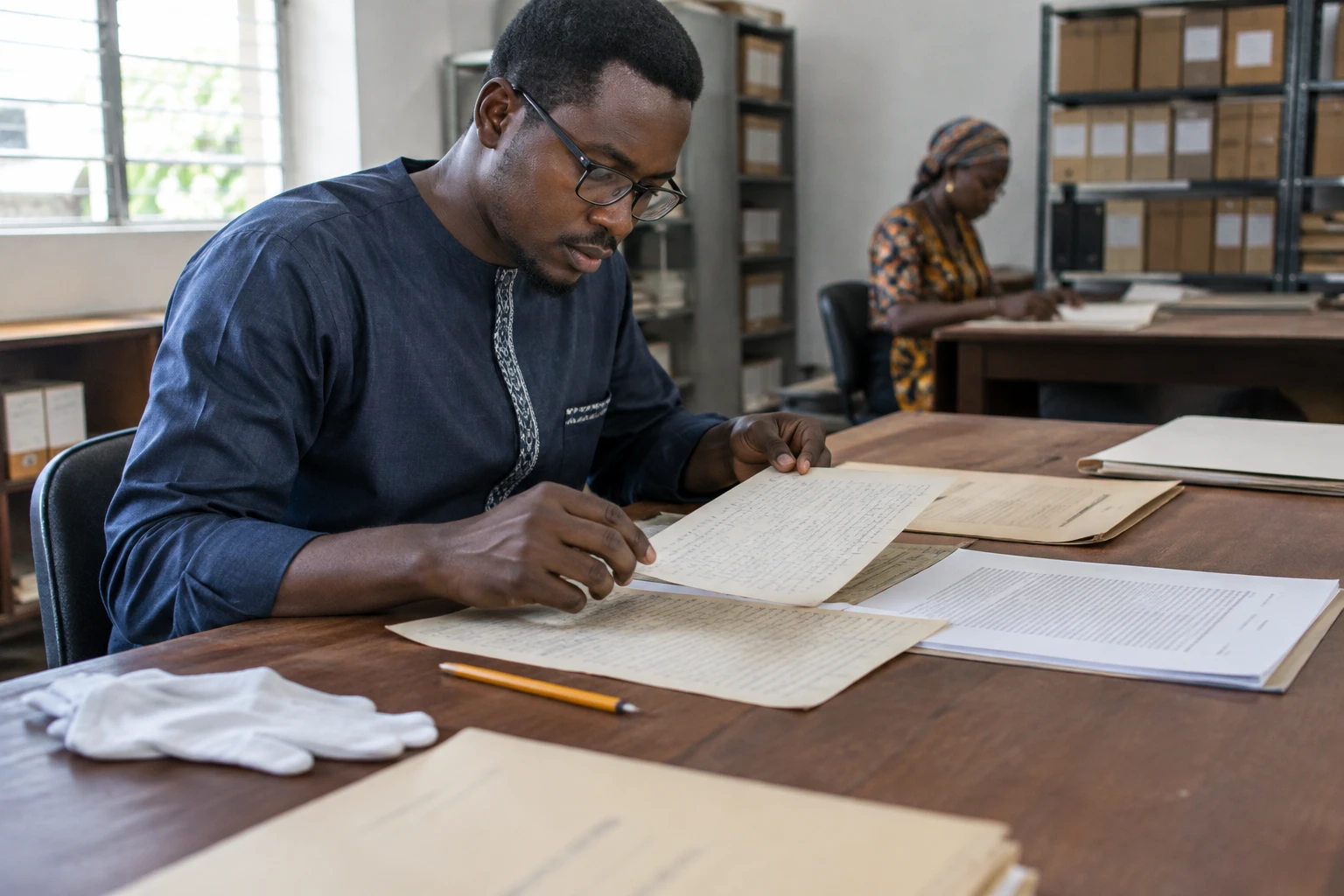
A poem does not always come into being at the moment we think we hear it. Between the memory of a language, a writer’s reading and the corrections made to a manuscript, it is built up in layers. Studying Léopold Sédar Senghor’s archives therefore offers a different perspective on a body of work often reduced to a few emblematic texts of négritude.
A body of work shaped between several worlds
A poet and the first president of independent Senegal, Senghor led the country from 1960 to 1980. But the literary workshop reconstructed by researcher Claire Riffard is confined neither to the presidential palace in Dakar nor to the libraries of Paris and Normandy. It also includes a place without shelves: the stories he heard during his Serer childhood.
Serer, the language of his childhood, nourished a memory of rhythm and speech. Senghor often spoke of the tales and songs he heard from farmers and shepherds. For Claire Riffard, this oral transmission helps explain how his poetry brings different heritages into dialogue. It does not simply juxtapose an African tradition and a French one: it transforms their sounds, images and forms into a distinctive style of writing.
This approach forms part of a broader intellectual history. Négritude, a movement to which Senghor contributed alongside Aimé Césaire and Léon-Gontran Damas, asserted the dignity of Black cultures in the face of colonial hierarchies. Reading the manuscripts today makes it possible to study how this thinking took concrete form in writing choices, without conflating the poet, the political leader and the critical debates prompted by his legacy.
Drafts reveal the poet’s craft
Anthologies often present Chants d’ombre, published in 1945, as the entry point to Senghor’s poetry. Yet he was already writing during his years of study in Dakar and Paris. The fate of these early texts remains difficult to establish. Senghor said he had destroyed some of them in 1935, but the archives do not make it possible to reconstruct in full what was lost.
This absence is no mere anecdotal detail. It is a reminder that literary archives are made up of preserved traces, but also of losses and retrospective memories. According to Riffard’s analysis, Senghor’s challenge was to move beyond the models he had read and create a poetry in which French would also carry Serer rhythms and memory.
The manuscripts also document the process of rewriting. Senghor called the work of revising a first draft « striquage ». The term evokes weaving: reworking, adjusting, embellishing. In the poem devoted to Senegalese athlete Yassine Mbaye, successive versions show the poet searching for the right words to describe a shade of skin. A Serer word, « khérère », appears in the preparatory work, then disappears from the published version, where other images take its place.
These variants reveal a precise literary choice. They do more than correct a sentence: they shed light on how Senghor calibrated metaphors and rhythm to convey a perception. This is one of the contributions of genetic criticism, which studies the stages in the making of a work through its drafts and archives.
From lived experience to poetry
Personal life and political upheaval also emerge in this creative process. Lettres d’hivernage, composed in the late 1960s, stages absence and an exchange of love in the form of letters addressed to a woman far away. The collection belongs to a period marked in Senegal by strong social protests, notably in 1968. Intimate experience becomes poetic material without turning into a diary.
The elegies offer another example of transformation. In 1974, Senghor wrote a poem in tribute to Georges Pompidou, his friend from his student days, after Pompidou’s death on 2 April. Their friendship, formed during their years of study in Paris, belongs to the poet’s personal history. Yet the elegy makes it more than a private memory: it gives form to mourning and loss in a carefully crafted composition.
Archives to share and discuss
Published by Hermann in August 2026, Claire Riffard’s book draws on scattered archives, correspondence and testimonies. Her research is linked to the work of the « Manuscrits francophones » team at the Institute for Modern Texts and Manuscripts, which studies literary collections from Africa and the Caribbean, among others. This approach helps place African writers at the heart of the material and intellectual history of literature, rather than treating them as exceptions to a canon defined elsewhere.
In Senegal, where Senghor remains a national and international figure, the manuscripts offer another way of approaching this legacy. They invite readers to distinguish recognition of his work from discussions of his political record and cultural choices. They also serve as a reminder that Senegalese literary creation cannot be reduced to one author, even when that author profoundly shaped his era.
Across the Francophone and pan-African worlds, the issue therefore goes beyond rediscovering a classic. Who preserves the archives, who can consult them and in which languages the works are studied: these questions also determine the place given to African literatures in the production of knowledge. Research on Senghor also shows that a published text is not an immobile object. Its drafts preserve traces of decisions, hesitations and movement between languages that illuminate the richness of his writing.
Discover Claire Riffard’s study of Senghor’s manuscripts and the research of the Manuscrits francophones team.