Algeria
 Egypt
 Libya
 Morocco
 Sudan
 Tunisia
 Benin
 Burkina Faso
 Cabo Verde
 Côte d'Ivoire
 Ghana
 Guinea
 Guinea-Bissau
 Liberia
 Mali
 Mauritania
 Niger
 Nigeria
 Sierra Leone
 The Gambia
 Togo
 Cameroon
 Central African Republic
 Chad
 DR Congo
 Equatorial Guinea
 Gabon
 Republic of the Congo
 São Tomé and Príncipe
 Burundi
 Comoros
 Djibouti
 Eritrea
 Ethiopia
 Kenya
 Madagascar
 Malawi
 Mauritius
 Mozambique
 Rwanda
 Seychelles
 Somalia
 South Sudan
 Tanzania
 Uganda
 Angola
 Botswana
 Eswatini
 Lesotho
 Namibia
 South Africa
 Zambia
 Zimbabwe
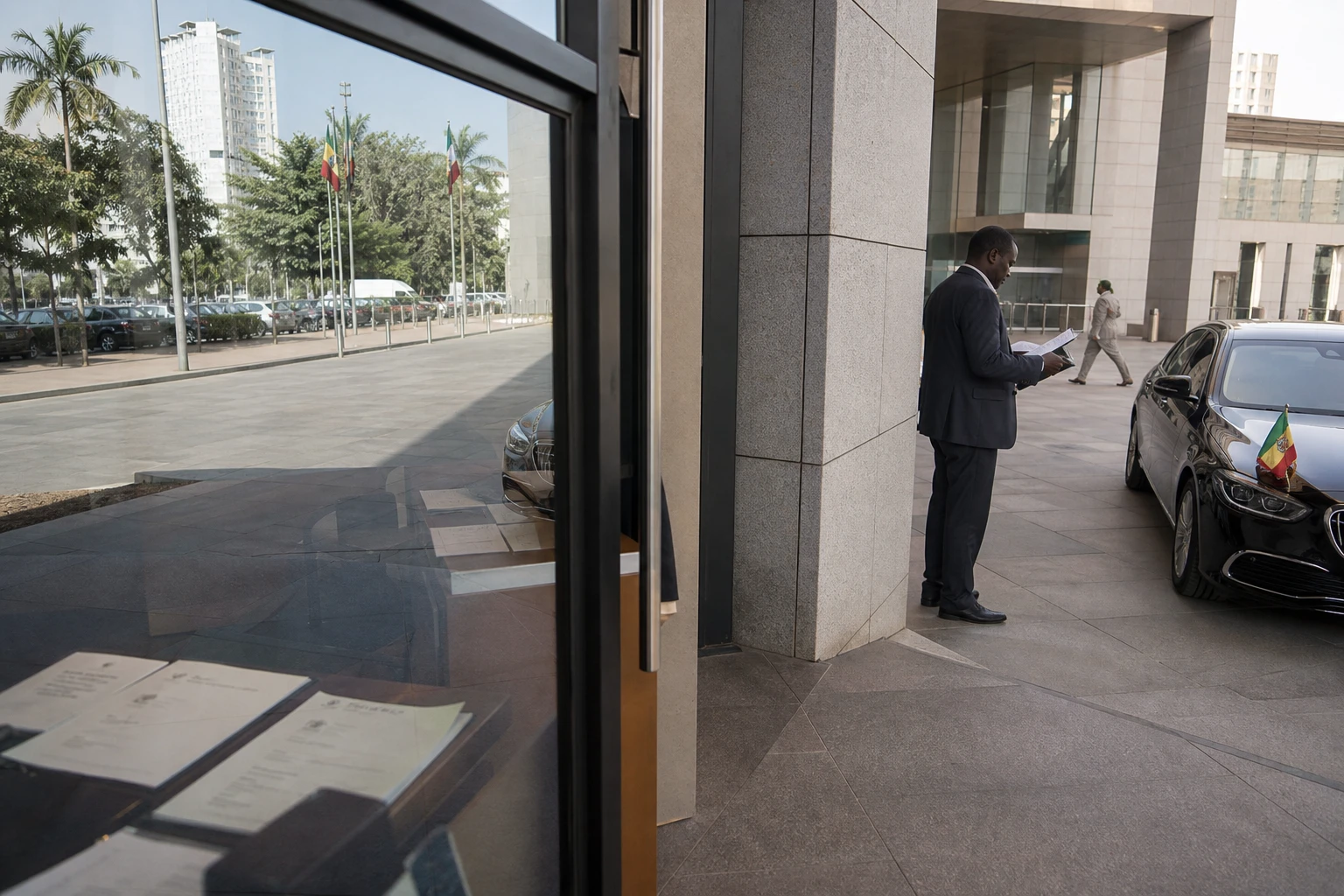
In Dakar, a diplomatic gesture that goes beyond mere courtesy
At first glance, Senegal’s support for an international candidacy looks like a conventional diplomatic move. But in Macky Sall’s case, the stakes are more sensitive. They touch on the country’s recent political history, the accountability proceedings opened in Dakar and the legal protection attached to one of the UN’s most senior positions.
On 20 July 2026, President Bassirou Diomaye Faye instructed Senegal’s diplomatic corps to support his predecessor’s candidacy for the post of United Nations secretary-general. The position was announced after a meeting at the Presidential Palace on 17 July. It marks a clear shift from the reserve shown by Senegalese authorities a few months earlier, when the race for the post was entering its public phase.
The decision comes amid a highly charged domestic context. Since 2024, Senegal has opened several proceedings into the previous government’s management, notably concerning public finances and the Covid fund. At the same time, the country is seeking to reassert its standing in ECOWAS, the Economic Community of West African States, while West Africa remains weakened by military transitions, institutional tensions and competition between national and regional agendas.
The legal case and the political case are not the same
The facts are stubborn. At this stage, Macky Sall is not personally facing any prosecution before the Senegalese courts. However, several former ministers in his government have been named in financial cases brought before the High Court of Justice, a Senegalese court with jurisdiction to try certain crimes or offences committed by members of the government in the exercise of their duties. The cases are progressing slowly, sustaining considerable political tension over the pace of justice.
On the budgetary front, Senegal continues to deal with the consequences of a major revision of its public accounts. The IMF confirmed in 2025 that debt and the deficit had been under-reported over the 2019–2023 period, with central government debt revised to 99.7% of GDP at the end of 2023, from an initial figure of 74.4%, and the average deficit revised upwards. In November 2025, the institution again highlighted the Senegalese authorities’ efforts to strengthen budget transparency and address the shortcomings exposed by the discovery of hidden debt. The issue is therefore not solely judicial. It affects the state’s financial credibility and its relationship with external partners.
In this climate, official support for the former president has an obvious political dimension. It may be seen as a gesture of institutional reconciliation. It could also be interpreted as a way of moving Macky Sall into an international arena where the domestic confrontation is less direct. Both readings coexist, which is precisely what makes the decision delicate.
What UN immunity really protects
The debate has resurfaced because a position in New York does not have the same effects as a mandate in Dakar. The 1946 Convention on the Privileges and Immunities of the United Nations provides that immunity is granted in the interests of the Organisation, not for the personal benefit of office-holders. It also specifies that, for the secretary-general, the Security Council is responsible for waiving immunity. This is crucial: it is not an absolute shield, but institutional protection that complicates any national legal action.
In practice, this immunity mainly covers acts performed in the course of international duties. It does not automatically turn earlier acts committed during a national presidential term into protected acts. In other words, any potential proceedings linked to the management of Senegalese public affairs before taking up a UN post would not disappear simply because of an appointment. Their handling, however, would become infinitely more political, since a diplomatic hurdle would have to be cleared at the Security Council, where five permanent members have veto power.
That is the heart of the problem: immunity does not erase the legal question, but it changes the arena. It can make prosecution more costly, slower and more contentious for the state seeking to pursue it. For Senegal, the difficulty would not be only legal. It would also be diplomatic, since a confrontation with a sitting secretary-general would have repercussions far beyond Dakar.
A candidacy amid the battle over Africa’s balance of power
Dakar’s choice also forms part of a wider African sequence. The African Union did not endorse the candidacy in the form its backers had hoped for, after reservations were expressed in spring 2026. The episode recalled a simple reality: in Addis Ababa as in New York, African candidacies depend not only on the candidate’s name, but also on procedural discipline, regional alliances and the ability to speak with one voice.
Senegal knows this multilateral world well. The country chaired the African Union in 2022 and remains deeply involved in continental forums. Its foreign ministry, moreover, maintains a consistent line in favour of pan-Africanism, regional integration and cooperation within ECOWAS and the African Union. From this perspective, supporting a former head of state for a global post may be a way to keep Dakar among the capitals that count in African decision-making.
The race remains open, however. The selection of the next secretary-general is officially governed by the UN, under a procedure based on General Assembly resolutions and a recommendation from the Security Council. Issues being closely watched include geographical rotation, the prospects for Latin American candidates and the recurring debate over whether a woman should lead the Organisation for the first time. In this contest, Senegalese support may strengthen a candidacy, but it is not enough to secure its success.
What this episode says about Senegal and the region
For Bassirou Diomaye Faye, the decision is revealing. It shows that a head of state can choose an institutional approach without embracing a partisan one. It also shows that in West Africa, diplomacy remains a space for domestic realignment. Relations between the government, opposition, judiciary and former leaders are not resolved in the courts alone; they also play out through international appointments, regional positions and symbols of prestige.
For Senegalese people, the stakes are more tangible. A UN candidacy can enhance the country’s image and highlight its diplomatic expertise. But it must not overshadow expectations for budget transparency, the judicial timetable and institutional stability. Dakar wants to be present on the world stage. It must also convince its own people.
Across the continent, the message is clear. African capitals are seeking more than a ceremonial place in global governance. They want influence over the rules, the balance of power and decision-making. Macky Sall’s case shows that African diplomacy now operates on two parallel tracks: defending national positions and fighting for stronger representation in international institutions. That is where part of the balance of power between Africa, ECOWAS and the UN system is now being decided.