Algeria
 Egypt
 Libya
 Morocco
 Sudan
 Tunisia
 Benin
 Burkina Faso
 Cabo Verde
 Côte d'Ivoire
 Ghana
 Guinea
 Guinea-Bissau
 Liberia
 Mali
 Mauritania
 Niger
 Nigeria
 Sierra Leone
 The Gambia
 Togo
 Cameroon
 Central African Republic
 Chad
 DR Congo
 Equatorial Guinea
 Gabon
 Republic of the Congo
 São Tomé and Príncipe
 Burundi
 Comoros
 Djibouti
 Eritrea
 Ethiopia
 Kenya
 Madagascar
 Malawi
 Mauritius
 Mozambique
 Rwanda
 Seychelles
 Somalia
 South Sudan
 Tanzania
 Uganda
 Angola
 Botswana
 Eswatini
 Lesotho
 Namibia
 South Africa
 Zambia
 Zimbabwe
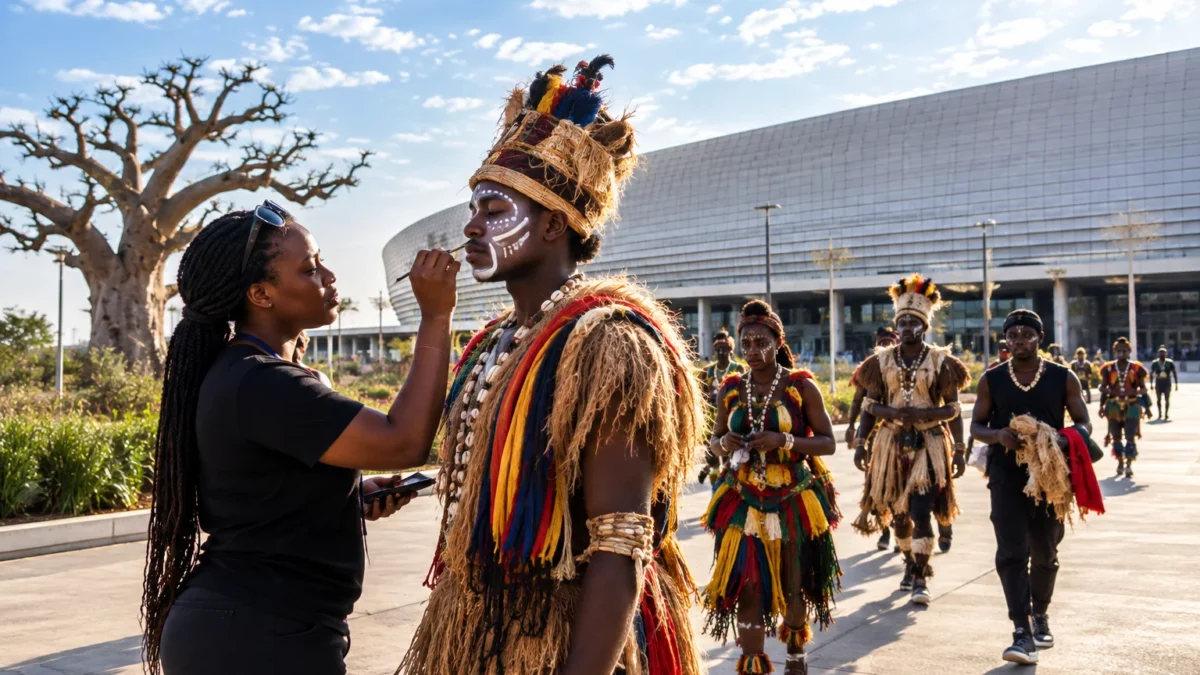
In Dakar, the Youth Olympic Games also drew on professions far removed from the podiums. Artistic make-up helped give performers and characters at the opening ceremony their faces. Nalorie Joelle’s career path highlights this contribution, which is often less visible than sporting performances.
Behind-the-scenes professions at the heart of the spectacle
The available material describes Nalorie Joelle as a young Senegalese woman who studied political science before turning to artistic make-up. It says she contributed to the opening ceremony of Dakar 2026 YOG. However, it does not specify her exact role in the team, which characters she made up or how long she spent preparing. These details therefore cannot be stated with any greater certainty.
This caveat does not diminish the interest of her career path. Rather, it is a reminder that a major event depends on a chain of skills extending beyond athletes and sports officials. Make-up artists, hairdressers, costume designers, technicians and performers all contribute to the staging. Their work shapes the audience’s experience and the way the host country tells its story.
At the opening of the Games on 31 October 2026, Senegal welcomed delegations at Abdoulaye Wade Stadium in Diamniadio. The International Olympic Committee says more than 1,100 people took part in the show and nearly 1,500 costumes were made locally. These figures give an idea of the scale of the artistic work involved, but do not make it possible to attribute a specific task or responsibility to Nalorie Joelle. The IOC’s information on the Dakar 2026 opening ceremony
An event in Senegal’s trajectory
The Youth Olympic Games — an international competition for young athletes — ran from 31 October to 13 November 2026. Dakar, Diamniadio and Saly hosted the events. Senegal was selected in 2018. Originally scheduled for 2022, the Games were postponed to 2026 during the Covid-19 pandemic.
This edition marked a first: it was the first Olympic sporting event to be held on the African continent. The stakes therefore went beyond the sporting calendar. For Senegal, hosting the Games was an opportunity to demonstrate its organisational capabilities and showcase its cultural expressions. For African countries, it established a tangible precedent in an Olympic movement that had long been organised elsewhere.
The ceremony also presented a culturally grounded narrative. Senegalese Radio and Television Broadcasting described a show featuring episodes from the history of Cayor and popular traditions. This choice is a reminder that an international ceremony is not merely a backdrop: it selects the stories, references and art forms presented to the world. RTS’s account of the ceremony
Assessing the benefits beyond the spotlight
Visibility for a profession at a global event can matter to those seeking to make it their career. But taking part in a ceremony does not, by itself, guarantee lasting employment or economic recognition. To assess the Games’ legacy, it will also be necessary to find out whether the skills put to use lead to further opportunities in the performing arts, audiovisual industries, fashion and cultural events.
The benefits may vary among those involved. Large production teams gain an international showcase; independent professionals may hope for new commissions, but there is no certainty. Likewise, competition venues and suppliers based in host areas do not represent the experience of the whole country. The effects on cultural workers, small businesses and audiences outside the main venues should therefore be considered separately.
A report published on 3 November by Senegalese media outlet Social Net Link discusses make-up artists and hairdressers working around the opening ceremony in the same professional sphere. It names Marième Ngom, among others, but does not establish any connection with Nalorie Joelle or confirm her career path. This separate account illustrates the range of professions involved; it does not fill in the missing information about Joelle. A Senegalese report on the women working behind the scenes
A cultural and professional legacy too
The Games ended on 13 November. Attention is now turning to their legacy: infrastructure, sports participation, training and benefits for local stakeholders. The International Olympic Committee said nearly 2,700 young athletes had taken part. The Associated Press, for its part, reported the event’s conclusion and organisers’ statements on the continent’s ability to host major competitions. These institutional assessments do not yet answer the question of whether the event created lasting jobs.
The career path attributed to Nalorie Joelle invites a broader assessment. A legacy is also built through skills acquired, partnerships forged and the place given to Senegalese professionals in future productions. The available information does not make it possible to say what the Games will mean for her career. It does, however, serve as a reminder that the success of an international show also depends on local talent, whose work deserves to be documented precisely.