
 Algeria
 Egypt
 Libya
 Morocco
 Sudan
 Tunisia
 Benin
 Burkina Faso
 Cabo Verde
 Côte d'Ivoire
 Ghana
 Guinea
 Guinea-Bissau
 Liberia
 Mali
 Mauritania
 Niger
 Nigeria
 Sierra Leone
 The Gambia
 Togo
 Cameroon
 Central African Republic
 Chad
 DR Congo
 Equatorial Guinea
 Gabon
 Republic of the Congo
 São Tomé and Príncipe
 Burundi
 Comoros
 Djibouti
 Eritrea
 Ethiopia
 Kenya
 Madagascar
 Malawi
 Mauritius
 Mozambique
 Rwanda
 Seychelles
 Somalia
 South Sudan
 Tanzania
 Uganda
 Angola
 Botswana
 Eswatini
 Lesotho
 Namibia
 South Africa
 Zambia
 Zimbabwe
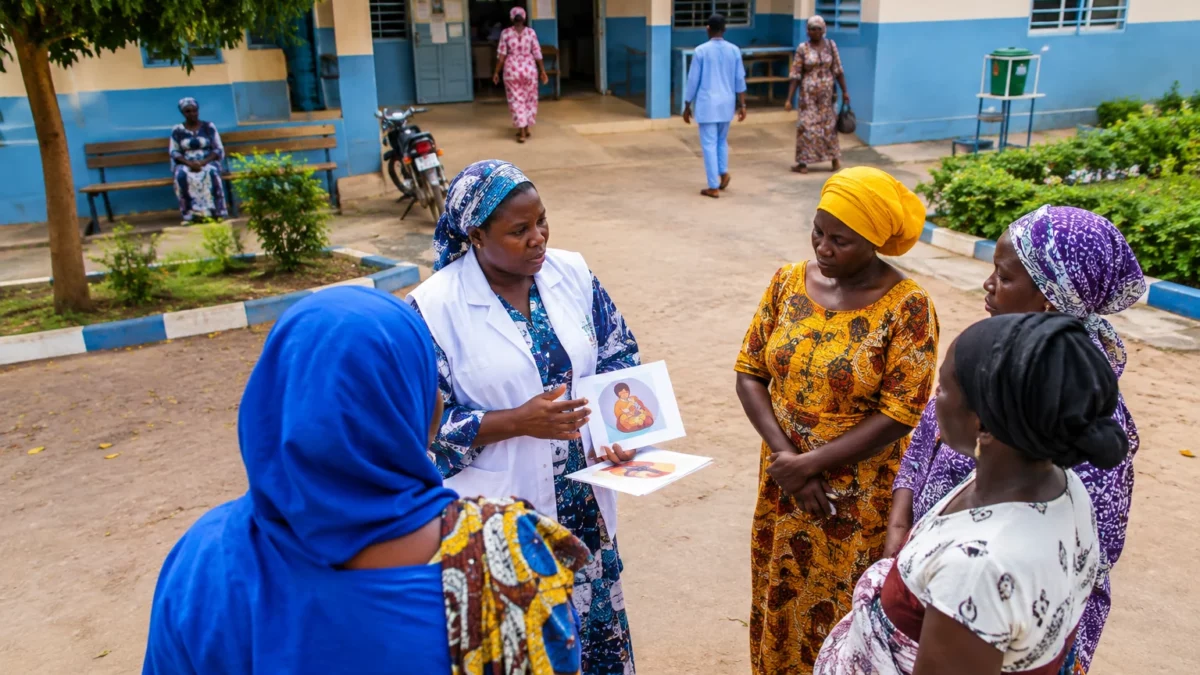
In eastern Senegal, the birth of a girl was followed by an emergency that the law did not prevent. The death of a newborn in Sadatou raises a practical question: how can girls be protected when a banned practice takes place inside the home itself?
Investigation after death in Sadatou
The baby girl was born on 11 November at the health post in Sadatou, in the Bakel department of the Tambacounda region. Information published by several media outlets indicates that she may have undergone FGM the following day, without her mother’s knowledge. She began to haemorrhage. The child died on 13 November while being transferred to the regional hospital in Tambacounda, according to a regional official cited by the Associated Press.
Gendarmes detained three people, including the father, the paternal grandmother and another woman suspected of having taken part in the act. The circumstances remain under investigation and those implicated are presumed innocent. The authorities also reported that the grandmother had allegedly offered to wash the newborn before the mutilation was carried out. These details will have to be established through legal proceedings.
Initial reports refer to excision and infibulation. The latter involves narrowing the vaginal opening through an incision and stitching. The medical report cited by Senegalese media says massive bleeding was caused by a sharp instrument. An autopsy has been ordered, according to the same reports.
A longstanding ban, contrasting local realities
In Senegal, Law No. 99-05 of 29 January 1999 made female genital mutilation illegal under the Penal Code. Article 299 bis provides for prison sentences of six months to five years. When the act results in death, the penalty can be life imprisonment. The law therefore establishes a clear ban; the tragedy in Sadatou highlights the difficulties of prevention and detection, particularly when the acts remain clandestine.
National figures do not describe local circumstances uniformly. According to the National Agency of Statistics and Demography’s 2023 Continuous Demographic and Health Survey, 20% of women aged 15 to 49 who were interviewed said they had undergone female genital mutilation. For girls under 15, the measured proportion is 13%. UNICEF notes stark regional disparities: its profile based on 2023 data estimates prevalence at 41.4% in Tambacounda, compared with 13.9% in Dakar.
These figures alone do not explain why the practice persists in a particular community. They do, however, show that national averages can mask significant disparities. The ANSD also reports that 94% of women who had undergone FGM and 95% of girls concerned had been cut by a traditional cutter. Public action must therefore reach families and people with social authority, beyond health services alone.
Preventing emergencies, providing support without stigma
Senegal’s national strategy to end female genital mutilation covers the period 2022-2030. It provides for an approach involving several sectors, communities and cross-border co-operation. This dimension is important in Sadatou, a locality close to the Malian border: family ties and travel do not always follow administrative boundaries. Prevention may therefore require co-ordination between local actors on both sides of the border.
For residents, the need is immediate: to be able to report a risk, obtain prompt care and protect newborns without exposing families to rumours or unverified accusations. For the authorities, the task is to enforce the law while maintaining trusted local contacts in villages. Awareness campaigns, community health workers and community organisations can help identify dangers before they become medical emergencies.
Senegalese organisations working to end female genital mutilation are calling for a full investigation and enforcement of the law. Their role is also to stress that lasting prevention requires close engagement with communities. The ANSD says 82% of women interviewed who knew about FGM believed it should not continue. This result points to significant support for ending the practice, without erasing resistance or differences between regions.
A Senegalese issue with wider resonance in West Africa
Senegal is a member of ECOWAS, the Economic Community of West African States. The fight against female genital mutilation concerns the whole region, where borders bring populations and community networks into close contact. Prevention efforts therefore stand to benefit from drawing on local experience and regional co-operation, rather than relying exclusively on judicial or centralised responses.
The country has set itself the goal of ending these practices by 2030. The gap between this ambition, the decline observed among adolescent girls and the persistence of clandestine cases makes it necessary to monitor progress in every region. In Sadatou, the courts will have to establish responsibility. But the wider significance of the tragedy will also depend on what follows: the ability of services to protect newborns, the continuity of community initiatives and the sustained presence of prevention networks in areas far from Dakar.



