Algeria
 Egypt
 Libya
 Morocco
 Sudan
 Tunisia
 Benin
 Burkina Faso
 Cabo Verde
 Côte d'Ivoire
 Ghana
 Guinea
 Guinea-Bissau
 Liberia
 Mali
 Mauritania
 Niger
 Nigeria
 Sierra Leone
 The Gambia
 Togo
 Cameroon
 Central African Republic
 Chad
 DR Congo
 Equatorial Guinea
 Gabon
 Republic of the Congo
 São Tomé and Príncipe
 Burundi
 Comoros
 Djibouti
 Eritrea
 Ethiopia
 Kenya
 Madagascar
 Malawi
 Mauritius
 Mozambique
 Rwanda
 Seychelles
 Somalia
 South Sudan
 Tanzania
 Uganda
 Angola
 Botswana
 Eswatini
 Lesotho
 Namibia
 South Africa
 Zambia
 Zimbabwe

In Dakar, the death of Cheikh Hamidou Kane raises a question that reaches beyond literature: how can knowledge be passed on without losing one’s connection to oneself? The Senegalese writer, who was 98, leaves behind a small but enduring body of work. He also leaves his name to a public university seeking to make higher education accessible to tens of thousands of young people.
A writer at the heart of debates about knowledge
Cheikh Hamidou Kane died on the evening of Saturday 3 October 2026 in Dakar. The news was announced on Sunday 4 October by the Senegalese Press Agency, then confirmed by Senegalese Radio and Television. His body was due to be taken from the hospital at 4pm the same day at Fann Hospital, before his burial at Yoff cemetery.
President Bassirou Diomaye Faye paid tribute to a figure who gave several generations of Africans “the words to think” about openness to the world. Prime Minister Ousmane Sonko, for his part, spoke of a major voice in Senegalese literature and thought. Former president Macky Sall also paid tribute to the writer.
These reactions highlight the national significance of his death. Cheikh Hamidou Kane was not merely the author of a classic studied in secondary schools and universities. He also belonged to a generation of African leaders who helped build independent states after years of colonial rule.
Born on 2 April 1928 in Matam, in Fouta-Toro, to a Fulani family, he received a dual education. He first attended Quranic school before joining the French school system. He later studied law and philosophy in Paris. He also graduated from the École nationale de la France d’Outre-mer in 1956.
This trajectory directly informed L’Aventure ambiguë, published by Julliard in 1961. The novel follows Samba Diallo, a young man torn between the religious teaching he received at home and the Western education he acquired in Europe. The book won the Grand Prix littéraire d’Afrique noire in 1962 and has been translated into more than 40 languages, according to the APS.
The book does not portray knowledge as a straightforward victory of one model over another. It stages a tension that remains current: learning sciences, technology and ideas from elsewhere while retaining control over one’s identity and destiny. This reflection continues to resonate in African debates about school curricula, languages of instruction and the place of the humanities.
From public service to reflection on development
After returning to Senegal in 1959, Cheikh Hamidou Kane held several public offices. He served as governor of the Thiès region, high commissioner-general for planning and then minister of planning. He later worked for Unicef, including in Lagos and Abidjan, before joining the International Development Research Centre in Canada.
His ministerial career continued in the late 1970s and 1980s. He headed the Ministry of Industrial Development and Crafts, then the Ministry of Planning and Co-operation. This experience gives his writing particular depth: for him, culture, education and public policy were not separate fields.
His second novel, Les Gardiens du temple, was published in 1995. Cheikh Hamidou Kane was also honoured with the Grand Prix des Mécènes in 2019. His death brings a long intellectual journey to a close, but comes as one of his central ideas remains at the heart of Senegal’s choices: widening access to knowledge while developing its own answers.
A digital university becomes a national test
In January 2023, former president Macky Sall decided to name the Virtual University of Senegal after Cheikh Hamidou Kane. A decree dated 6 March 2023 formalised the name Cheikh Hamidou Kane Digital University, or UN-CHK.
Founded in 2013, the institution was intended to address a practical problem: accommodating more high-school graduates in higher education despite the limited capacity of conventional campuses. Its model is based on distance learning, digital platforms and open digital spaces in several regions of the country.
UN-CHK now lists 73,797 students on its official website. It is therefore one of Senegal’s largest public higher education institutions by enrolment, behind Cheikh Anta Diop University in Dakar. Its growth reflects strong demand, particularly among young people who live far from the capital or have to work while pursuing their studies.
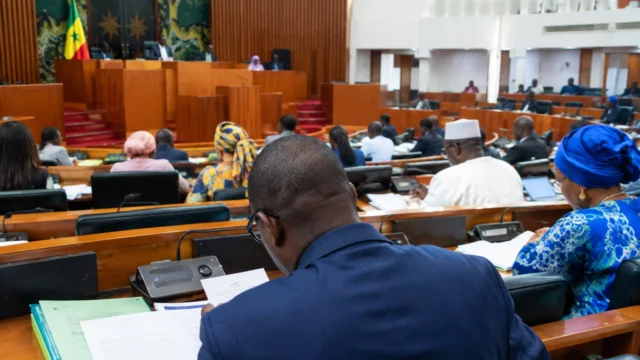
This rapid growth has nevertheless exposed the system’s limits. Students assigned to the institution have reported delays in receiving computer equipment and in the start of classes. The local section of the Autonomous Union of Higher Education has even warned of the risk of a severely disrupted academic year.
The university eventually officially launched the 2025-2026 academic year on 1 July 2026. In a statement about the start of the year, UN-CHK announced that teaching activities would be accelerated to make up for the backlog affecting cohort 13.
The challenge goes beyond screens
UN-CHK’s experience shows that digital transformation is not simply a matter of putting courses online. It requires computers to be available, a stable internet connection, academic support and suitable places to study. These conditions vary widely between Dakar, other cities and rural areas.
Students therefore do not all have the same experience. In the capital, access to the internet and university services is generally easier. In the regions, digital learning can reduce distances, but it can also deepen inequalities when equipment or electricity is lacking. Families then bear some of the costs, directly or indirectly.
For the Senegalese state, the challenge is twofold: it must absorb growing demand for university places while ensuring that education is recognised and delivered consistently. For students, the urgent issues are timetables, examinations, degrees and entry into the labour market. For teachers, mass enrolment requires new tools and a different organisation of work.
This issue also falls within the framework of ECOWAS, the Economic Community of West African States. Student mobility, the recognition of degrees and the movement of skills are becoming essential questions. Senegal has significant experience to share, but it still needs to strengthen the quality and continuity of its digital model.
A literary legacy becomes a continental issue
The connection between Cheikh Hamidou Kane’s death and the difficulties facing the university that bears his name is more than symbolic. It is a reminder that the major questions in his work remain tangible. Who produces knowledge? Who has access to it? In which languages? And in the service of what vision of society?
Across Africa, Senegal’s experience will be watched by countries facing rising university enrolments and a lack of infrastructure. Distance learning can create new opportunities. It cannot, however, replace public investment, academic support or quality content.
Cheikh Hamidou Kane has died as his country continues to seek a balance between heritage, modernity and educational sovereignty. His work posed this tension through fiction. UN-CHK now confronts it in the lived experience of Senegalese students, in virtual lecture halls and digital spaces in Dakar and the regions.