Algeria
 Egypt
 Libya
 Sudan
 Tunisia
 Benin
 Burkina Faso
 Cabo Verde
 Côte d'Ivoire
 Ghana
 Guinea
 Guinea-Bissau
 Liberia
 Mali
 Mauritania
 Niger
 Nigeria
 Senegal
 Sierra Leone
 The Gambia
 Togo
 Cameroon
 Central African Republic
 Chad
 DR Congo
 Equatorial Guinea
 Gabon
 Republic of the Congo
 São Tomé and Príncipe
 Burundi
 Comoros
 Djibouti
 Eritrea
 Ethiopia
 Kenya
 Madagascar
 Malawi
 Mauritius
 Mozambique
 Rwanda
 Seychelles
 Somalia
 South Sudan
 Tanzania
 Uganda
 Angola
 Botswana
 Eswatini
 Lesotho
 Namibia
 South Africa
 Zambia
 Zimbabwe
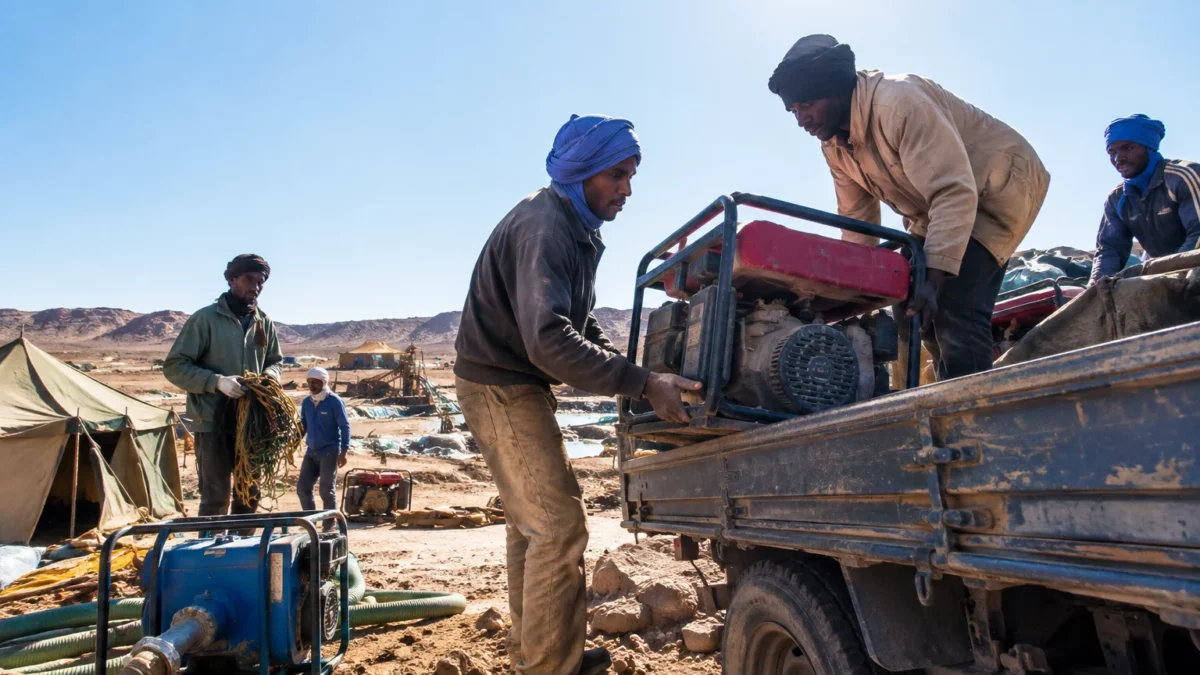
In northern Mauritania, moving a mining camp is not simply a matter of folding a few tents. Generators, crushers and water pumps must be transported, while preserving the incomes of families whose livelihoods depend on an activity that has become important to the local economy. That is the challenge posed by the two-week deadline given to gold miners operating near the borders of Tiris Zemmour.
A security buffer in a sensitive border region
Tiris Zemmour, in the north of the country, is a vast and sparsely populated region. Its mining areas lie close to Western Sahara, a disputed territory where Morocco and the Polisario Front have been at odds for decades. The conflict intensified again from 2020. Incidents in areas near the border make the movement of civilians and equipment particularly sensitive.
Mauritania says it pursues a policy of non-alignment in the conflict and seeks to prevent tensions from spilling over into its territory. The country belongs to the Arab Maghreb Union, a regional organisation that includes Mauritania, Morocco and Algeria, among others. But cooperation among its members remains limited, while Western Sahara continues to be a source of regional disagreement.
Artisanal gold mining, meaning small-scale gold prospecting and extraction, has expanded in northern Mauritania in recent years. The public agency Maaden Mauritanie oversees part of this activity. It provides a source of income for workers and the businesses supplying them, but also exposes operators to risks linked to relocation, poorly organised sites and proximity to military zones.
Fourteen days to move the installations
In mid-November 2026, the governor of Tiris Zemmour, Idrissa Demba Coréra, told operators to leave sites located within 10 kilometres of Mauritania’s borders. The measure aims to clear a strip of land so that the armed forces and security services can monitor the area and move through it more freely. The authorities also present the move away from the border as a way to protect gold miners.
The deadline announced is two weeks. The governor and officials from Maaden Mauritanie visited the sites concerned, including areas around Bir Moghrein and Fderick, to explain the instruction. Mauritanian media have reported reactions from unions and gold miners, who object to the way the decision was announced and are seeking guarantees that they will be able to continue their work.
A figure of about 7,000 people affected has circulated in reports surrounding the measure. It has not, however, been confirmed by a second independent source in the available information. It therefore cannot be presented as an established count. Likewise, initial reports of a request for an extension reflect the practical difficulties of the move, but do not specify how many operators have already left.
For workers, the deadline has immediate consequences. Dismantling, loading and reinstalling heavy equipment takes time and costs money. An interruption could also affect transporters, small businesses and service providers whose livelihoods depend on mining. Operators with substantial resources are not necessarily in the same position as teams with little equipment that depend on daily income.
Security and incomes, two priorities to reconcile
The authorities have tasked Maaden Mauritanie with directing gold miners to alternative areas inside the country. This commitment will be crucial. A replacement site must be accessible, adequately equipped and authorised for mining. Without these conditions, evacuation may shift the difficulties rather than resolve them, or push some workers to continue their activity outside regulated areas.
The state therefore faces a dual challenge. It must reduce risks in a sensitive border area, while also ensuring a workable transition for people whose incomes depend on gold mining. Security is not measured solely by the ability to clear the land: it also depends on clear instructions, dialogue with workers’ organisations and the availability of practical alternatives.
The question of a connection with MINURSO, the United Nations mission tasked with monitoring the ceasefire in Western Sahara, must be treated with caution. The available information does not show that Mauritania’s measure stems from a scheduled departure by the mission. The authorities cite border security reasons. The existence of regional tensions is not enough to establish a causal link.
A local decision watched beyond Tiris Zemmour
The evacuation highlights a tension that extends beyond Mauritania: in Saharan border regions, civilian economic activity can come into contact with armed rivalries and security measures. For Nouakchott, maintaining control of its borders is a matter of sovereignty. For gold miners, the immediate priority is not to lose their equipment or access to a source of income.
What happens next will depend on compliance with the deadline, the identification of relocation sites and the way Maaden Mauritanie supports operators. The next developments to watch are the arrangements for relocation and any discussions between the authorities, mining unions and workers. It is at this stage that the balance between territorial security and the continuity of livelihoods in northern Mauritania will be tested.
Sources consulted: Mauritanian News Agency on the oversight of gold mining ; Info Plus on the evacuation deadline in Tiris Zemmour ; Sahara Médias on the border measure ; Le Quotidien on mining unions’ reactions ; United Nations report on the situation in Western Sahara.