Algeria
 Egypt
 Libya
 Sudan
 Tunisia
 Benin
 Burkina Faso
 Cabo Verde
 Côte d'Ivoire
 Ghana
 Guinea
 Guinea-Bissau
 Liberia
 Mali
 Mauritania
 Niger
 Nigeria
 Senegal
 Sierra Leone
 The Gambia
 Togo
 Cameroon
 Central African Republic
 Chad
 DR Congo
 Equatorial Guinea
 Gabon
 Republic of the Congo
 São Tomé and Príncipe
 Burundi
 Comoros
 Djibouti
 Eritrea
 Ethiopia
 Kenya
 Madagascar
 Malawi
 Mauritius
 Mozambique
 Rwanda
 Seychelles
 Somalia
 South Sudan
 Tanzania
 Uganda
 Angola
 Botswana
 Eswatini
 Lesotho
 Namibia
 South Africa
 Zambia
 Zimbabwe
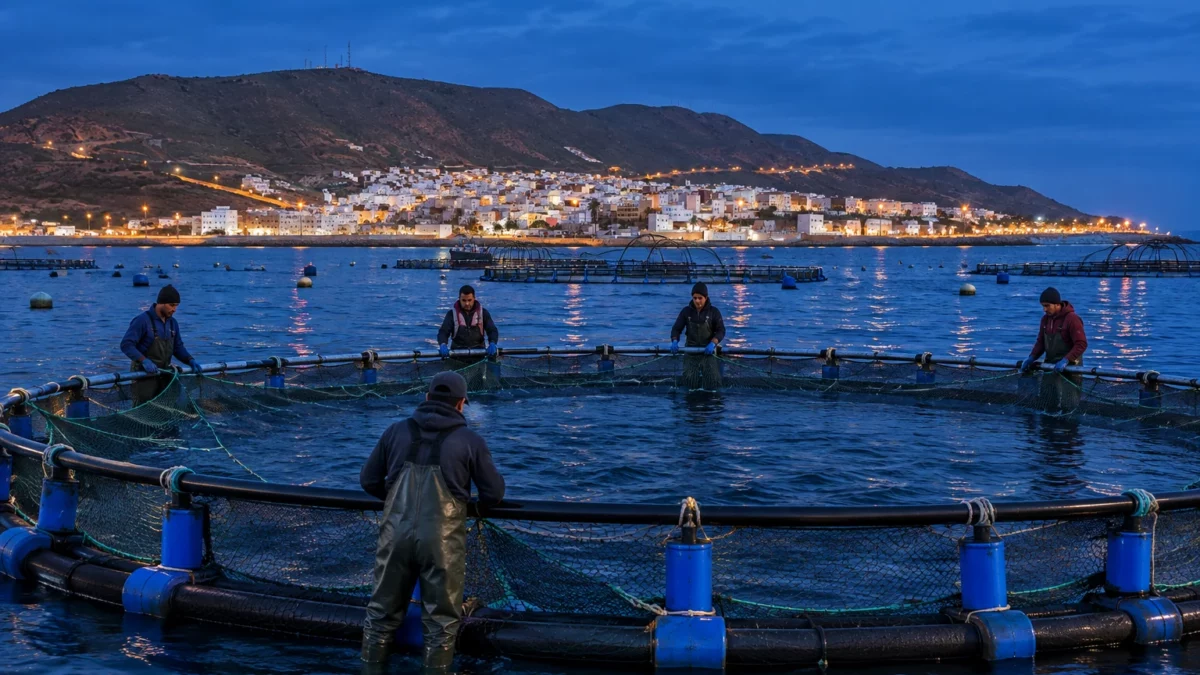
Producing more fish without relying solely on wild catches is a challenge for coastal countries. In Morocco and Namibia, open-sea projects are testing a promising but still costly approach. Their success will be measured less by announced capacity than by the fish actually produced, local jobs and effects on ecosystems.
Two coastlines, projects at different stages
Morocco, in North Africa, and Namibia, in southern Africa, are approaching the sector in different contexts. The former is seeking to test an experimental gilthead sea bream facility. The latter is focusing in particular on salmon, with large-scale commercial projects near Lüderitz, on the Atlantic coast.
The distinction matters. A pilot farm is used to test equipment and farming conditions. A licence or announced production capacity, by contrast, does not mean that a farm is already operating at full capacity. In Namibia, timelines and investments should therefore be understood as development stages, not as production already achieved.
The FAO generally describes offshore aquaculture as an activity located away from the coast, in deep water exposed to significant waves and currents. Its indicative criteria include a distance of more than two kilometres and a depth of over 50 metres, but do not constitute a universal definition. The sites at Sidi Ifni and Lüderitz illustrate the search for open marine spaces, although their facilities and conditions are not identical. The FAO’s definition of offshore aquaculture also highlights the operational demands associated with these conditions.
At Sidi Ifni, a pilot farm to test the model
On 30 October 2026, Morocco inaugurated a pilot fish farm at Sidi Ifni, led by the National Institute of Fisheries Research (INRH). The site is about seven nautical miles from the port. It comprises four floating cages measuring 29 metres in diameter and aims to produce 280 tonnes of gilthead sea bream a year.
The announced investment is 50 million dirhams, or about five million dollars. The immediate aim is to establish whether open-sea farming is technically and economically viable. Moroccan media have also reported that the experimental programme, conducted from 2021 to 2026, preceded the inauguration. This gives the project a demonstration role: it is intended to provide lessons for researchers and future operators, not yet to prove that an industrial-scale sector is profitable. Details of the Sidi Ifni pilot project have been reported in Morocco by several media outlets, including Yabiladi.
For the Moroccan authorities, the challenge is also to diversify maritime activities and test production tools suited to local conditions. But a capacity of 280 tonnes remains modest compared with the volumes associated with Namibian projects. The pilot’s results, particularly the regularity of harvests and operating costs, will weigh on future decisions.
In Namibia, industrial ambitions still taking shape
Near Lüderitz, the African Aquaculture Company (AAC) is developing a salmon-farming project with a target capacity of 51,000 tonnes a year. In 2026, its permit period was extended from 15 to 25 years. The company has also announced an initial phase funded to the tune of 41 million Namibian dollars, followed by an investment of 40 million Namibian dollars from Omankete Investments. These sums signal interest from Namibian investors, but do not establish that commercial production has begun. The Namibian outlet The Namibian reported Omankete’s investment. SeafoodSource has also followed the project, including the permit extension and development timeline.
Another operator, Benguela Blue Aquafarming, has obtained permits for a salmon farm using submersible cages, about eight kilometres from Lüderitz. Its authorised capacity can reach 35,000 tonnes a year. A groundbreaking ceremony was announced in 2024, but that announcement alone does not show that the farm has entered production. The Namibian reported on the timeline presented at the time, while Innovasea detailed the permits and planned cages.
Namibia already has a marine fishing economy and is seeking to expand its aquaculture activities. In Lüderitz, the local challenge is to turn investment projects into jobs, skills and benefits for businesses in the port and region. The benefits will depend in particular on the share of activities awarded to Namibian workers and suppliers, and on the ability to link exports to the local economy.
Profitability and environmental safeguards in question
Moving cages away from coastal areas can reduce competition for space and encourage water circulation. It does not automatically make farming sustainable. Waste, disease, treatments, mortality and fish escapes remain risks to be monitored. Permits, water-quality monitoring and data transparency will therefore matter as much as stated production capacity.
Operating further offshore also raises costs. It requires robust cages and moorings, vessels, monitoring equipment, fish feed and logistics capable of operating despite bad weather. A 2018 estimate published by CEA Consulting put the potential additional cost of some offshore technologies at 15–30% compared with conventional production. The study is not an assessment of the Moroccan or Namibian projects, but it highlights the economic hurdle the sector must address. CEA Consulting’s study of offshore aquaculture costs estimates that economies of scale could narrow this gap without necessarily eliminating it.
For consumers, market access will also be an issue. Namibian salmon is targeting regional and international markets, while the Moroccan farm is testing the production of a species already familiar in Mediterranean markets. Local production, however, guarantees neither affordable prices nor better food security if most of the output is exported.
These projects offer a glimpse of two different African strategies: public-sector experimentation in Morocco and the pursuit of large-scale export production in Namibia. To assess their impact, it will be necessary to track the start of production, actual harvests, local benefits and the results of environmental monitoring. Investment announcements open up a possibility; only verifiable performance will show whether open-sea aquaculture can become a sustainable sector along these coastlines.