Algeria
 Egypt
 Libya
 Sudan
 Tunisia
 Benin
 Burkina Faso
 Cabo Verde
 Côte d'Ivoire
 Ghana
 Guinea
 Guinea-Bissau
 Liberia
 Mali
 Mauritania
 Niger
 Nigeria
 Senegal
 Sierra Leone
 The Gambia
 Togo
 Cameroon
 Central African Republic
 Chad
 DR Congo
 Equatorial Guinea
 Gabon
 Republic of the Congo
 São Tomé and Príncipe
 Burundi
 Comoros
 Djibouti
 Eritrea
 Ethiopia
 Kenya
 Madagascar
 Malawi
 Mauritius
 Mozambique
 Rwanda
 Seychelles
 Somalia
 South Sudan
 Tanzania
 Uganda
 Angola
 Botswana
 Eswatini
 Lesotho
 Namibia
 South Africa
 Zambia
 Zimbabwe
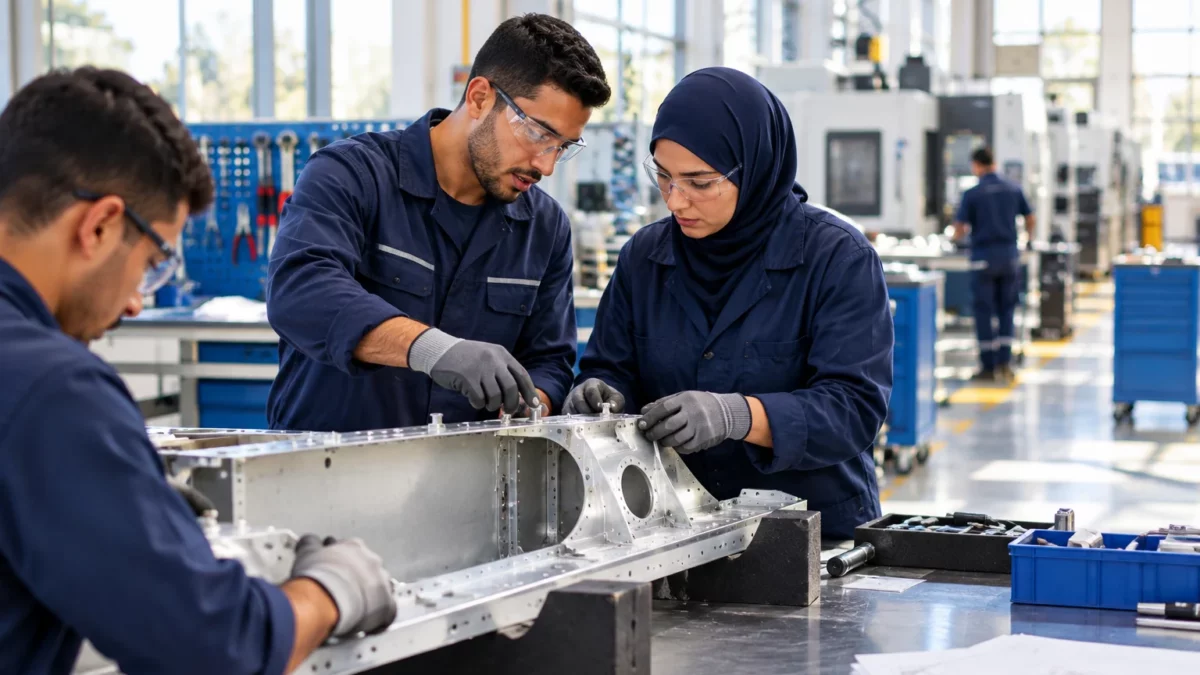
Making more defence equipment in Morocco means more than assembling hardware bought abroad. The challenge is to build an industrial chain capable of designing, producing and maintaining equipment and, eventually, exporting it. A roadmap presented in Rabat sets out this ambition for 2035, with demanding targets whose achievement will depend on investment, skills and the genuine transfer of technology.
A long-term industrial ambition
Morocco already has industrial activity in the automotive, aerospace and electronics sectors. The authorities want to build on this expertise to develop defence and security production. The strategy is part of a legal framework launched in 2020, with Law 10-20 governing, among other things, the manufacture, import and export of defence equipment.
The regional context also matters. In North Africa, equipment choices and military partnerships are shaped by enduring power dynamics. Morocco is a member of the Arab Maghreb Union (AMU), a regional organisation bringing together five North African countries, but economic integration remains limited. The Moroccan roadmap therefore appears first and foremost to be a national project, while also targeting international markets and global value chains.
This development does not mean the country has stopped importing arms. According to the Stockholm International Peace Research Institute (SIPRI), Morocco’s imports of major arms fell by 26% between 2015-2019 and 2020-2024, following a period of sharp growth. SIPRI notes, however, that deliveries already scheduled could push imports back up in the coming years.
Four billion dirhams and three targets for 2035
On 18 November 2026, during a working session in Rabat, King Mohammed VI instructed the Hassan II Fund for Economic and Social Development to contribute 4 billion dirhams to the roadmap. This is a public contribution announced to support the programme, not a guaranteed total cost for all the projects. The official statement does not yet give a timetable for disbursements.
The targets announced for 2035 are specific: create nearly 50,000 direct and indirect jobs, meet about 40% of the needs of the Royal Armed Forces and security services through domestic production, and generate more than 65% of sector revenues from exports. These are government targets, not results already achieved.
The plan provides for the creation of a strategic agency to steer policy in the sector and support investors. An industrial holding company is also to organise projects and mobilise public and private capital. Two dedicated zones are planned in Benguerir and Benslimane, complementing those already launched in Nouaceur and Sidi Yahia.
The targeted fields range from drones and autonomous systems to land and naval equipment, as well as defence electronics, cybersecurity and artificial intelligence. The planned supply chain is not limited to assembly: it also includes design, testing, maintenance and storage. This integration is crucial if local companies are to acquire lasting skills rather than remain simple subcontractors.
Jobs promised, benefits to be measured
The promise of 50,000 jobs covers direct and indirect positions, but their distribution and skill levels have not yet been detailed publicly. The activities could involve engineers, technicians, digital specialists and production workers. The vocational training programmes and specialised academy envisaged by the plan will need to bring courses into line with industrial needs, while providing pathways for young talent and Moroccan professionals established abroad.
The benefits will not be the same in every region. The new zones could attract suppliers and investment to the areas where they are located. But job creation will also depend on the ability of Moroccan small and medium-sized enterprises to access markets, financing and the necessary certifications. Without local suppliers integrated into the chain, the zones risk concentrating assembly activities with limited value added in the country.
An earlier industrial project offers an initial indication of the model being sought. A plant for WhAP 8×8 armoured vehicles, the result of cooperation between Morocco and India, was inaugurated in Berrechid in September 2025. This kind of partnership can provide access to processes and markets. But the key measure will be the share of components, maintenance and technological development actually carried out in Morocco.
The test of technology transfer and exports
The target of generating more than 65% of revenues from exports gives the project a commercial as well as a strategic dimension. To achieve it, Moroccan companies will need to offer competitive products and meet the rules of buyer markets. Foreign partnerships can accelerate this growth in capacity, but their contribution will depend on agreements covering training, intellectual property, maintenance and local procurement.
The roadmap also raises questions about financing and oversight of results. The 4 billion dirhams announced are not, by themselves, enough to establish the cost of infrastructure, research or industrial contracts. Private capital is expected to be mobilised, but the precise arrangements, investment criteria and evaluation mechanisms have yet to be made public. Transparency on these issues will make it possible to distinguish announcements from capabilities actually brought into service.
Across Africa, Morocco’s initiative forms part of a broader question: how can local industrial capacity be developed in a market where equipment, components and technologies still come largely from external suppliers? The project could create skills and opportunities beyond the military sector, particularly in electronics and digital technologies with civilian applications. But that wider impact will depend on verifiable benefits, not just stated targets.
The next steps will therefore be practical: establish the governing bodies, clarify the financing plan, advance the industrial zones and publish measurable milestones. Monitoring will need to focus on jobs actually created, the share of local production, skills transfer and exports. These will be the benchmarks against which the ambition set for 2035 can be assessed.