Algeria
 Egypt
 Libya
 Morocco
 Sudan
 Tunisia
 Benin
 Burkina Faso
 Cabo Verde
 Côte d'Ivoire
 Ghana
 Guinea
 Guinea-Bissau
 Liberia
 Mali
 Mauritania
 Niger
 Nigeria
 Senegal
 Sierra Leone
 The Gambia
 Togo
 Cameroon
 Central African Republic
 Chad
 Equatorial Guinea
 Gabon
 Republic of the Congo
 São Tomé and Príncipe
 Burundi
 Comoros
 Djibouti
 Eritrea
 Ethiopia
 Kenya
 Madagascar
 Malawi
 Mauritius
 Mozambique
 Rwanda
 Seychelles
 Somalia
 South Sudan
 Tanzania
 Uganda
 Angola
 Botswana
 Eswatini
 Lesotho
 Namibia
 South Africa
 Zambia
 Zimbabwe
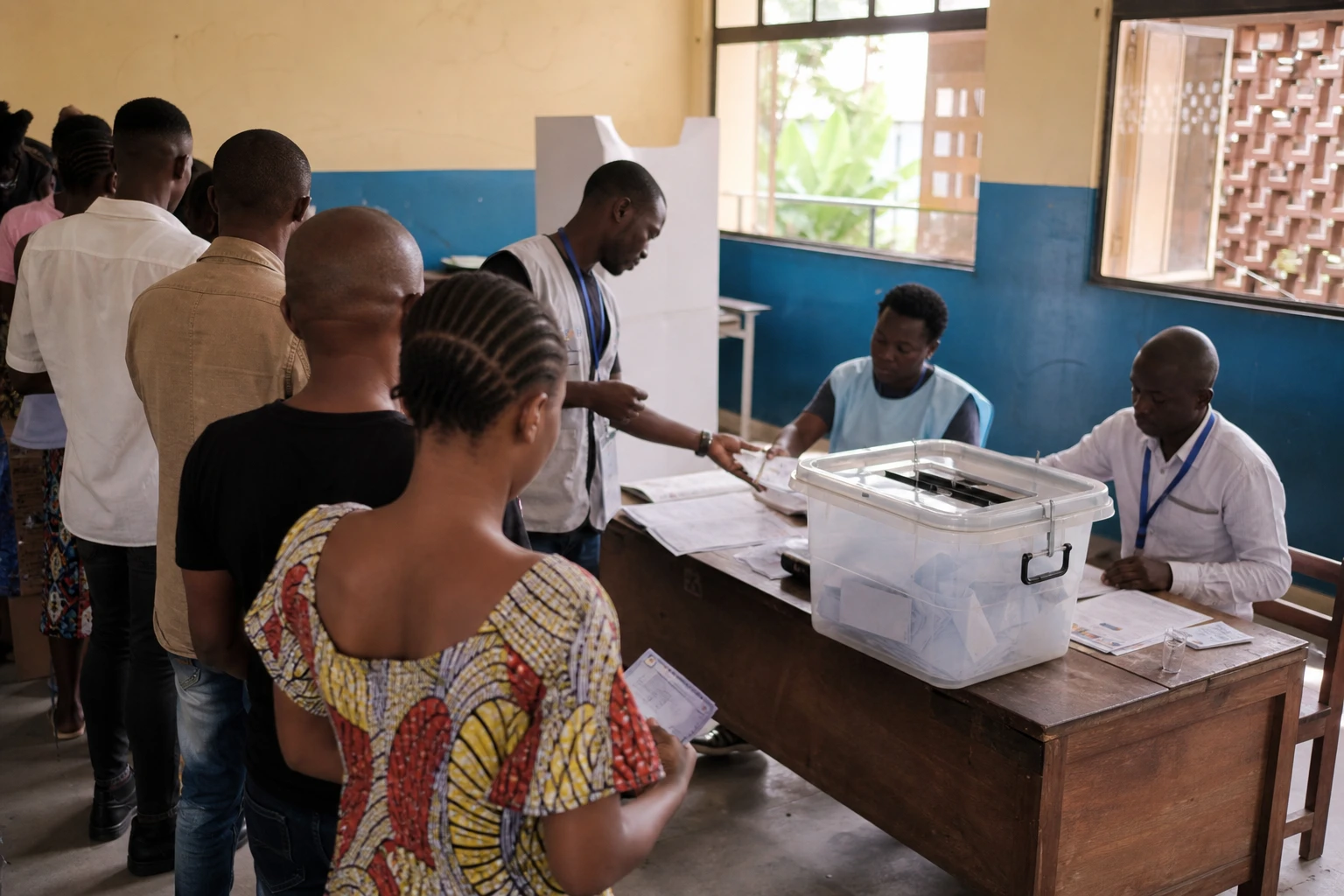
In Komanda, the memory of the dead underscores the urgency of the present
In Komanda, in Irumu territory, Ituri, the memory of 27 July 2025 is no frozen ritual. A year after an attack on worshippers gathered in a Catholic church, families are still speaking of those absent, the missing and the fear that long dictated the rhythm of evenings in this town in the east of the Democratic Republic of the Congo. The commemorative ceremony recalled a simple reality: in Ituri, civilian security is a condition of everyday life, not a slogan.
This province, which borders Uganda and lies at the heart of the Great Lakes region, has for years been under pressure from armed groups, foremost among them the Allied Democratic Forces, or ADF, a movement of Ugandan origin that several UN reports link to Islamic State. In the east of the Congo, local violence intersects with regional dynamics, population displacement, trafficking and fragile public services. This is the context that gives Komanda significance far beyond a single town.
What is known about the attack and its toll
During the night of 26–27 July 2025, armed men attacked Komanda, particularly around a religious vigil. The United Nations peacekeeping mission in the DRC, MONUSCO, condemned the attack and reported that 43 civilians had been killed. The UN Office of the High Commissioner for Human Rights, for its part, said at least 40 Christian worshippers had been killed, including 13 children, and reported fires at shops and homes. Exact tolls varied in the first hours after the news broke, making caution necessary.
The religious nature of the target made an impression far beyond Ituri. The attack was part of a series of acts of violence attributed to the ADF in the east of the DRC, where civilians remain the primary victims. In August 2025, Human Rights Watch also recalled that Islamic State had claimed responsibility for the attack on its Telegram channel, giving a different toll from those cited by the authorities and the UN, further evidence of the conflicting accounts that emerge in the first hours after a massacre.
A year later, the commemorative Mass provided a setting for a twofold message. Survivors spoke of a wound that was still open. Religious leaders and local actors, meanwhile, called for those still reported missing or being held in the bush not to be forgotten. The issue of captives, often pushed aside after the initial shock, remains one of the most painful aspects of armed violence in Ituri.
A relative lull, but no return to normality
On the ground, Komanda has recovered some of its activity. Shops have reopened. Markets are filling up again. Residents move around more freely than in the aftermath of the attack. Local authorities and civil society also point to an increase in joint patrols by the Armed Forces of the Democratic Republic of the Congo, the FARDC, and the Congolese National Police. This partial return to normal matters to households, traders and transport operators, as it gives some room to the largely informal local economy.
But the improvement remains fragile. In Ituri, movement at night is an indicator of confidence as well as of security. When a town can once again remain active until 8pm or 10pm, that signals a genuine easing of tensions, without erasing the threat facing nearby villages, secondary roads and rural areas. In this province, the gap between the urban centre and the outskirts remains vast: what appears to have been restored in Komanda may not have been restored in the hills or in more isolated farming corridors.
Ituri: security can no longer be considered apart from public health
This insecurity is now compounded by a major health crisis. Since May 2026, Ituri has been at the centre of an Ebola outbreak caused by the Bundibugyo virus, a variant of the Ebola virus. The World Health Organization has said the outbreak began in the province, then crossed its administrative borders, and was considered a public health emergency of international concern.
The figures are changing rapidly. As of 28 July 2026, data from the Congolese health ministry reported by the Associated Press showed 3,262 cases and 1,437 deaths. A few days earlier, the WHO had reported 2,848 cases and 1,184 deaths in Ituri, with the outbreak spreading to other provinces. This rapid rise explains the concern among health authorities and the mobilisation of surveillance, care and public-awareness teams.
The overlap between armed violence and a health crisis changes how Komanda must be understood. The same roads are used by traders, displaced people, patients and medical teams. The same villages live with insecurity and distrust of the state. In such a context, trust becomes a public-health tool. If residents flee medical teams or avoid health facilities out of fear or exhaustion, the response to the virus is weakened.
What Komanda tells the DRC and the Great Lakes region
Komanda also serves as a reminder of a broader point: in the east of the DRC, security, local governance and health are interconnected. An attack on a church, a blocked road, an increased patrol or an Ebola alert do not belong to separate policy areas. They are different sides of the same challenge facing the state, against a backdrop of persistent regional tensions and constant cross-border movement.
For Kinshasa, the challenge remains to combine civilian protection, regional security cooperation and the health response. For the people of Ituri, the need is more concrete: to be able to work, pray, travel and receive medical care without fear dictating the terms. A year after Komanda, the commemoration therefore did more than evoke the past. It recalled that in the Democratic Republic of the Congo, local peace is now measured also by the ability to push back armed groups, protect civilians and contain an epidemic that continues to weigh on the entire region.