Algeria
 Egypt
 Libya
 Morocco
 Sudan
 Tunisia
 Benin
 Burkina Faso
 Cabo Verde
 Côte d'Ivoire
 Ghana
 Guinea
 Guinea-Bissau
 Liberia
 Mali
 Mauritania
 Niger
 Nigeria
 Senegal
 Sierra Leone
 The Gambia
 Togo
 Cameroon
 Central African Republic
 Chad
 Equatorial Guinea
 Gabon
 Republic of the Congo
 São Tomé and Príncipe
 Burundi
 Comoros
 Djibouti
 Eritrea
 Ethiopia
 Kenya
 Madagascar
 Malawi
 Mauritius
 Mozambique
 Rwanda
 Seychelles
 Somalia
 South Sudan
 Tanzania
 Uganda
 Angola
 Botswana
 Eswatini
 Lesotho
 Namibia
 South Africa
 Zambia
 Zimbabwe
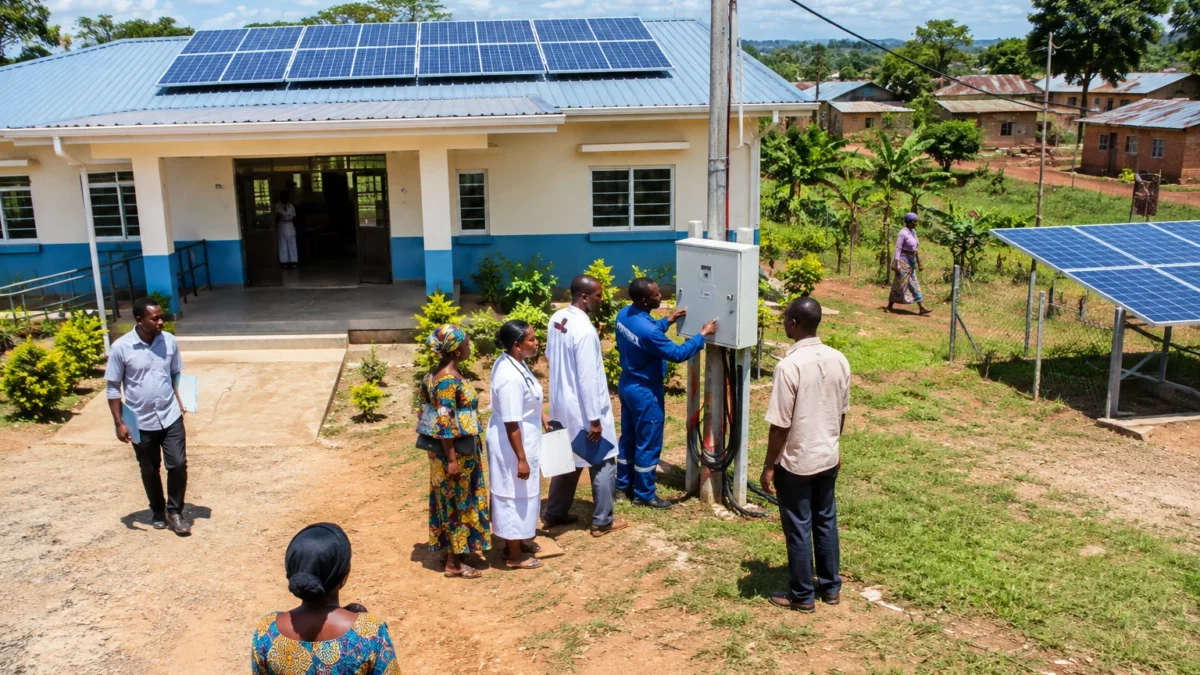
For a processing workshop, a school or a health centre far from the grid, the challenge is not simply to produce more electricity. Power must also be delivered to users at an affordable cost. In the Democratic Republic of the Congo, a new agreement with Belgian companies has brought this issue back into focus.
National strategy combines large grids with local solutions
On 13 November 2026 in Paris, Aimé Sakombi Molendo, the Minister of Hydraulic Resources and Electricity, signed a memorandum of understanding with a Belgian consortium led by Janson. The agreement covers decentralised electrification projects, including mini power stations and mini-grids for rural and peri-urban areas.
The date, location, signatory and purpose of the agreement have been reported by several Congolese media outlets. The ministry presents the partnership as a way to improve access to electricity and support local economic activity. However, the available information gives neither the selected sites nor the planned investment amount. Congo Inter reports the details of the signing, which were also carried by Ouragan.cd.
A mini-grid generates and distributes electricity across a locality or group of localities without relying entirely on the national grid. It can combine solar panels, batteries and other forms of generation. This solution does not replace large-scale infrastructure. However, it can serve areas where extending national power lines would be slow or costly.
The agreement forms part of the DRC’s National Energy Compact, drawn up under Mission 300, an initiative by the African Development Bank and the World Bank to expand access to electricity in sub-Saharan Africa. The Congolese government aims to raise the access rate to 62% by 2030, from 21.5% in 2024, and estimates investment needs at $37bn. The target includes $20bn in private financing and $17bn in public funding. The ministry sets out the Energy Compact’s objectives; the Council of Ministers’ report also gives the figures.
From agreement to projects: details still to be clarified
Needs extend well beyond generation. Electricity must also be transmitted and distributed, users connected and installations maintained. The ministry says preliminary discussions on decentralised solutions took place in Brussels in April 2026. But a memorandum of understanding does not, by itself, mean that work is financed or under way.
Several details remain to be specified: the provinces and localities targeted, the number and capacity of installations, the timetable, the investment amount and the division of responsibilities between the companies. The documents made public provide no further detail on the operating model or proposed tariffs. This information will make it possible to distinguish an intention to co-operate from projects ready to be built.
Viability will also depend on the number of subscribers, their consumption and their ability to pay. In a locality, households are not the only potential customers: shops, workshops, public services and small processing units can support demand. Conversely, high upfront costs or bills that do not reflect local incomes risk limiting connections and the revenue needed for maintenance.
The division of responsibilities between the public and private sectors will therefore matter as much as the capital announced. The National Agency for Electrification and Energy Services in Rural and Peri-urban Areas (ANSER) is tasked with promoting access in underserved areas. The Electricity Sector Regulatory Authority oversees, among other things, tariffs and consumer protection. For residents, results will be measured by the continuity of service, the cost of connection and the ability to repair faults quickly — not just by the number of power stations built.
The potential benefits are tangible. A more reliable supply can help preserve products, keep a workshop operating or ensure that a health centre functions. But the impact will depend on where projects are located and whether local small businesses can genuinely access electricity. National announcements do not yet reveal which communities will be served first.
A question of regional coherence
The DRC has significant hydropower potential and is also pursuing large-scale generation projects. Yet high installed capacity does not guarantee that electricity reaches remote households and businesses. Mini-grids address part of this territorial challenge, while investment in transmission and distribution remains essential. National policy must therefore bring large-scale infrastructure and local solutions together.
The Energy Compact states that the private capital being sought concerns the entire electricity value chain, not mini-grids alone. The Belgian agreement is therefore one avenue among others, and it is not possible to infer what share of the total funding it might receive. Co-operation signed in Paris must still be translated into financial commitments, identified sites and transparent operating rules.
At regional level, energy access is also linked to grid integration and electricity trading in Central Africa. The impact of this partnership will first depend on its implementation in the DRC. The next steps to watch are the publication of the targeted localities, costs, timetable and regulatory arrangements. These details will show whether the agreement brings power sustainably closer to people, beyond Kinshasa and the major urban centres.