
 Algeria
 Egypt
 Libya
 Morocco
 Sudan
 Tunisia
 Benin
 Burkina Faso
 Cabo Verde
 Côte d'Ivoire
 Ghana
 Guinea
 Guinea-Bissau
 Liberia
 Mali
 Mauritania
 Niger
 Nigeria
 Senegal
 Sierra Leone
 The Gambia
 Togo
 Cameroon
 Central African Republic
 Chad
 Equatorial Guinea
 Gabon
 Republic of the Congo
 São Tomé and Príncipe
 Burundi
 Comoros
 Djibouti
 Eritrea
 Ethiopia
 Kenya
 Madagascar
 Malawi
 Mauritius
 Mozambique
 Rwanda
 Seychelles
 Somalia
 South Sudan
 Tanzania
 Uganda
 Angola
 Botswana
 Eswatini
 Lesotho
 Namibia
 South Africa
 Zambia
 Zimbabwe
In Kasaï-Oriental, the question is no longer simply whether copper can be mined. It is also a matter of determining where it will be processed, who will control its access to the market and what share of the value will remain in the province.
The Corporation of Copper Operators and Traders in Congo (COMINEC) is considering setting up a furnace there to produce blister copper, a metal that has already been processed but still needs refining. The project could shorten a supply chain currently oriented towards other provinces. It remains, however, at the announcement stage.
A new industry in a province known for diamonds
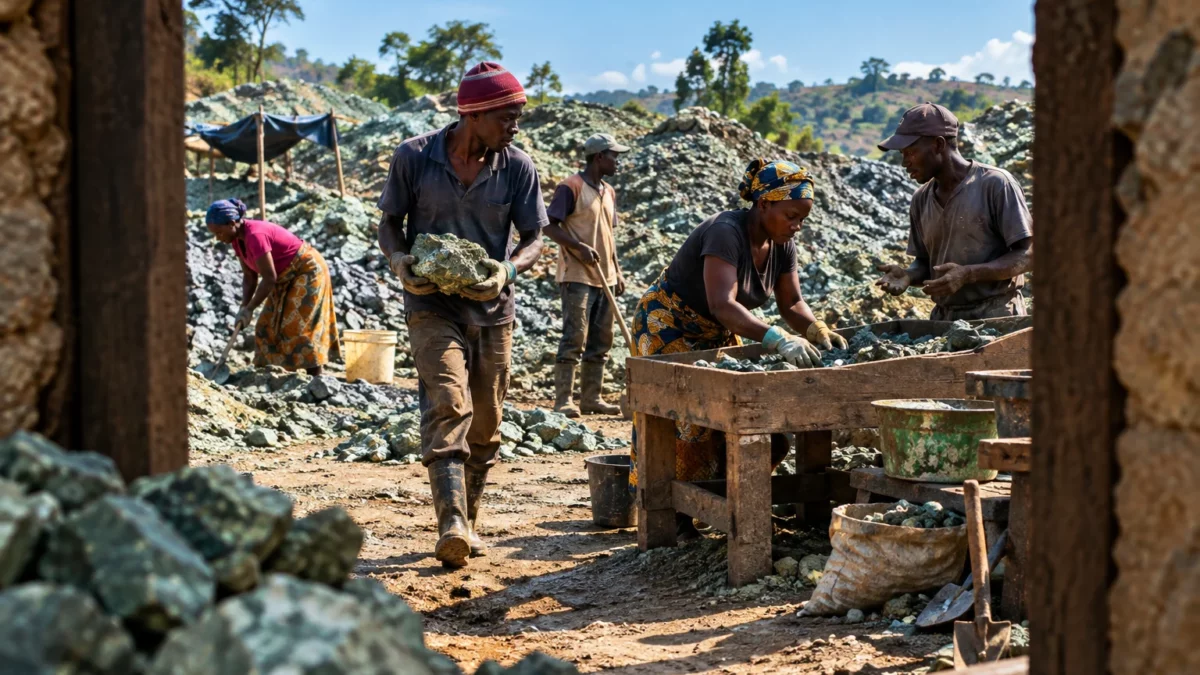
Kasaï-Oriental, whose provincial capital is Mbuji-Mayi, is seeking to diversify an economy long associated with diamonds. In Katende, in Miabi territory, artisanal copper mining is expanding. In July 2026, the director-general of the Support and Supervision Service for Artisanal and Small-Scale Mining (SAEMAPE) cited between 3,000 and 4,000 miners at the site. That figure, reported during a discussion of the deposit’s potential, remains attributed to that official.
In May, SAEMAPE said studies on the prospects for mining had been completed and that the national Mines Ministry was considering partnerships. This step is a reminder that the presence of ore is not enough to start regular production: reserves must also be established, mining rights clarified and the required permits obtained. The Congolese Press Agency reported on these steps by SAEMAPE.
The region is part of a national economy in which copper and cobalt are mainly associated with the south-east of the Democratic Republic of Congo. Developing an industry in Kasaï-Oriental would therefore shift part of the value chain towards the country’s centre, without guaranteeing that revenues, jobs or public income would remain there.
The announced project and the steps still to come
On 16 November 2026, COMINEC president Bertin Tshibaka Badiata presented the furnace proposal to Governor Jean-Paul Mbwebwa Kapo. According to his statements, the facility would process ore from Katende, Matshia and Kabeya-Kamwanga, among other places. The blister copper produced would have a stated grade of 90 to 98 per cent before export, notably to China.
COMINEC says it favours a coal-fired furnace over an electricity-powered one. Its president cited supplies from Zambia, saying the former source at Luena, associated with Gécamines, was no longer operating. These technical choices, the volumes required and their cost have not been detailed publicly in the information available. It is therefore not yet possible to assess operating costs or the facility’s environmental impact.
The corporation says it has identified nearly 17 areas showing signs of copper and plans discovery work, which involves removing the layers of earth covering the ore. But the start of operations will depend on mining permits. At Katende, land and mining rights are a key issue: MIBA, the Congolese state-owned mining company, began exploration work in June as part of the MICKA project with China Railway Resources Universal. Congolese media have reported on the start of this exploration. The relationship between MICKA and the supply envisaged by COMINEC has not been clarified.
Transport, trading and local benefits
Artisanal miners say they face difficulties selling their output. Transporting it to Likasi, in Haut-Katanga, entails transport costs and multiple payments, according to accounts reported locally. In response, the governor announced at the end of October that a trading centre in Katende was under consideration. It could bring buyers and producers closer together and better regulate transactions, but its establishment and operating arrangements remain to be confirmed. Provincial announcements about the centre have been reported in Kasaï-Oriental.
COMINEC says processing ore locally would reduce the transport of raw material and could attract trading houses or other commercial activity. The corporation also cites the Lobito Corridor, which links the DRC to the Atlantic coast via Angola, as an export option. It estimates the distance to Lobito at about 2,000 kilometres, compared with nearly 2,900 kilometres to Dar es-Salaam. These estimates are not enough to establish which route would be cheaper: rail tariffs, road conditions, logistics capacity and cross-border procedures will all affect the calculation.
The effects would not be the same for everyone. Miners could benefit from a closer buyer if the furnace operates and prices are transparent. Local transporters and traders could benefit from new flows. Residents living near the site, however, would be affected by coal use, emissions and pressure on resources. Provincial revenues would depend on formalising trade and enforcing tax and mining rules.
An industrial promise to be tested against the facts
At this stage, no investment cost, processing capacity, construction timetable or full list of partners has been disclosed. The availability of ore, security of rights, access to fuel and existence of regular buyers remain to be demonstrated. The project’s scope will also depend on how it fits with MIBA’s activities and public mechanisms for overseeing the artisanal sector.
For the DRC, the stakes go beyond one province: they are part of the continental debate on local processing of resources and the place of producer countries in global industrial supply chains. At regional level, the Lobito Corridor could provide a route to the Atlantic, but it does not automatically make a new facility competitive. The next decisive steps will be permits, technical studies, financing and the practical arrangements for the trading centre. These, rather than the announcement alone, will determine Kasaï-Oriental’s ability to capture a lasting share of copper’s value.



