Algeria
 Egypt
 Libya
 Morocco
 Sudan
 Tunisia
 Benin
 Burkina Faso
 Cabo Verde
 Côte d'Ivoire
 Ghana
 Guinea
 Guinea-Bissau
 Liberia
 Mali
 Mauritania
 Niger
 Nigeria
 Senegal
 Sierra Leone
 The Gambia
 Togo
 Cameroon
 Central African Republic
 Chad
 Equatorial Guinea
 Gabon
 Republic of the Congo
 São Tomé and Príncipe
 Burundi
 Comoros
 Djibouti
 Eritrea
 Ethiopia
 Kenya
 Madagascar
 Malawi
 Mauritius
 Mozambique
 Rwanda
 Seychelles
 Somalia
 South Sudan
 Tanzania
 Uganda
 Angola
 Botswana
 Eswatini
 Lesotho
 Namibia
 South Africa
 Zambia
 Zimbabwe
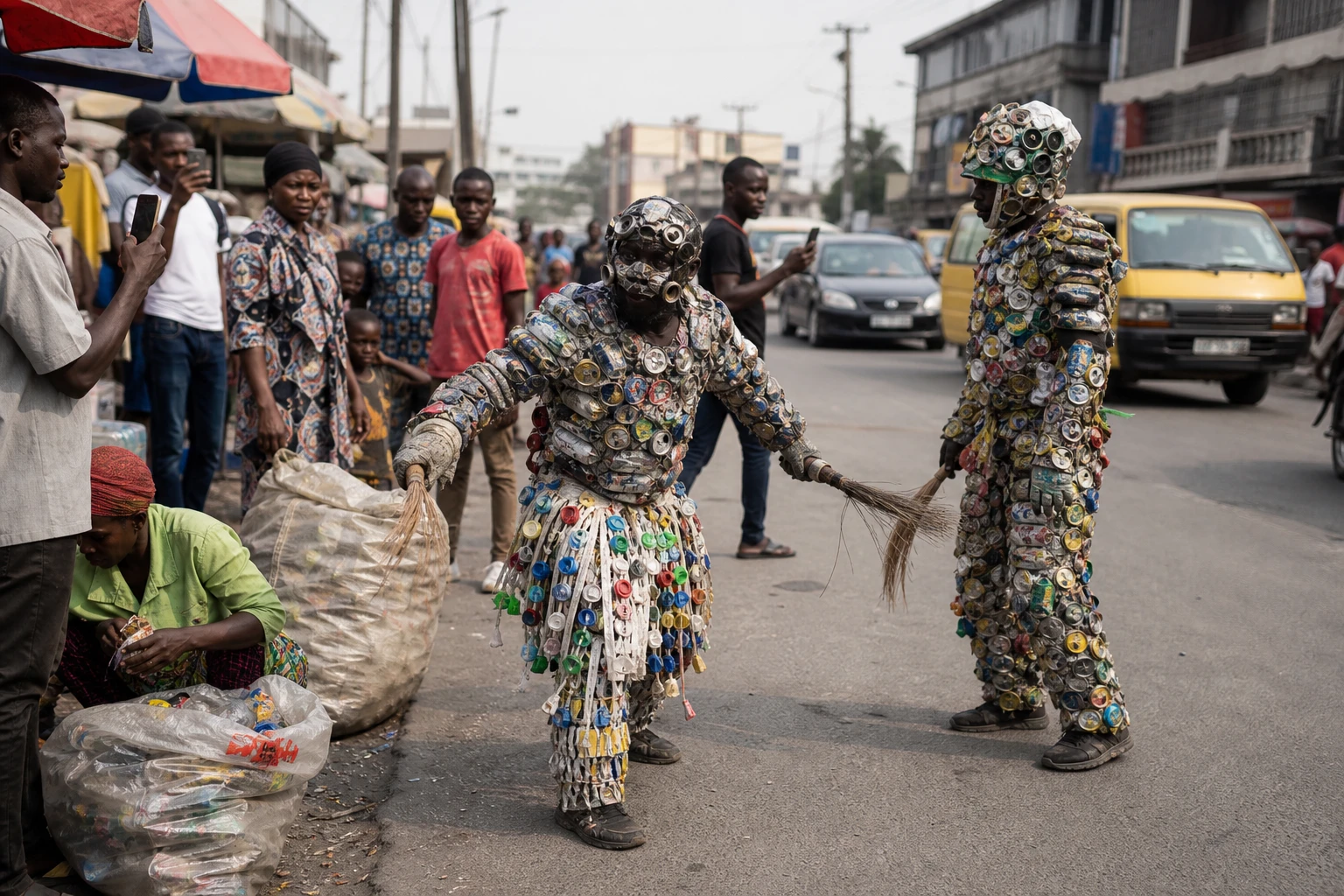
In Kinshasa, art takes on waste
In Kinshasa, mountains of plastic do not disappear on their own. Sometimes they end up on the shoulders of artists who choose to turn them into a public language. That is the point of Kin’Act, the Congolese festival celebrating its 10th edition in the capital of the Democratic Republic of the Congo.
The idea is easy to grasp. Performers walk through the streets wearing costumes made from cans, reclaimed materials and objects taken from everyday rubbish. The spectacle catches the eye, but above all it serves as a warning. Poor sanitation remains a tangible problem in Kinshasa, visible on its avenues and in its working-class neighbourhoods, and the festival is rooted in this distinctly Kinshasa urban reality.
A capital under pressure, a regular cultural signal
Kinshasa is not only the political capital of the DRC. It is also a megacity where waste management has become a matter of public health, jobs and local governance. Available estimates vary by source, but point to a massive volume: around 10,000 tonnes a day according to figures cited by Congolese institutions, more than 17,000 tonnes a day in a recent government document, and a very low recovery rate of around 1% in UN-Habitat research.
The issue extends well beyond the cultural sphere. It affects drainage, traffic, household health and the city’s finances. The Congolese government announced integrated waste-management projects for Kinshasa in 2024, then revived those plans in 2025. This shows that the issue is no longer peripheral. It is now central to the capital’s urban modernisation.
What Kin’Act does, and why its 10th edition matters
Kin’Act was conceived as a performance that leaves venues to engage with residents. Its founder, Eddy Ekete, says the idea is to speak “directly” to people through the waste itself. The festival therefore combines street art, costumes made from reclaimed materials, workshops and awareness-raising. It is not simply an aesthetic parade. It is a way of bringing debate to places where it is often missing: public spaces, close to Kinshasa’s residents.
The 10th edition gives this approach a new dimension. First, it shows that a locally rooted cultural project can endure. It also confirms that in Kinshasa, contemporary art is not detached from practical concerns. Waste, recycling, street cleanliness and the responsibility of the authorities become material for creative work. In a city where municipalities, urban services and private operators still struggle to cover the entire collection chain, this staging of rubbish does more than provoke thought. It connects aesthetics with sanitation.
The impact is not the same for everyone. For residents, the message is immediate: throw less away, sort more, and stop treating the street as a rubbish dump. For the authorities, the challenge is more political: resources, regular collection, recovery channels and credible coordination between the city, municipalities and operators are needed. For artists, finally, Kin’Act creates a rare space. It shows that performance can address an urban issue without losing its visual power or popular reach.
An impact beyond Kinshasa
The festival resonates far beyond the DRC. Across urban Africa, waste is becoming one of the major challenges facing rapidly growing capitals. The African Development Bank notes in its country profile that Kinshasa must contend with a massive daily output of rubbish and efforts to manage it that remain inadequate. At the same time, the UN is warning of rising global volumes of municipal waste and the urgent need to reduce production. Kin’Act sits squarely within this tension between urban crisis and local solutions.
There is also a regional dimension. Kinshasa is part of Central Africa, where several cities are seeking to turn sanitation into a sector for innovation, health and jobs. In this context, the festival acts as a symbolic laboratory: it shows that urban solutions can come from culture as well as infrastructure. And it offers a concrete reminder that a capital is measured not only by its buildings, but by its ability to deal with what it produces every day.
What happens next will depend on the same equation facing many African cities: political will, sustained funding, recycling channels and public participation. Kin’Act has already marked a milestone. It has turned a visible problem into a public performance. And in Kinshasa, this way of confronting waste already counts as a political act in the broadest sense.