
 Algeria
 Egypt
 Libya
 Morocco
 Sudan
 Tunisia
 Benin
 Burkina Faso
 Cabo Verde
 Côte d'Ivoire
 Ghana
 Guinea
 Guinea-Bissau
 Liberia
 Mali
 Mauritania
 Niger
 Nigeria
 Senegal
 Sierra Leone
 The Gambia
 Togo
 Cameroon
 Central African Republic
 Chad
 Equatorial Guinea
 Gabon
 Republic of the Congo
 São Tomé and Príncipe
 Burundi
 Comoros
 Djibouti
 Eritrea
 Ethiopia
 Kenya
 Madagascar
 Malawi
 Mauritius
 Mozambique
 Rwanda
 Seychelles
 Somalia
 South Sudan
 Tanzania
 Uganda
 Angola
 Botswana
 Eswatini
 Lesotho
 Namibia
 South Africa
 Zambia
 Zimbabwe
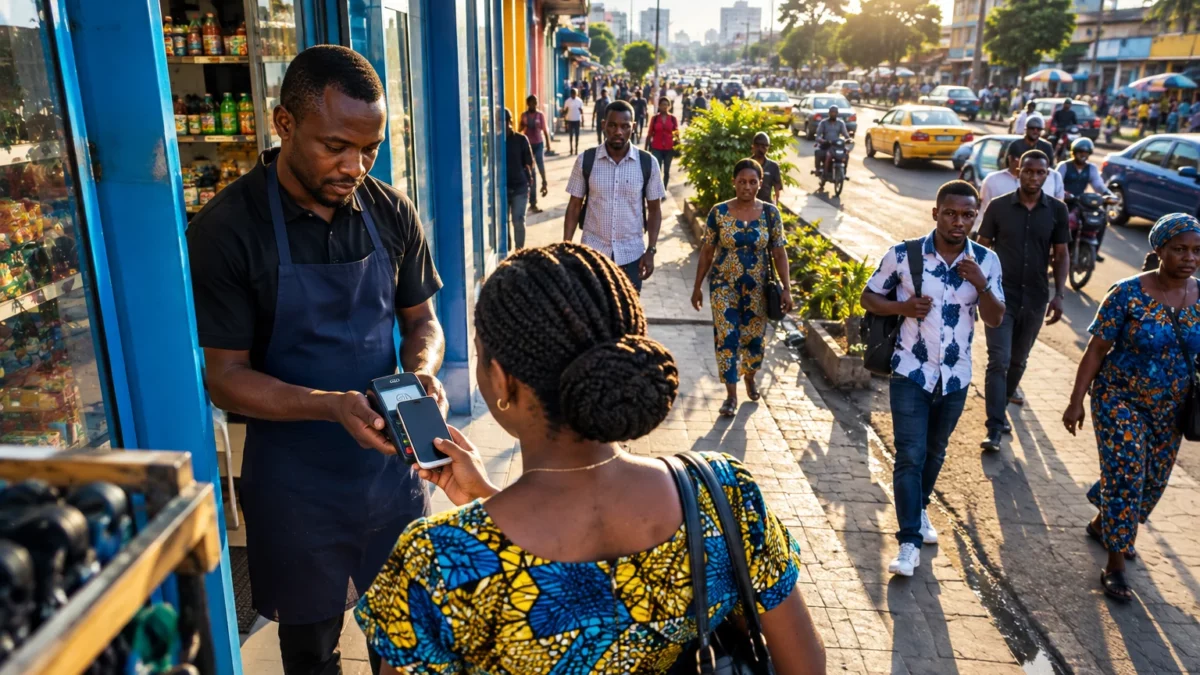
In Kinshasa, shoppers can now pay in stores using an Android phone, without a physical bank card. But the arrival of contactless payments also raises a broader question: who will actually be able to use these tools in a country where access to financial services remains unequal across regions and income groups?
A new stage for mobile payments in DR Congo
Visa launched the contactless payment function in its Visa Pay app in the Democratic Republic of the Congo on 16 November 2026. The governor of the Central Bank of the Congo (BCC), André Wameso, made the first transaction during a demonstration in Kinshasa. Several Congolese media outlets reported the launch and the date of the transaction.
The function allows users to pay for a purchase by holding a compatible NFC-enabled Android smartphone near a terminal that accepts Visa contactless payments. NFC refers to short-range communication technology that enables data exchange between two nearby devices. The service is offered through four participating institutions: Access Bank, Sofibanque, Solidaire Banque and UBA.
The phone must be compatible and the shop must have a suitable terminal. The launch therefore does not mean that all Visa Pay users, or all businesses in the country, can already pay this way. The precise access requirements depend in particular on the participating financial institution.
Visa Pay was already available in DR Congo for transfers between accounts and mobile networks, as well as online payments using virtual cards. The addition of contactless payments extends its use to purchases in physical shops. The solution is presented as interoperable, but that promise depends on the effective participation of the banks, payment operators and merchants concerned.
Financial inclusion is about more than an app
The BCC places the digitalisation of payments within a broader strategy. Its 2023-2028 National Financial Inclusion Strategy aims to improve access to formal, affordable and appropriate services. The central bank says the national goal is to reach 65% financial inclusion by 2028, with particular attention to rural populations, women, young people and small businesses.
In this context, mobile payments can make cashless transactions easier and give merchants another way to accept payments. They can also help bring more activities into the formal economy. However, the availability of an app guarantees neither access to a compatible phone, nor a reliable connection, nor a nearby acceptance point.
The effects will therefore vary between users. Customers who already have a smartphone and an account with a participating bank may adopt the service quickly. For people living in rural areas, those using older phones or those who rely mainly on cash, material and financial barriers remain significant. Small merchants, meanwhile, will need access to working terminals and an understanding of the costs associated with digital payments.
Security is another practical concern. Visa says transactions use, among other measures, tokenisation, which replaces sensitive payment data with a digital identifier, and device authentication. These safeguards reduce certain risks, but they do not replace customer information, transparency on fees or channels for redress in the event of a disputed transaction.
Deployment to be tested on the ground
The BCC presents the expansion of digital payments as part of its policy on inclusion and modernising the financial system. DR Congo is also moving forward as authorities seek to strengthen interoperability: in other words, enabling different instruments and networks to communicate. Central bank regulations include rules on the interoperability of electronic payments and the National Payment Switch, the infrastructure intended to facilitate exchanges between operators.
This approach reflects debates across the region, where central banks and operators are seeking to make digital payments more accessible and compatible beyond a single network. For DR Congo, a member of the Southern African Development Community (SADC), the challenge goes beyond adopting a technology: it also involves building reliable infrastructure and rules that protect users while facilitating transactions.
The launch is also a showcase for Visa and its partner banks. The company says DR Congo is the first market where this function has been integrated into Visa Pay. This commercial announcement, however, is not enough in itself to measure the number of businesses equipped, how often the service is used or the share of payments that will actually move away from cash.
The next steps will be decisive: expanding the network of participating institutions, making terminals available beyond Kinshasa, the costs for merchants and customers, and the quality of support when problems arise. The 65% financial inclusion target set for 2028 offers a national benchmark. Progress will be judged less by the first transaction than by the ability to make the service useful, safe and accessible over time, including beyond major urban centres.



